In mathematics, specifically functional analysis, a series is unconditionally convergent if all reorderings of the series converge to the same value. In contrast, a series is conditionally convergent if it converges but different orderings do not all converge to that same value. Unconditional convergence is equivalent to absolute convergence in finite-dimensional vector spaces, but is a weaker property in infinite dimensions.
Definition
Let
X
{\displaystyle X}


The series
∑
i
∈
I
x
i
{\displaystyle \textstyle \sum _{i\in I}x_{i}}


- the indexing set
I
0
:=
{
i
∈
I
:
x
i
≠
0
}
{\displaystyle I_{0}:=\left\{i\in I:x_{i}\neq 0\right\}}
is countable, and
- for every permutation (bijection)
σ
:
I
0
→
I
0
{\displaystyle \sigma :I_{0}\to I_{0}}
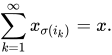
of I 0 = { i k } k = 1 ∞ {\displaystyle I_{0}=\left\{i_{k}\right\}_{k=1}^{\infty }}
the following relation holds: ∑ k = 1 ∞ x σ ( i k ) = x . {\displaystyle \sum _{k=1}^{\infty }x_{\sigma \left(i_{k}\right)}=x.}
Alternative definition
Unconditional convergence is often defined in an equivalent way: A series is unconditionally convergent if for every sequence
(
ε
n
)
n
=
1
∞
,
{\displaystyle \left(\varepsilon _{n}\right)_{n=1}^{\infty },}



If
X
{\displaystyle X}


See also
- Absolute convergence – Mode of convergence of an infinite series
- Modes of convergence (annotated index) – Property of a sequence or seriesPages displaying short descriptions of redirect targets
- Rearrangements and unconditional convergence/Dvoretzky–Rogers theorem – Mode of convergence of an infinite series
- Riemann series theorem – Unconditionally convergent series converge absolutely
References
- Ch. Heil: A Basis Theory Primer
- Knopp, Konrad (1956). Infinite Sequences and Series. Dover Publications. ISBN 9780486601533.
{{cite book}}: ISBN / Date incompatibility (help) - Knopp, Konrad (1990). Theory and Application of Infinite Series. Dover Publications. ISBN 9780486661650.
- Wojtaszczyk, P. (1996). Banach spaces for analysts. Cambridge University Press. ISBN 9780521566759.
This article incorporates material from Unconditional convergence on PlanetMath, which is licensed under the Creative Commons Attribution/Share-Alike License.