In mathematics, von Neumann's theorem is a result in the operator theory of linear operators on Hilbert spaces.
Statement of the theorem
Let
G
{\displaystyle G}
and
H
{\displaystyle H}
be Hilbert spaces, and let
T
:
dom
(
T
)
⊆
G
→
H
{\displaystyle T:\operatorname {dom} (T)\subseteq G\to H}
be an unbounded operator from
G
{\displaystyle G}
into
H
.
{\displaystyle H.}
Suppose that
T
{\displaystyle T}
is a closed operator and that
T
{\displaystyle T}
is densely defined, that is,
dom
(
T
)
{\displaystyle \operatorname {dom} (T)}
is dense in
G
.
{\displaystyle G.}
Let
T
∗
:
dom
(
T
∗
)
⊆
H
→
G
{\displaystyle T^{*}:\operatorname {dom} \left(T^{*}\right)\subseteq H\to G}
denote the adjoint of
T
.
{\displaystyle T.}
Then
T
∗
T
{\displaystyle T^{*}T}
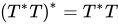
is also densely defined, and it is self-adjoint. That is,
(
T
∗
T
)
∗
=
T
∗
T
{\displaystyle \left(T^{*}T\right)^{*}=T^{*}T}
and the operators on the right- and left-hand sides have the same dense domain in
G
.
{\displaystyle G.}
[1]
References
- Acuña, Pablo (2021). "von Neumann's Theorem Revisited". Foundations of Physics. 51 (3): 73. Bibcode:2021FoPh...51...73A. doi:10.1007/s10701-021-00474-5. ISSN 0015-9018. S2CID 237887405.