In mathematics, the Wielandt theorem characterizes the gamma function, defined for all complex numbers
z
{\displaystyle z}


-
Γ
(
z
)
=
∫
0
+
∞
t
z
−
1
e
−
t
d
t
,
{\displaystyle \Gamma (z)=\int _{0}^{+\infty }t^{z-1}\mathrm {e} ^{-t}\,\mathrm {d} t,}
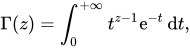
as the only function
f
{\displaystyle f}


-
f
{\displaystyle f}
;
-
f
(
1
)
=
1
{\displaystyle f(1)=1}
;
-
f
(
z
+
1
)
=
z
f
(
z
)
{\displaystyle f(z+1)=z\,f(z)}
for all z ∈ H {\displaystyle z\in H}
and
-
f
{\displaystyle f}
.
This theorem is named after the mathematician Helmut Wielandt.
See also
References
- Reinhold Remmert (1996). "Wielandt's theorem about the Γ-function". American Mathematical Monthly. 103: 214–220. JSTOR 2975370..