| Algebraic structure → Group theory Group theory |
|---|
In abstract algebra, a normal subgroup (also known as an invariant subgroup or self-conjugate subgroup)[1] is a subgroup that is invariant under conjugation by members of the group of which it is a part. In other words, a subgroup
N
{\displaystyle N}
of the group
G
{\displaystyle G}
is normal in
G
{\displaystyle G}
if and only if
g
n
g
−
1
∈
N
{\displaystyle gng^{-1}\in N}
for all
g
∈
G
{\displaystyle g\in G}
and
n
∈
N
.
{\displaystyle n\in N.}
The usual notation for this relation is
N
◃
G
.
{\displaystyle N\triangleleft G.}
Normal subgroups are important because they (and only they) can be used to construct quotient groups of the given group. Furthermore, the normal subgroups of
G
{\displaystyle G}
are precisely the kernels of group homomorphisms with domain
G
,
{\displaystyle G,}
which means that they can be used to internally classify those homomorphisms.
Évariste Galois was the first to realize the importance of the existence of normal subgroups.[2]
Definitions
A subgroup
N
{\displaystyle N}
of a group
G
{\displaystyle G}
is called a normal subgroup of
G
{\displaystyle G}
if it is invariant under conjugation; that is, the conjugation of an element of
N
{\displaystyle N}
by an element of
G
{\displaystyle G}
is always in
N
.
{\displaystyle N.}
[3] The usual notation for this relation is
N
◃
G
.
{\displaystyle N\triangleleft G.}
Equivalent conditions
For any subgroup
N
{\displaystyle N}
of
G
,
{\displaystyle G,}
the following conditions are equivalent to
N
{\displaystyle N}
being a normal subgroup of
G
.
{\displaystyle G.}
Therefore, any one of them may be taken as the definition.
- The image of conjugation of
N
{\displaystyle N}
by any element of G {\displaystyle G}
is a subset of N , {\displaystyle N,}
[4] i.e., g N g − 1 ⊆ N {\displaystyle gNg^{-1}\subseteq N}
for all g ∈ G {\displaystyle g\in G}
.
- The image of conjugation of
N
{\displaystyle N}
by any element of G {\displaystyle G}
is equal to N , {\displaystyle N,}
[4] i.e., g N g − 1 = N {\displaystyle gNg^{-1}=N}
for all g ∈ G {\displaystyle g\in G}
.
- For all
g
∈
G
,
{\displaystyle g\in G,}
the left and right cosets g N {\displaystyle gN}
and N g {\displaystyle Ng}
are equal.[4]
- The sets of left and right cosets of
N
{\displaystyle N}
in G {\displaystyle G}
coincide.[4]
- Multiplication in
G
{\displaystyle G}
preserves the equivalence relation "is in the same left coset as". That is, for every g , g ′ , h , h ′ ∈ G {\displaystyle g,g',h,h'\in G}
satisfying g N = g ′ N {\displaystyle gN=g'N}
and h N = h ′ N {\displaystyle hN=h'N}
, we have ( g h ) N = ( g ′ h ′ ) N . {\displaystyle (gh)N=(g'h')N.}
- There exists a group on the set of left cosets of
N
{\displaystyle N}
where multiplication of any two left cosets g N {\displaystyle gN}
and h N {\displaystyle hN}
yields the left coset ( g h ) N {\displaystyle (gh)N}
. (This group is called the quotient group of G {\displaystyle G}
modulo N {\displaystyle N}
, denoted G / N {\displaystyle G/N}
.)
-
N
{\displaystyle N}
is a union of conjugacy classes of G . {\displaystyle G.}
[2]
-
N
{\displaystyle N}
is preserved by the inner automorphisms of G . {\displaystyle G.}
[5]
- There is some group homomorphism
G
→
H
{\displaystyle G\to H}
whose kernel is N . {\displaystyle N.}
[2]
- There exists a group homomorphism
ϕ
:
G
→
H
{\displaystyle \phi :G\to H}
whose fibers form a group where the identity element is N {\displaystyle N}
and multiplication of any two fibers ϕ − 1 ( h 1 ) {\displaystyle \phi ^{-1}(h_{1})}
and ϕ − 1 ( h 2 ) {\displaystyle \phi ^{-1}(h_{2})}
yields the fiber ϕ − 1 ( h 1 h 2 ) {\displaystyle \phi ^{-1}(h_{1}h_{2})}
. (This group is the same group G / N {\displaystyle G/N}
mentioned above.)
- There is some congruence relation on
G
{\displaystyle G}
for which the equivalence class of the identity element is N {\displaystyle N}
.
- For all
n
∈
N
{\displaystyle n\in N}
and g ∈ G , {\displaystyle g\in G,}
the commutator [ n , g ] = n − 1 g − 1 n g {\displaystyle [n,g]=n^{-1}g^{-1}ng}
is in N . {\displaystyle N.}
- Any two elements commute modulo the normal subgroup membership relation. That is, for all
g
,
h
∈
G
,
{\displaystyle g,h\in G,}
g h ∈ N {\displaystyle gh\in N}
if and only if h g ∈ N . {\displaystyle hg\in N.}

Examples
For any group
G
,
{\displaystyle G,}
the trivial subgroup
{
e
}
{\displaystyle \{e\}}
consisting of just the identity element of
G
{\displaystyle G}
is always a normal subgroup of
G
.
{\displaystyle G.}
Likewise,
G
{\displaystyle G}
itself is always a normal subgroup of
G
.
{\displaystyle G.}
(If these are the only normal subgroups, then
G
{\displaystyle G}
is said to be simple.)[6] Other named normal subgroups of an arbitrary group include the center of the group (the set of elements that commute with all other elements) and the commutator subgroup
[
G
,
G
]
.
{\displaystyle [G,G].}
[7][8] More generally, since conjugation is an isomorphism, any characteristic subgroup is a normal subgroup.[9]
If
G
{\displaystyle G}
is an abelian group then every subgroup
N
{\displaystyle N}
of
G
{\displaystyle G}
is normal, because
g
N
=
{
g
n
}
n
∈
N
=
{
n
g
}
n
∈
N
=
N
g
.
{\displaystyle gN=\{gn\}_{n\in N}=\{ng\}_{n\in N}=Ng.}
More generally, for any group
G
{\displaystyle G}
, every subgroup of the center
Z
(
G
)
{\displaystyle Z(G)}
of
G
{\displaystyle G}
is normal in
G
{\displaystyle G}
. (In the special case that
G
{\displaystyle G}
is abelian, the center is all of
G
{\displaystyle G}
, hence the fact that all subgroups of an abelian group are normal.) A group that is not abelian but for which every subgroup is normal is called a Hamiltonian group.[10]
A concrete example of a normal subgroup is the subgroup
N
=
{
(
1
)
,
(
123
)
,
(
132
)
}
{\displaystyle N=\{(1),(123),(132)\}}

of the symmetric group
S
3
,
{\displaystyle S_{3},}
consisting of the identity and both three-cycles. In particular, one can check that every coset of
N
{\displaystyle N}
is either equal to
N
{\displaystyle N}
itself or is equal to
(
12
)
N
=
{
(
12
)
,
(
23
)
,
(
13
)
}
.
{\displaystyle (12)N=\{(12),(23),(13)\}.}
On the other hand, the subgroup
H
=
{
(
1
)
,
(
12
)
}
{\displaystyle H=\{(1),(12)\}}
is not normal in
S
3
{\displaystyle S_{3}}
since
(
123
)
H
=
{
(
123
)
,
(
13
)
}
≠
{
(
123
)
,
(
23
)
}
=
H
(
123
)
.
{\displaystyle (123)H=\{(123),(13)\}\neq \{(123),(23)\}=H(123).}
[11] This illustrates the general fact that any subgroup
H
≤
G
{\displaystyle H\leq G}
of index two is normal.
As an example of a normal subgroup within a matrix group, consider the general linear group
G
L
n
(
R
)
{\displaystyle \mathrm {GL} _{n}(\mathbf {R} )}
of all invertible
n
×
n
{\displaystyle n\times n}
matrices with real entries under the operation of matrix multiplication and its subgroup
S
L
n
(
R
)
{\displaystyle \mathrm {SL} _{n}(\mathbf {R} )}
of all
n
×
n
{\displaystyle n\times n}
matrices of determinant 1 (the special linear group). To see why the subgroup
S
L
n
(
R
)
{\displaystyle \mathrm {SL} _{n}(\mathbf {R} )}
is normal in
G
L
n
(
R
)
{\displaystyle \mathrm {GL} _{n}(\mathbf {R} )}
, consider any matrix
X
{\displaystyle X}
in
S
L
n
(
R
)
{\displaystyle \mathrm {SL} _{n}(\mathbf {R} )}
and any invertible matrix
A
{\displaystyle A}
. Then using the two important identities
det
(
A
B
)
=
det
(
A
)
det
(
B
)
{\displaystyle \det(AB)=\det(A)\det(B)}
and
det
(
A
−
1
)
=
det
(
A
)
−
1
{\displaystyle \det(A^{-1})=\det(A)^{-1}}
, one has that
det
(
A
X
A
−
1
)
=
det
(
A
)
det
(
X
)
det
(
A
)
−
1
=
det
(
X
)
=
1
{\displaystyle \det(AXA^{-1})=\det(A)\det(X)\det(A)^{-1}=\det(X)=1}
, and so
A
X
A
−
1
∈
S
L
n
(
R
)
{\displaystyle AXA^{-1}\in \mathrm {SL} _{n}(\mathbf {R} )}
as well. This means
S
L
n
(
R
)
{\displaystyle \mathrm {SL} _{n}(\mathbf {R} )}
is closed under conjugation in
G
L
n
(
R
)
{\displaystyle \mathrm {GL} _{n}(\mathbf {R} )}
, so it is a normal subgroup.[a]
In the Rubik's Cube group, the subgroups consisting of operations which only affect the orientations of either the corner pieces or the edge pieces are normal.[12]
The translation group is a normal subgroup of the Euclidean group in any dimension.[13] This means: applying a rigid transformation, followed by a translation and then the inverse rigid transformation, has the same effect as a single translation. By contrast, the subgroup of all rotations about the origin is not a normal subgroup of the Euclidean group, as long as the dimension is at least 2: first translating, then rotating about the origin, and then translating back will typically not fix the origin and will therefore not have the same effect as a single rotation about the origin.
Properties
- If
H
{\displaystyle H}
is a normal subgroup of G , {\displaystyle G,}
and K {\displaystyle K}
is a subgroup of G {\displaystyle G}
containing H , {\displaystyle H,}
then H {\displaystyle H}
is a normal subgroup of K . {\displaystyle K.}
[14]
- A normal subgroup of a normal subgroup of a group need not be normal in the group. That is, normality is not a transitive relation. The smallest group exhibiting this phenomenon is the dihedral group of order 8.[15] However, a characteristic subgroup of a normal subgroup is normal.[16] A group in which normality is transitive is called a T-group.[17]
- The two groups
G
{\displaystyle G}
and H {\displaystyle H}
are normal subgroups of their direct product G × H . {\displaystyle G\times H.}
- If the group
G
{\displaystyle G}
is a semidirect product G = N ⋊ H , {\displaystyle G=N\rtimes H,}
then N {\displaystyle N}
is normal in G , {\displaystyle G,}
though H {\displaystyle H}
need not be normal in G . {\displaystyle G.}
- If
M
{\displaystyle M}
and N {\displaystyle N}
are normal subgroups of an additive group G {\displaystyle G}
such that G = M + N {\displaystyle G=M+N}
and M ∩ N = { 0 } {\displaystyle M\cap N=\{0\}}
, then G = M ⊕ N . {\displaystyle G=M\oplus N.}
[18]
- Normality is preserved under surjective homomorphisms;[19] that is, if
G
→
H
{\displaystyle G\to H}
is a surjective group homomorphism and N {\displaystyle N}
is normal in G , {\displaystyle G,}
then the image f ( N ) {\displaystyle f(N)}
is normal in H . {\displaystyle H.}
- Normality is preserved by taking inverse images;[19] that is, if
G
→
H
{\displaystyle G\to H}
is a group homomorphism and N {\displaystyle N}
is normal in H , {\displaystyle H,}
then the inverse image f − 1 ( N ) {\displaystyle f^{-1}(N)}
is normal in G . {\displaystyle G.}
- Normality is preserved on taking direct products;[20] that is, if
N
1
◃
G
1
{\displaystyle N_{1}\triangleleft G_{1}}
and N 2 ◃ G 2 , {\displaystyle N_{2}\triangleleft G_{2},}
then N 1 × N 2 ◃ G 1 × G 2 . {\displaystyle N_{1}\times N_{2}\;\triangleleft \;G_{1}\times G_{2}.}
- Every subgroup of index 2 is normal. More generally, a subgroup,
H
,
{\displaystyle H,}
of finite index, n , {\displaystyle n,}
in G {\displaystyle G}
contains a subgroup, K , {\displaystyle K,}
normal in G {\displaystyle G}
and of index dividing n ! {\displaystyle n!}
called the normal core. In particular, if p {\displaystyle p}
is the smallest prime dividing the order of G , {\displaystyle G,}
then every subgroup of index p {\displaystyle p}
is normal.[21]
- The fact that normal subgroups of
G
{\displaystyle G}
are precisely the kernels of group homomorphisms defined on G {\displaystyle G}
accounts for some of the importance of normal subgroups; they are a way to internally classify all homomorphisms defined on a group. For example, a non-identity finite group is simple if and only if it is isomorphic to all of its non-identity homomorphic images,[22] a finite group is perfect if and only if it has no normal subgroups of prime index, and a group is imperfect if and only if the derived subgroup is not supplemented by any proper normal subgroup.
Lattice of normal subgroups
Given two normal subgroups,
N
{\displaystyle N}
and
M
,
{\displaystyle M,}
of
G
,
{\displaystyle G,}
their intersection
N
∩
M
{\displaystyle N\cap M}
and their product
N
M
=
{
n
m
:
n
∈
N
and
m
∈
M
}
{\displaystyle NM=\{nm:n\in N\;{\text{ and }}\;m\in M\}}
are also normal subgroups of
G
.
{\displaystyle G.}
The normal subgroups of
G
{\displaystyle G}
form a lattice under subset inclusion with least element,
{
e
}
,
{\displaystyle \{e\},}
and greatest element,
G
.
{\displaystyle G.}
The meet of two normal subgroups,
N
{\displaystyle N}
and
M
,
{\displaystyle M,}
in this lattice is their intersection and the join is their product.
Normal subgroups, quotient groups and homomorphisms
If
N
{\displaystyle N}
is a normal subgroup, we can define a multiplication on cosets as follows:
(
a
1
N
)
(
a
2
N
)
:=
(
a
1
a
2
)
N
.
{\displaystyle \left(a_{1}N\right)\left(a_{2}N\right):=\left(a_{1}a_{2}\right)N.}
This relation defines a mapping
G
/
N
×
G
/
N
→
G
/
N
.
{\displaystyle G/N\times G/N\to G/N.}
To show that this mapping is well-defined, one needs to prove that the choice of representative elements
a
1
,
a
2
{\displaystyle a_{1},a_{2}}
does not affect the result. To this end, consider some other representative elements
a
1
′
∈
a
1
N
,
a
2
′
∈
a
2
N
.
{\displaystyle a_{1}'\in a_{1}N,a_{2}'\in a_{2}N.}
Then there are
n
1
,
n
2
∈
N
{\displaystyle n_{1},n_{2}\in N}
such that
a
1
′
=
a
1
n
1
,
a
2
′
=
a
2
n
2
.
{\displaystyle a_{1}'=a_{1}n_{1},a_{2}'=a_{2}n_{2}.}
It follows that
a
1
′
a
2
′
N
=
a
1
n
1
a
2
n
2
N
=
a
1
a
2
n
1
′
n
2
N
=
a
1
a
2
N
,
{\displaystyle a_{1}'a_{2}'N=a_{1}n_{1}a_{2}n_{2}N=a_{1}a_{2}n_{1}'n_{2}N=a_{1}a_{2}N,}
where we also used the fact that
N
{\displaystyle N}
is a normal subgroup, and therefore there is
n
1
′
∈
N
{\displaystyle n_{1}'\in N}
such that
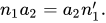
n
1
a
2
=
a
2
n
1
′
.
{\displaystyle n_{1}a_{2}=a_{2}n_{1}'.}
This proves that this product is a well-defined mapping between cosets.
With this operation, the set of cosets is itself a group, called the quotient group and denoted with
G
/
N
.
{\displaystyle G/N.}
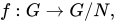
There is a natural homomorphism,
f
:
G
→
G
/
N
,
{\displaystyle f:G\to G/N,}
given by
f
(
a
)
=
a
N
.
{\displaystyle f(a)=aN.}
This homomorphism maps
N
{\displaystyle N}
into the identity element of
G
/
N
,
{\displaystyle G/N,}
which is the coset
e
N
=
N
,
{\displaystyle eN=N,}
[23] that is,
ker
(
f
)
=
N
.
{\displaystyle \ker(f)=N.}
In general, a group homomorphism,
f
:
G
→
H
{\displaystyle f:G\to H}
sends subgroups of
G
{\displaystyle G}
to subgroups of
H
.
{\displaystyle H.}
Also, the preimage of any subgroup of
H
{\displaystyle H}
is a subgroup of
G
.
{\displaystyle G.}
We call the preimage of the trivial group
{
e
}
{\displaystyle \{e\}}
in
H
{\displaystyle H}
the kernel of the homomorphism and denote it by
ker
f
.
{\displaystyle \ker f.}
As it turns out, the kernel is always normal and the image of
G
,
f
(
G
)
,
{\displaystyle G,f(G),}
is always isomorphic to
G
/
ker
f
{\displaystyle G/\ker f}
(the first isomorphism theorem).[24] In fact, this correspondence is a bijection between the set of all quotient groups of
G
,
G
/
N
,
{\displaystyle G,G/N,}
and the set of all homomorphic images of
G
{\displaystyle G}
(up to isomorphism).[25] It is also easy to see that the kernel of the quotient map,
f
:
G
→
G
/
N
,
{\displaystyle f:G\to G/N,}
is
N
{\displaystyle N}
itself, so the normal subgroups are precisely the kernels of homomorphisms with domain
G
.
{\displaystyle G.}
[26]
See also
Operations taking subgroups to subgroups
Subgroup properties complementary (or opposite) to normality
Subgroup properties stronger than normality
Subgroup properties weaker than normality
Related notions in algebra
Notes
- In other language:
det
{\displaystyle \det }
is a homomorphism from G L n ( R ) {\displaystyle \mathrm {GL} _{n}(\mathbf {R} )}
to the multiplicative subgroup R × {\displaystyle \mathbf {R} ^{\times }}
, and S L n ( R ) {\displaystyle \mathrm {SL} _{n}(\mathbf {R} )}
is the kernel. Both arguments also work over the complex numbers, or indeed over an arbitrary field.
References
- Bradley 2010, p. 12.
- Cantrell 2000, p. 160.
- Dummit & Foote 2004.
- Hungerford 2003, p. 41.
- Fraleigh 2003, p. 141.
- Robinson 1996, p. 16.
- Hungerford 2003, p. 45.
- Hall 1999, p. 138.
- Hall 1999, p. 32.
- Hall 1999, p. 190.
- Judson 2020, Section 10.1.
- Bergvall et al. 2010, p. 96.
- Thurston 1997, p. 218.
- Hungerford 2003, p. 42.
- Robinson 1996, p. 17.
- Robinson 1996, p. 28.
- Robinson 1996, p. 402.
- Hungerford 2013, p. 290.
- Hall 1999, p. 29.
- Hungerford 2003, p. 46.
- Robinson 1996, p. 36.
- Dõmõsi & Nehaniv 2004, p. 7.
- Hungerford 2003, pp. 42–43.
- Hungerford 2003, p. 44.
- Robinson 1996, p. 20.
- Hall 1999, p. 27.
Bibliography
- Bergvall, Olof; Hynning, Elin; Hedberg, Mikael; Mickelin, Joel; Masawe, Patrick (16 May 2010). "On Rubik's Cube" (PDF). KTH.
- Cantrell, C.D. (2000). Modern Mathematical Methods for Physicists and Engineers. Cambridge University Press. ISBN 978-0-521-59180-5.
- Dõmõsi, Pál; Nehaniv, Chrystopher L. (2004). Algebraic Theory of Automata Networks. SIAM Monographs on Discrete Mathematics and Applications. SIAM.
- Dummit, David S.; Foote, Richard M. (2004). Abstract Algebra (3rd ed.). John Wiley & Sons. ISBN 0-471-43334-9.
- Fraleigh, John B. (2003). A First Course in Abstract Algebra (7th ed.). Addison-Wesley. ISBN 978-0-321-15608-2.
- Hall, Marshall (1999). The Theory of Groups. Providence: Chelsea Publishing. ISBN 978-0-8218-1967-8.
- Hungerford, Thomas (2003). Algebra. Graduate Texts in Mathematics. Springer.
- Hungerford, Thomas (2013). Abstract Algebra: An Introduction. Brooks/Cole Cengage Learning.
- Judson, Thomas W. (2020). Abstract Algebra: Theory and Applications.
- Robinson, Derek J. S. (1996). A Course in the Theory of Groups. Graduate Texts in Mathematics. Vol. 80 (2nd ed.). Springer-Verlag. ISBN 978-1-4612-6443-9. Zbl 0836.20001.
- Thurston, William (1997). Levy, Silvio (ed.). Three-dimensional geometry and topology, Vol. 1. Princeton Mathematical Series. Princeton University Press. ISBN 978-0-691-08304-9.
- Bradley, C. J. (2010). The mathematical theory of symmetry in solids : representation theory for point groups and space groups. Oxford New York: Clarendon Press. ISBN 978-0-19-958258-7. OCLC 859155300.
Further reading
- I. N. Herstein, Topics in algebra. Second edition. Xerox College Publishing, Lexington, Mass.-Toronto, Ont., 1975. xi+388 pp.