
In mathematics, the image of a function
f
:
X
→
Y
{\displaystyle f:X\to Y}


Preimages or inverse images are defined similarly, by exchanging the roles of the domain and the codomain:
The preimage of an element
y
{\displaystyle y}


Images and inverse images may also be defined similarly for general binary relations. in this generalization, images and preimages play symmetric roles: the images and the preimages of a relation are respectively the preimages and the images of the opposite relation.
Definition
| Algebraic structure → Group theory Group theory |
|---|
 |
Modular groups
|

 is a function from domain
X
{\displaystyle X}
is a function from domain
X
{\displaystyle X}
 to codomain
Y
{\displaystyle Y}
to codomain
Y
{\displaystyle Y}
 . The image of element
x
{\displaystyle x}
is element
y
{\displaystyle y}
. The preimage of element
y
{\displaystyle y}
is the set {
x
,
x
′
{\displaystyle x,x'}
. The image of element
x
{\displaystyle x}
is element
y
{\displaystyle y}
. The preimage of element
y
{\displaystyle y}
is the set {
x
,
x
′
{\displaystyle x,x'}
 }. The preimage of element
y
′
{\displaystyle y'}
}. The preimage of element
y
′
{\displaystyle y'}
 is
∅
{\displaystyle \varnothing }
is
∅
{\displaystyle \varnothing }
 .
. is a function from domain
X
{\displaystyle X}
to codomain
Y
{\displaystyle Y}
. The image of all elements in subset
A
{\displaystyle A}
is a function from domain
X
{\displaystyle X}
to codomain
Y
{\displaystyle Y}
. The image of all elements in subset
A
{\displaystyle A}
 is subset
B
{\displaystyle B}
is subset
B
{\displaystyle B}
 . The preimage of
B
{\displaystyle B}
is subset
C
{\displaystyle C}
. The preimage of
B
{\displaystyle B}
is subset
C
{\displaystyle C}

 is a function from domain
X
{\displaystyle X}
to codomain
Y
{\displaystyle Y}
. The yellow oval inside
Y
{\displaystyle Y}
is the image of
f
{\displaystyle f}
. The preimage of
Y
{\displaystyle Y}
is the entire domain
X
{\displaystyle X}
is a function from domain
X
{\displaystyle X}
to codomain
Y
{\displaystyle Y}
. The yellow oval inside
Y
{\displaystyle Y}
is the image of
f
{\displaystyle f}
. The preimage of
Y
{\displaystyle Y}
is the entire domain
X
{\displaystyle X}
The word "image" is used in three related ways. In these definitions,
f
:
X
→
Y
{\displaystyle f:X\to Y}
Image of an element
If
x
{\displaystyle x}
Given
y
{\displaystyle y}


Image of a subset
Throughout, let
f
:
X
→
Y
{\displaystyle f:X\to Y}


![{\displaystyle f[A]}](https://wikimedia.org/api/rest_v1/media/math/render/svg/35ed71bdb47bfe4c79812b2740415da6f8914c21)

![{\displaystyle f[A]=\{f(a):a\in A\}}](https://wikimedia.org/api/rest_v1/media/math/render/svg/7d19427c9343e8704849ffc0e4b3e42dab282717)
This induces a function
f
[
⋅
]
:
P
(
X
)
→
P
(
Y
)
{\displaystyle f[\,\cdot \,]:{\mathcal {P}}(X)\to {\mathcal {P}}(Y)}
![{\displaystyle f[\,\cdot \,]:{\mathcal {P}}(X)\to {\mathcal {P}}(Y)}](https://wikimedia.org/api/rest_v1/media/math/render/svg/f45e5bce2ba9c1f00d861f52ebd7c3d0ea60f3f3)

Image of a function
The image of a function is the image of its entire domain, also known as the range of the function.[3] This last usage should be avoided because the word "range" is also commonly used to mean the codomain of
f
{\displaystyle f}
Generalization to binary relations
If
R
{\displaystyle R}




Inverse image
Let
f
{\displaystyle f}


![{\displaystyle f^{-1}[B],}](https://wikimedia.org/api/rest_v1/media/math/render/svg/f6dbf84017bfac544e2b90326d745c352343f1a1)
![{\displaystyle f^{-1}[B]=\{x\in X\,:\,f(x)\in B\}.}](https://wikimedia.org/api/rest_v1/media/math/render/svg/e050cb119eb86cfaeefe36aad4c569dc8bb9ccbf)
Other notations include
f
−
1
(
B
)
{\displaystyle f^{-1}(B)}


![{\displaystyle f^{-1}[\{y\}]}](https://wikimedia.org/api/rest_v1/media/math/render/svg/08e16042ec23362592815cff817c8b2760d62671)


For example, for the function
f
(
x
)
=
x
2
,
{\displaystyle f(x)=x^{2},}


![{\displaystyle f^{-1}[B]}](https://wikimedia.org/api/rest_v1/media/math/render/svg/6089e39c5def7b9907ba317bbb0593f74e5550aa)


Notation for image and inverse image
The traditional notations used in the previous section do not distinguish the original function
f
:
X
→
Y
{\displaystyle f:X\to Y}

Arrow notation
-
f
→
:
P
(
X
)
→
P
(
Y
)
{\displaystyle f^{\rightarrow }:{\mathcal {P}}(X)\to {\mathcal {P}}(Y)}
with f → ( A ) = { f ( a ) | a ∈ A } {\displaystyle f^{\rightarrow }(A)=\{f(a)\;|\;a\in A\}}
-
f
←
:
P
(
Y
)
→
P
(
X
)
{\displaystyle f^{\leftarrow }:{\mathcal {P}}(Y)\to {\mathcal {P}}(X)}
with f ← ( B ) = { a ∈ X | f ( a ) ∈ B } {\displaystyle f^{\leftarrow }(B)=\{a\in X\;|\;f(a)\in B\}}


Star notation
-
f
⋆
:
P
(
X
)
→
P
(
Y
)
{\displaystyle f_{\star }:{\mathcal {P}}(X)\to {\mathcal {P}}(Y)}
instead of f → {\displaystyle f^{\rightarrow }}
-
f
⋆
:
P
(
Y
)
→
P
(
X
)
{\displaystyle f^{\star }:{\mathcal {P}}(Y)\to {\mathcal {P}}(X)}
instead of f ← {\displaystyle f^{\leftarrow }}


Other terminology
- An alternative notation for
f
[
A
]
{\displaystyle f[A]}
[6][7]
- Some texts refer to the image of
f
{\displaystyle f}

Examples
-
f
:
{
1
,
2
,
3
}
→
{
a
,
b
,
c
,
d
}
{\displaystyle f:\{1,2,3\}\to \{a,b,c,d\}}
defined by { 1 ↦ a , 2 ↦ a , 3 ↦ c . {\displaystyle \left\{{\begin{matrix}1\mapsto a,\\2\mapsto a,\\3\mapsto c.\end{matrix}}\right.}
The image of the set { 2 , 3 } {\displaystyle \{2,3\}}
under f {\displaystyle f}
The image of the function f {\displaystyle f}
The preimage of a {\displaystyle a}
is f − 1 ( { a } ) = { 1 , 2 } . {\displaystyle f^{-1}(\{a\})=\{1,2\}.}
The preimage of { a , b } {\displaystyle \{a,b\}}
is also f − 1 ( { a , b } ) = { 1 , 2 } . {\displaystyle f^{-1}(\{a,b\})=\{1,2\}.}
The preimage of { b , d } {\displaystyle \{b,d\}}
under f {\displaystyle f}
-
f
:
R
→
R
{\displaystyle f:\mathbb {R} \to \mathbb {R} }
defined by f ( x ) = x 2 . {\displaystyle f(x)=x^{2}.}
The image of { − 2 , 3 } {\displaystyle \{-2,3\}}
under f {\displaystyle f}
and the image of f {\displaystyle f}
(the set of all positive real numbers and zero). The preimage of { 4 , 9 } {\displaystyle \{4,9\}}
under f {\displaystyle f}
The preimage of set N = { n ∈ R : n < 0 } {\displaystyle N=\{n\in \mathbb {R} :n<0\}}
under f {\displaystyle f}
-
f
:
R
2
→
R
{\displaystyle f:\mathbb {R} ^{2}\to \mathbb {R} }
defined by f ( x , y ) = x 2 + y 2 . {\displaystyle f(x,y)=x^{2}+y^{2}.}
The fibers f − 1 ( { a } ) {\displaystyle f^{-1}(\{a\})}
are concentric circles about the origin, the origin itself, and the empty set (respectively), depending on whether a > 0 , a = 0 , or a < 0 {\displaystyle a>0,\ a=0,{\text{ or }}\ a<0}
(respectively). (If a ≥ 0 , {\displaystyle a\geq 0,}
then the fiber f − 1 ( { a } ) {\displaystyle f^{-1}(\{a\})}
satisfying the equation x 2 + y 2 = a , {\displaystyle x^{2}+y^{2}=a,}
that is, the origin-centered circle with radius a . {\displaystyle {\sqrt {a}}.}
)
- If
M
{\displaystyle M}
is a manifold and π : T M → M {\displaystyle \pi :TM\to M}
is the canonical projection from the tangent bundle T M {\displaystyle TM}
to M , {\displaystyle M,}
then the fibers of π {\displaystyle \pi }
are the tangent spaces T x ( M ) for x ∈ M . {\displaystyle T_{x}(M){\text{ for }}x\in M.}
This is also an example of a fiber bundle.
- A quotient group is a homomorphic image.

Properties
Counter-examples based on the real numbers
R
,
{\displaystyle \mathbb {R} ,}
 f : R → R {\displaystyle f:\mathbb {R} \to \mathbb {R} } defined by
x
↦
x
2
,
{\displaystyle x\mapsto x^{2},}
 showing that equality generally need not hold for some laws: |
|---|
  The sets
A
=
[
−
4
,
2
]
{\displaystyle A=[-4,2]} The sets
A
=
[
−
4
,
2
]
{\displaystyle A=[-4,2]}
![{\displaystyle A=[-4,2]}](https://wikimedia.org/api/rest_v1/media/math/render/svg/43003748ab0ca4b4a821c4b5accad858d6155679) and
B
=
[
−
2
,
4
]
{\displaystyle B=[-2,4]} and
B
=
[
−
2
,
4
]
{\displaystyle B=[-2,4]}
![{\displaystyle B=[-2,4]}](https://wikimedia.org/api/rest_v1/media/math/render/svg/64442023d6e9792651d8b4088dbddffce2f96a23) are shown in blue immediately below the
x
{\displaystyle x}
-axis while their intersection
A
3
=
[
−
2
,
2
]
{\displaystyle A_{3}=[-2,2]} are shown in blue immediately below the
x
{\displaystyle x}
-axis while their intersection
A
3
=
[
−
2
,
2
]
{\displaystyle A_{3}=[-2,2]}
![{\displaystyle A_{3}=[-2,2]}](https://wikimedia.org/api/rest_v1/media/math/render/svg/e9d73ae1daa856a3eb86573c3510c9fcdd8f23fb) is shown in green. is shown in green. |
  |
  |
General
For every function
f
:
X
→
Y
{\displaystyle f:X\to Y}


| Image | Preimage |
|---|---|
f
(
X
)
⊆
Y
{\displaystyle f(X)\subseteq Y}
 |
f
−
1
(
Y
)
=
X
{\displaystyle f^{-1}(Y)=X}
 |
f
(
f
−
1
(
Y
)
)
=
f
(
X
)
{\displaystyle f\left(f^{-1}(Y)\right)=f(X)}
 |
f
−
1
(
f
(
X
)
)
=
X
{\displaystyle f^{-1}(f(X))=X}
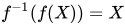 |
f
(
f
−
1
(
B
)
)
⊆
B
{\displaystyle f\left(f^{-1}(B)\right)\subseteq B}
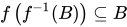 (equal if B ⊆ f ( X ) ; {\displaystyle B\subseteq f(X);}  for instance, if
f
{\displaystyle f}
is surjective)[9][10] for instance, if
f
{\displaystyle f}
is surjective)[9][10] |
f
−
1
(
f
(
A
)
)
⊇
A
{\displaystyle f^{-1}(f(A))\supseteq A}
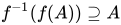 (equal if f {\displaystyle f} is injective)[9][10] |
f
(
f
−
1
(
B
)
)
=
B
∩
f
(
X
)
{\displaystyle f(f^{-1}(B))=B\cap f(X)}
 |
(
f
|
A
)
−
1
(
B
)
=
A
∩
f
−
1
(
B
)
{\displaystyle \left(f\vert _{A}\right)^{-1}(B)=A\cap f^{-1}(B)}
 |
f
(
f
−
1
(
f
(
A
)
)
)
=
f
(
A
)
{\displaystyle f\left(f^{-1}(f(A))\right)=f(A)}
 |
f
−
1
(
f
(
f
−
1
(
B
)
)
)
=
f
−
1
(
B
)
{\displaystyle f^{-1}\left(f\left(f^{-1}(B)\right)\right)=f^{-1}(B)}
 |
f
(
A
)
=
∅
if and only if
A
=
∅
{\displaystyle f(A)=\varnothing \,{\text{ if and only if }}\,A=\varnothing }
 |
f
−
1
(
B
)
=
∅
if and only if
B
⊆
Y
∖
f
(
X
)
{\displaystyle f^{-1}(B)=\varnothing \,{\text{ if and only if }}\,B\subseteq Y\setminus f(X)}
 |
f
(
A
)
⊇
B
if and only if
there exists
C
⊆
A
such that
f
(
C
)
=
B
{\displaystyle f(A)\supseteq B\,{\text{ if and only if }}{\text{ there exists }}C\subseteq A{\text{ such that }}f(C)=B}
 |
f
−
1
(
B
)
⊇
A
if and only if
f
(
A
)
⊆
B
{\displaystyle f^{-1}(B)\supseteq A\,{\text{ if and only if }}\,f(A)\subseteq B}
 |
f
(
A
)
⊇
f
(
X
∖
A
)
if and only if
f
(
A
)
=
f
(
X
)
{\displaystyle f(A)\supseteq f(X\setminus A)\,{\text{ if and only if }}\,f(A)=f(X)}
 |
f
−
1
(
B
)
⊇
f
−
1
(
Y
∖
B
)
if and only if
f
−
1
(
B
)
=
X
{\displaystyle f^{-1}(B)\supseteq f^{-1}(Y\setminus B)\,{\text{ if and only if }}\,f^{-1}(B)=X}
 |
f
(
X
∖
A
)
⊇
f
(
X
)
∖
f
(
A
)
{\displaystyle f(X\setminus A)\supseteq f(X)\setminus f(A)}
 |
f
−
1
(
Y
∖
B
)
=
X
∖
f
−
1
(
B
)
{\displaystyle f^{-1}(Y\setminus B)=X\setminus f^{-1}(B)}
 [9] [9] |
f
(
A
∪
f
−
1
(
B
)
)
⊆
f
(
A
)
∪
B
{\displaystyle f\left(A\cup f^{-1}(B)\right)\subseteq f(A)\cup B}
 [11] [11] |
f
−
1
(
f
(
A
)
∪
B
)
⊇
A
∪
f
−
1
(
B
)
{\displaystyle f^{-1}(f(A)\cup B)\supseteq A\cup f^{-1}(B)}
 [11] [11] |
f
(
A
∩
f
−
1
(
B
)
)
=
f
(
A
)
∩
B
{\displaystyle f\left(A\cap f^{-1}(B)\right)=f(A)\cap B}
 [11] [11] |
f
−
1
(
f
(
A
)
∩
B
)
⊇
A
∩
f
−
1
(
B
)
{\displaystyle f^{-1}(f(A)\cap B)\supseteq A\cap f^{-1}(B)}
 [11] [11] |
Also:
-
f
(
A
)
∩
B
=
∅
if and only if
A
∩
f
−
1
(
B
)
=
∅
{\displaystyle f(A)\cap B=\varnothing \,{\text{ if and only if }}\,A\cap f^{-1}(B)=\varnothing }

Multiple functions
For functions
f
:
X
→
Y
{\displaystyle f:X\to Y}


-
(
g
∘
f
)
(
A
)
=
g
(
f
(
A
)
)
{\displaystyle (g\circ f)(A)=g(f(A))}
-
(
g
∘
f
)
−
1
(
C
)
=
f
−
1
(
g
−
1
(
C
)
)
{\displaystyle (g\circ f)^{-1}(C)=f^{-1}(g^{-1}(C))}


Multiple subsets of domain or codomain
For function
f
:
X
→
Y
{\displaystyle f:X\to Y}


| Image | Preimage |
|---|---|
A
⊆
B
implies
f
(
A
)
⊆
f
(
B
)
{\displaystyle A\subseteq B\,{\text{ implies }}\,f(A)\subseteq f(B)}
 |
S
⊆
T
implies
f
−
1
(
S
)
⊆
f
−
1
(
T
)
{\displaystyle S\subseteq T\,{\text{ implies }}\,f^{-1}(S)\subseteq f^{-1}(T)}
 |
f
(
A
∪
B
)
=
f
(
A
)
∪
f
(
B
)
{\displaystyle f(A\cup B)=f(A)\cup f(B)}
 [11][12] [11][12] |
f
−
1
(
S
∪
T
)
=
f
−
1
(
S
)
∪
f
−
1
(
T
)
{\displaystyle f^{-1}(S\cup T)=f^{-1}(S)\cup f^{-1}(T)}
 |
f
(
A
∩
B
)
⊆
f
(
A
)
∩
f
(
B
)
{\displaystyle f(A\cap B)\subseteq f(A)\cap f(B)}
 [11][12] [11][12](equal if f {\displaystyle f} is injective[13]) |
f
−
1
(
S
∩
T
)
=
f
−
1
(
S
)
∩
f
−
1
(
T
)
{\displaystyle f^{-1}(S\cap T)=f^{-1}(S)\cap f^{-1}(T)}
 |
f
(
A
∖
B
)
⊇
f
(
A
)
∖
f
(
B
)
{\displaystyle f(A\setminus B)\supseteq f(A)\setminus f(B)}
 [11] [11](equal if f {\displaystyle f} is injective[13]) |
f
−
1
(
S
∖
T
)
=
f
−
1
(
S
)
∖
f
−
1
(
T
)
{\displaystyle f^{-1}(S\setminus T)=f^{-1}(S)\setminus f^{-1}(T)}
 [11] [11] |
f
(
A
△
B
)
⊇
f
(
A
)
△
f
(
B
)
{\displaystyle f\left(A\triangle B\right)\supseteq f(A)\triangle f(B)}
 (equal if f {\displaystyle f} is injective) |
f
−
1
(
S
△
T
)
=
f
−
1
(
S
)
△
f
−
1
(
T
)
{\displaystyle f^{-1}\left(S\triangle T\right)=f^{-1}(S)\triangle f^{-1}(T)}
 |
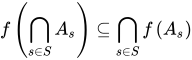
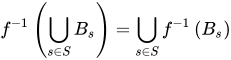
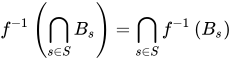
The results relating images and preimages to the (Boolean) algebra of intersection and union work for any collection of subsets, not just for pairs of subsets:
-
f
(
⋃
s
∈
S
A
s
)
=
⋃
s
∈
S
f
(
A
s
)
{\displaystyle f\left(\bigcup _{s\in S}A_{s}\right)=\bigcup _{s\in S}f\left(A_{s}\right)}
-
f
(
⋂
s
∈
S
A
s
)
⊆
⋂
s
∈
S
f
(
A
s
)
{\displaystyle f\left(\bigcap _{s\in S}A_{s}\right)\subseteq \bigcap _{s\in S}f\left(A_{s}\right)}
-
f
−
1
(
⋃
s
∈
S
B
s
)
=
⋃
s
∈
S
f
−
1
(
B
s
)
{\displaystyle f^{-1}\left(\bigcup _{s\in S}B_{s}\right)=\bigcup _{s\in S}f^{-1}\left(B_{s}\right)}
-
f
−
1
(
⋂
s
∈
S
B
s
)
=
⋂
s
∈
S
f
−
1
(
B
s
)
{\displaystyle f^{-1}\left(\bigcap _{s\in S}B_{s}\right)=\bigcap _{s\in S}f^{-1}\left(B_{s}\right)}
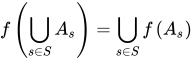
(Here,
S
{\displaystyle S}
With respect to the algebra of subsets described above, the inverse image function is a lattice homomorphism, while the image function is only a semilattice homomorphism (that is, it does not always preserve intersections).
See also
- Bijection, injection and surjection – Properties of mathematical functions
- Fiber (mathematics) – Set of all points in a function's domain that all map to some single given point
- Image (category theory)
- Kernel of a function – Equivalence relation expressing that two elements have the same image under a functionPages displaying short descriptions of redirect targets
- Set inversion – Mathematical problem of finding the set mapped by a specified function to a certain range
Notes
- "5.4: Onto Functions and Images/Preimages of Sets". Mathematics LibreTexts. 2019-11-05. Retrieved 2020-08-28.
- Paul R. Halmos (1968). Naive Set Theory. Princeton: Nostrand. Here: Sect.8
- Weisstein, Eric W. "Image". mathworld.wolfram.com. Retrieved 2020-08-28.
- Dolecki & Mynard 2016, pp. 4–5.
- Blyth 2005, p. 5.
- Jean E. Rubin (1967). Set Theory for the Mathematician. Holden-Day. p. xix. ASIN B0006BQH7S.
- M. Randall Holmes: Inhomogeneity of the urelements in the usual models of NFU, December 29, 2005, on: Semantic Scholar, p. 2
- Hoffman, Kenneth (1971). Linear Algebra (2nd ed.). Prentice-Hall. p. 388.
- See Halmos 1960, p. 31
- See Munkres 2000, p. 19
- See p.388 of Lee, John M. (2010). Introduction to Topological Manifolds, 2nd Ed.
- Kelley 1985, p. 85
- See Munkres 2000, p. 21
References
- Artin, Michael (1991). Algebra. Prentice Hall. ISBN 81-203-0871-9.
- Blyth, T.S. (2005). Lattices and Ordered Algebraic Structures. Springer. ISBN 1-85233-905-5..
- Dolecki, Szymon; Mynard, Frédéric (2016). Convergence Foundations Of Topology. New Jersey: World Scientific Publishing Company. ISBN 978-981-4571-52-4. OCLC 945169917.
- Halmos, Paul R. (1960). Naive set theory. The University Series in Undergraduate Mathematics. van Nostrand Company. ISBN 9780442030643. Zbl 0087.04403.
{{cite book}}: ISBN / Date incompatibility (help) - Kelley, John L. (1985). General Topology. Graduate Texts in Mathematics. Vol. 27 (2 ed.). Birkhäuser. ISBN 978-0-387-90125-1.
- Munkres, James R. (2000). Topology (2nd ed.). Upper Saddle River, NJ: Prentice Hall, Inc. ISBN 978-0-13-181629-9. OCLC 42683260. (accessible to patrons with print disabilities)
This article incorporates material from Fibre on PlanetMath, which is licensed under the Creative Commons Attribution/Share-Alike License.