 An Affrilachian family | |
| Total population | |
|---|---|
| around 900,000[1] (Appalachian Regional Commission, 2024 estimate) | |
| Regions with significant populations | |
| Blue Ridge Mountains, Central and Southern Appalachia, including: West Virginia, Eastern Kentucky Coalfield, SWVA, East Tennessee, WNC, North Georgia | |
| Languages | |
| English: Affrilachian, Ebonics | |
| Religion | |
| Baptist, Methodist, Holiness Pentecostalism. A minority are Catholic or practices folk religions (Granny magic, Hoodoo) | |
| Related ethnic groups | |
| Melungeon, Carmel Indians, Chestnut Ridge people, Black Ozarkers, African-Americans, Appalachians |
Affrilachia is a term that focuses on the culture and contributions of Black Southerner artists, writers, and musicians in the Appalachian region of the United States.[2] The term is used to describe Affrilachia people and culture. The term "Affrilachia" is attributed to Kentucky-based writer Frank X Walker, who began using it in the 1990s as a way to negate the stereotype of Appalachian culture,[2][3] which portrays Appalachians as predominantly white and living in small mountain communities.[4] The term Affrilachian stands for an African American who is a native or resident in the Appalachian region.[5] The word "Affrilachia" is included in the second edition of the Oxford American Dictionary.[6]
History

The African-American population within the entire ARC's jurisdiction. This includes the Affrilachains of central and southern Appalachia as well as other groups, such as Black Southerners

Affrilachians have existed since the early origin of the United States and the establishment of colonial communities within Appalachia. They have resided there both as enslaved and free persons.[7]: 1
Age of Discovery
Affrilachians entered into Appalachia in waves; these waves include those who arrived with white settlers, those who arrived after 1880, among other waves.[8]
The earliest Africans who came to live in and around the southern Appalachian Mountains arrived during the Age of Discovery, often with explorers like Spanish Conquistadors.[9] Affilachians and Amerindians have interacted at least since this era.[8]
One of the earliest accounts of African peoples in Appalachia is seen in Hernando de Soto's expeditions. de Soto forced The Lady of Cofitachequi to be his guide in the Appalachian Mountains. When she escaped, the Lady of Cofitachequi, whose paramountcy bordered the Appalachian Mountains, was accompanied by her own Amerindian servants as well as enslaved people of Africa or Afro-Caribbean descent defecting from de Soto's expedition. One enslaved man returned to de Soto's party and reported that The Lady of Cofitachequi had taken one of the escaped slaves as her lover and partner.[10][11]
Colonial and Revolutionary Eras
Affrilachians and Native Americans, particularly the Cherokee, had extensive social interactions due to both groups being enslaved by white settlers; this peaked and began to decline after the Yamasee War (1715-1717).[12] Theda Perdue of University of North Carolina at Chapel Hill recorded that "in 1763 whites agreed to pay Indians one musket and three blankets, the equivalent of thirty-five deerskins, for each black slave captured and returned."[13]
By the time of the American Revolution, the Cherokee had begun to participate in the slave economy of the Southern US; they were known to capture Black enslaved people from one settler community and sell them to a different settler community.[12] Slave raids perpetrated by Native Americans began to diminish after 1794; this was marked by the scalping of the Cherokee slave raider Chief Benge of the Chikamauga, who abducted 2 white women and 3 enslaved people in Southwest Virginia, before being killed by the Virginia militia under Colonel Arthur Campbell on behalf of Governor Henry Lee.[13]
Colonists actively conspired to disrupt friendly relationships and cause hostilities between the Affrilachians and the Cherokee; Affrilachian soldiers participated in the Yamasee War against the Yamasee (among other Native Americans) and slaveholders were forbidden from bringing slaves into Cherokee towns to prevent any opportunity of cross-racial interactions.[14]
Free Blacks and Maroons
If any negroes shall run away into the woods from their English masters, the Cherokees shall endeavor to apprehend them and bring them to the plantation from which they ran away, or to the Governor, and for every slave so apprehended and brought back, the Indian that brings him shall receive a gun and a matchcoat. [13]
— The Treaty of Whitehall (1730)
In the colonial era, enslaved African-Americans were known to escape into the Backcountry in search of freedom.[13]
In colonial and revolutionary era Virginia, there was a dichotomy between the Appalachian Mountains region, where refuge from slavery and discrimination could be found, and the Tidewater Region, where there was a plantation-heavy economy.[8] Slaveholders feared that escaped slaves in the Cherokee's Appalachian territory would form powerful maroon communities.[13] In one effort to prevent this, The Treaty of Whitehall between the English and Cherokee in 1730 stated that the Cherokee must return escaped slaves and would be compensated for their cooperation.[13]
Other communities established by Free Blacks and Maroons in the Antebellum era include Free Hill, Tennessee, Junaluska, North Carolina, and Affrilachian communities at Entry Mountain and Moatstown in Pendleton County, West Virginia.[15][16]
After the Civil War
Liberia, South Carolina was founded immediately after the Civil War as a freedom colony in Pickens County, on the border with Western North Carolina.[17]
Demographics
Demographic history
In the 1790 census, Affrilachians both free and enslaved totaled approximately 6% of Appalachian population (19,000 people out of a 307,000 total). This rose by the 1860 census, which saw Affrilachians comprising 10% of the overall Appalachian population of 5.4 million residents.[7]: 1
In the 1990 census, Appalachia racial diversity had shrunk to pre-Civil War levels, with 7% of its population now being Affrilachian, at approximately 1.6 million people within the Appalachian Regional Commission's (ARC) jurisdiction. Also at this time, ethnic minorities constituted approximately half of new births.[7]: 2 From 1990 to 2000, Affrilachian continued to be the largest ethnic minority within the ARC's zone.[7]: 7 Instead of rurality, Affrilachians today are more likely to be urban residents.[7]: 19 [18]
Culture
Literature
Frank X Walker wrote Isaac Murphy: I Dedicate This Ride (2010), Masked Man, Black: Pandemic and Protest Poems (2020), Black Box: Poems (2006), and Affrilachia: Poems by Frank X Walker (2000).[19]
Crystal Wilkinson is the author of the books The Birds of Opulence (2016), Water Street (2011), Blackberries, Blackberries (2000), and Perfect Black (2021).[20]
In 2018, Affrilachian poets celebrated 25 years since the term was created in the book, Black Bone: 25 Years of the Affrilachian Poets edited by Bianca Lynn Spriggs and Jeremy Paden, published by The University Press of Kentucky.[21] This book had contributions from Frank X Walker himself along with other prominent members of the Affrilachian literary community.[21]
Nikki Giovanni is another prominent Affrilachian poet from Knoxville, Tennessee.
Language

Many Affrilachians speak African-American Appalachian English (AAAE). In comparison to other groups speaking Black American English, Affrilachians have been reported as increasingly adopting Appalachian/Southern dialect commonly associated with White Appalachians. These similarities include an accent that is rhotic, the categorical use of the grammatical construction "he works" or "she goes" (rather than the AAVE "he work" and "she go"), and Appalachian vocabulary (such as airish for "windy"). However, even African-American English in Appalachia is diverse, with African-American women linguistically divided along sociocultural lines.[22]
Despite its distinctiveness, AAAE shares many features with other varieties of Appalachian English, including the use of nonstandard pronunciation, grammar, and vocabulary. AAAE also shares features with other varieties of African American English, particularly those spoken in the South. For instance, a study of African American communities in the Appalachian region of Virginia found that the dialects of these communities shared many features with both African American English and Southern White English.[23]
Visual arts
Appalachia is also home to vibrant African American art communities. In 2011, artist, educator, and curator Marie Cochran started the western North Carolina–based Affrilachian Artist Project to combat the common perception of Appalachia as a racially homogeneous, white region.[24] She co-curated the Affrilachian Artist Project's inaugural exhibition at the August Wilson Cultural Center in Pittsburgh, Pennsylvania.[25] A traveling version of the exhibit, which includes work by LaKeisha Blount, Victoria Casey-McDonald, and Rahkie Mateen, has been hosted by galleries throughout Appalachia.[24][26]
Music

History
African Americans, including those who identify as Affrilachian, have had a significant impact on the sound of Appalachian music over the years. The start of African American influence on Appalachian music began when individuals were forcefully brought from West Africa to the United States and put into slavery.[27] Along with West African enslaved musicians came various stringed instruments made from gourds, such as the ngoni, that would later become the banjo, an instrument that is common in Appalachian music.[27][28] The enslaved West African musicians played stringed instruments using a unique picking technique called “clawhammer”, which has become a popular banjo style in the Appalachian region.[28]
African Americans continued to influence Appalachian music on plantations, where work songs and spirituals were frequently sung, and into the 19th and early 20th centuries.[27][29] By this time, string music began to be associated with minstrelsy and black-face performances, so African American musicians distanced themselves from it.[29] Some modern string bands, however, such as the now-disbanded Carolina Chocolate Drops, have worked to reclaim Appalachian music for the Affrilachian community.[27] With members including Rhiannon Giddens and Dom Flemons, the Carolina Chocolate Drops won a Grammy for Best Traditional Folk Album in 2011.[30]
Affrilachian Jazz
Affrilachian jazz is not one unified body, but several distinct styles; styles include one based in Knoxville and Chattanooga, and another centered around Asheville into Winston-Salem.[31]
Affrilachian Blues
Affrilachian Blues is a sub-genre of the Blues. Affirlachian blues has 4 major styles: Vaudaville, boogie-woogie (piano), dance (string-band), and down-home (guitar and harmonica). [31] [32] Due to their melancholy lyricism and fusion with traditional mountain ballads, Affrialchian blues have also be called Ballad-blues. [33]
Stick McGhee was an Affrilachian Blues musician from Knoxville. Other Affrilachian blues artist include John Jackson, Bill Williams, J.C. Burris, Brownie McGhee, Archie Edwards, Carl Martin, Lesley Riddle, Etta Baker, brothers Marvin and Turner Foddrell, John Tinsley, and Estil C. Ball. Some Affrilachian Blues musician overlap with Piedmont blues musicians from the neighboring region. Likewise, some artists who lived bordering or outside of Appalachia have been cited as Appalachian, Piedmont, and/or Country Blues artists. These include Pink Anderson, Reverend Gary Davis, Ted Bogan, Peg Leg Sam, Josh White, Charles Henry "Baby" Tate. [34] [35] The Blues and its Affrilachian musicians were one of the precursors of and contributors to the creation of Bluegrass. [31]

Cuisine
Affrilachian food and cuisine has slight variations from region to region, just like the rest of Appalachian culture. Some of the staples across Affrilachian cuisine are the practices of preserving produce through pickling, fermenting, and canning as well as drying out other crops such as beans and corn.[36] Much of the food that is eaten in the various Appalachian regions has historically included the crops that families could grow themselves or trade for at local markets. Another Affrilachian staple is the style of pan-frying many different dishes using butter as opposed to neutral oils—a technique also common in French and Creole cooking. Rufus Estes has differentiated his fried chicken from many others using the "pan-fried in butter" method.
Molasses and sorghum are frequently used in baking and as sweeteners. Vegetables such as okra, kale, collard greens, sweet potatoes, and cabbage are prevalent in Affrilachian cooking as are a variety of beans grown in the region. Cornbread is a common side dish. Fruit cobblers and sweet potato pies are popular desserts.[36]
Malinda Russell has been coined as an influential member of Affrilachia because of the cookbook The Domestic Cookbook: Containing a Careful Selection of Useful Receipts for the Kitchen that she published and her "Washington Cake" that gained fame from its combination of citrus and spiced flavors.[36]
Affrilachian Artist Project

Frank X Walker co-founded The Affrilachian Poets and in 2009, created The Affrilachian Journal of Arts and Culture.[5] Frank X Walker is a graduate of the University of Kentucky, currently serving as an associate professor in the UK Department of English.[37] Walker's partnership with the University of Kentucky allowed him to also create and teach an educational program on African-American and Africana studies, which further contributed to and raised awareness of Affrilachian art, culture, and history.[5] Affrilachia is also the title of Walker's 2000 book of poetry, published by Old Cove Press.[38]
In 2011, Marie T. Cochran created the Affrilachian Artist Project with the goal of building a sustainable collaborative network among the region's artists and community organizers.[3] Today, the project has over 2,000 members and has organized several Affrilachian-themed art exhibitions.
The Appalachian region has more than thirty prominent art community members who identify with the term Affrilachian, including writers, musicians, and artists such as Frank X Walker, Nikky Finney, Kelly Norman Ellis, Mitchell L. H. Douglas, Crystal Wilkinson, Parneshia Jones, Ricardo Nazario y Colón, Ellen Hagan, and Keith S. Wilson.[39][24][40] As of March 2022, 3,400 people currently follow the Affrilachian Artist Project's Facebook page.[3]
Gallery
Lifestyle
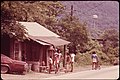 Affrilachian community in the Kanawha valley region
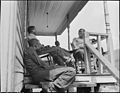 Affrilachian men, West Virginia
 Affrilachian men, Knoxville
 Affrilachian Winter
 Walking in Charleston, WV
 Woman near Beckley, WV
 Man near Beckley, WV
 Man near Rhodell, WV
 At the public library, Charleston, WV
 Affrilachian widow
 Affrilachian company store
 Affrilachian children of miners
 Woman (Clarice Brown) near Charleston, WV
 Man (Edward Austin) in Raleigh Co., WV


.jpg)

..._-_NARA_-_556495.jpg)
%2C_NEAR_BECKLEY._A_RETIRED..._-_NARA_-_556483.jpg)


Work and occupation
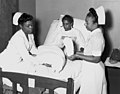 Nurses
 Miners working
 Worker eating
 Miners in West Virginia
 Affrilachian woman washing clothes
 Affrilachian miner
.jpg)
.jpg)
.jpg)

_-_NARA_-_518409.jpg)
Culture
 Affrilachian leaders, Oak Ridge
 Leisure and dance, Oak Ridge
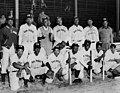 The Oak Ridge Bombers
 Boxing event
 Basketball in Rand, WV
 Affrilachian church
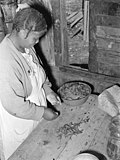 Woman preparing a poke salad
 an Affliachian flag
.jpg)
.jpg)
.jpg)
.jpg)


Mixed-race groups

 Melungeons in Asheville
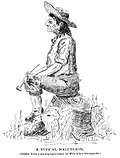 Depiction of a Melungeon


Notable People
 Sam Johnson; laborer, carpenter and musician
 Dolly Johnson (Aunt Dolly); small-business owner and chef
 Levi Danials, Director of Field Services for the United Mine Workers of America
 Celeste Brackett Newcomer, educator at Storer College
 Nikki Giovanni, poet
 Ancella Radford Bickley, historian
 Samuel W. Starks, Fraternity Leader and Librarian
 Coralie Franklin Cook, Women's Rights Activist and Orator
.jpg)


.jpg)
Stereotypes
Affrilachians have long faced a history of erasure, seldom being depicted in representations of Appalachia. [41] As an erroneous generalization, Appalachia has been characterized as a place wholly lacking in diversity, where Native Americans were entirely pushed out and whose inhabitants are functionally white in total, mainly of Scotch-Irish, Anglo, or German stock. [42] [17] White supremacist fictions of racial purity supported the visibility of White Appalachians and the invisibility of Affrilachians and other minority groups. [43]
See also
| Part of a series on ethnic |
| African Americans |
|---|
 |

- Melungeons, a mixed-race group of Affrilachians and White Appalachians
- Black Ozarkers, commonly descended from Affrilachians
- Creoles of Color
- Gullah people
- Black Southerners
- Appalachian Americans
References
- A New Diversity: Race and Ethnicity in Appalachia The entire African-descendent population within the Appalachian Regional Commission's jurisdiction is 1.9 million.
- Stasio, Dana Terry, Frank. "Finding Affrilachia". www.wunc.org. Retrieved March 4, 2019.
{{cite web}}: CS1 maint: multiple names: authors list (link) - "I Pledge Allegiance to Affrilachia". Rewire.News. February 28, 2019. Retrieved March 4, 2019.
- "Naming Affrilachia: Toward Rhetorical Ecologies of Identity Performance in Appalachia | enculturation". enculturation.net. Retrieved March 4, 2019.
- Spriggs, Bianca. "Frank X Walker: Exemplar of Affrilachia." Appalachian Heritage, vol. 39 no. 4, 2011, p. 21–25. Project MUSE, doi:10.1353/aph.2011.0109.
- Thompson, Aaron. "Stereotypes Of Appalachia Obscure A Diverse Picture". NPR.org. Retrieved March 5, 2021.
- "A "New Diversity"" (PDF). The Appalachian Regional Commission. Retrieved January 6, 2026.
- Turner, William H.; Cabbell, Edward J. (1985). Blacks in Appalachia. University Press of Kentucky. p. 21. ISBN 978-0-8131-0162-0.
- Perdue, Theda (1985). Turner, William H.; Cabbell, Edward J. (eds.). Blacks in Appalachia. University Press of Kentucky. p. 23. ISBN 978-0-8131-0162-0.
- Turner, William H.; Cabbell, Edward J. (1985). Blacks in Appalachia. University Press of Kentucky. p. 23-24. ISBN 978-0-8131-0162-0.
- Snyder, Christina (2009). The Lady of Cofitachequi: Gender and Political Power among Native Southerners. University Press of Georgia Press. p. 21-22.
- Perdue, Theda (1985). Turner, William H.; Cabbell, Edward J. (eds.). Blacks in Appalachia. University Press of Kentucky. p. 24. ISBN 978-0-8131-0162-0.
- Perdue, Theda (1985). Turner, William H.; Cabbell, Edward J. (eds.). Blacks in Appalachia. University Press of Kentucky. p. 25. ISBN 978-0-8131-0162-0.
- Perdue, Theda (1985). Turner, William H.; Cabbell, Edward J. (eds.). Blacks in Appalachia. University Press of Kentucky. p. 26. ISBN 978-0-8131-0162-0.
- Williams, Heidi Coryell (January 30, 2015). "Invisible Appalachia: Junaluska". Our State. Clemson University, Clemson, South Carolina. Retrieved June 9, 2026.
- Rexroad, Wm. D. (January 30, 2015). "Invisible Appalachia: Junaluska". Black in Appalachia. Retrieved June 9, 2026.
- Coggeshall, John M. (October 4, 2018). "The Black Freedom Colonies of Appalachia Where Former Slaves 'Could Speak Their Minds'". Zocalo Public Square. Clemson University, Clemson, South Carolina. Retrieved June 9, 2026.
- Note: the above figures are sourced from the Appalachian Regional Council, whose jurisdiction and population demographics extends past cultural Appalachia.
- "Frank X Walker - Affrilachian Poet, Educator, Author of Black Box, Buffalo Dance: the Journey of York, and Affrilachia". www.frankxwalker.com. Retrieved March 23, 2022.
- "Books". Crystal Wilkinson. Retrieved March 4, 2021.
- "Black Bone". The University Press of Kentucky. Retrieved March 4, 2021.
- Wolfram, Walt. (2013). "African American speech in southern Appalachia Archived 2024-04-14 at the Wayback Machine". In Talking Appalachian: Voice, Identity, and Community, edited by Nancy Hayward and Amy Clark. pp. 81–93.
- Fasold, R. W.; Wolfram, W. (1977). Appalachian speech. Arlington, VA: Center for Applied Linguistics. Center for Applied Linguistics, 1611 N.
- "Affrilachian Artist Project Brings Together Appalachian Artists Of Color". BPR. February 28, 2020. Retrieved March 25, 2022.
- Nelson, Katy (November 26, 2012). "Growing project showcases black artists in the mountain region". Carolina Public Press. Retrieved March 25, 2022.
- Dyer, Candice. "Artist explores intersection of Black culture, Appalachia". The Atlanta Journal-Constitution. ISSN 1539-7459. Retrieved March 25, 2022.
- Gatlinburg, Mailing Address: 107 Park Headquarters Road; Us, TN 37738 Phone: 865 436-1200 Contact. "African American Southern Appalachian Music - Great Smoky Mountains National Park (U.S. National Park Service)". www.nps.gov. Retrieved March 25, 2022.
{{cite web}}: CS1 maint: numeric names: authors list (link) - "Affrilachian Folk | Affrilachian Folk". rampages.us. Retrieved April 13, 2021.
- Chia, Connie (November 12, 2014). "Doug Orr: African American Influence on Appalachian Music". UNC Press Blog. Retrieved March 25, 2022.
- "Nonesuch Records Carolina Chocolate Drops". Nonesuch Records Official Website. Retrieved March 25, 2022.
- Hay, Fred J. (2003). Black Musicians in Appalachia: An Introduction to Affrilachian Music. University of Illinois Press. p. 11.
- Pearson, Barry Lee (2003). Appalachian Blues. University of Illinois Press. p. 28.
- Hay, Fred J. (2003). Black Musicians in Appalachia: An Introduction to Affrilachian Music. University of Illinois Press. p. 12.
- "Classic Appalachian Blues from Smithsonian Folkways". Smithsonian Folkways Recordings. Washington, DC: Smithsonian Institution. 2018. Retrieved June 10, 2026.
- Various Artist (2010) [1940]. Classic Appalachian Blues from Smithsonian Folkways (audio) (CD). Southern Appalachia: Smithsonian Folkways Recordings. Retrieved June 10, 2026.
- Caldwell, Robin (December 18, 2019). "What it Means to Eat "Affrilachian" or Black and Appalachian". Black Southern Belle. Retrieved March 6, 2021.
- "Behind the Blue: Poet Frank X Walker Reflects on Work as Writer, Professor". UKNow. October 13, 2016. Retrieved March 4, 2021.
- Walker, Frank X. (2000). Affrilachia. Old Cove Press. ISBN 978-0-9675424-0-9.
- "Members". The Affrilachian Poets. Retrieved March 4, 2019.
- "About - Keith S. Wilson".
- Clark, Jacqueline (February 20, 2019). "Hidden Black History in Appalachia". The Society Pages. Ripon College, Ripon, Wisconsin. Retrieved June 9, 2026.
- Marshall, Megan R. (2024). Affrilachia: Unheard Voices of Appalachia. Hood University. p. iv.
- Hay, Fred J. (2003). Black Musicians in Appalachia: An Introduction to Affrilachian Music. University of Illinois Press. p. 7.
Further reading
- Affrilachia: Testimonies (November 2024) Chris Aluka Berry et al., The University Press of Kentucky