
 to
B
{\displaystyle B}
to
B
{\displaystyle B}
 in
R
2
.
{\displaystyle \mathbb {R} ^{2}.}
in
R
2
.
{\displaystyle \mathbb {R} ^{2}.}
 However, different paths can trace the same set of points.
In mathematics, a path in a topological space
X
{\displaystyle X}

Paths play an important role in the fields of topology and mathematical analysis.
For example, a topological space for which there exists a path connecting any two points is said to be path-connected. Any space may be broken up into path-connected components. The set of path-connected components of a space
X
{\displaystyle X}

One can also define paths and loops in pointed spaces, which are important in homotopy theory. If
X
{\displaystyle X}


Definition
A curve in a topological space
X
{\displaystyle X}


![{\displaystyle f:[a,b]\to X}](https://wikimedia.org/api/rest_v1/media/math/render/svg/3424abb0ac51cc67213d701795a2d943e1d35e7f)
![{\displaystyle [a,b]}](https://wikimedia.org/api/rest_v1/media/math/render/svg/9c4b788fc5c637e26ee98b45f89a5c08c85f7935)


![{\displaystyle [0,1],}](https://wikimedia.org/api/rest_v1/media/math/render/svg/971caee396752d8bf56711f55d2c3b1207d4a236)
![{\displaystyle f:[0,1]\to X}](https://wikimedia.org/api/rest_v1/media/math/render/svg/ebe010ee7ddd6d0aeff0b2b0fc720cb06cdb7c99)
![{\displaystyle I:=[0,1]}](https://wikimedia.org/api/rest_v1/media/math/render/svg/bdbfc5255f5a968586a0c0f9844b5e0d24b3fc61)
An arc or C0-arc in
X
{\displaystyle X}
Importantly, a path is not just a subset of
X
{\displaystyle X}


A loop in a space
X
{\displaystyle X}


-
f
:
S
1
→
X
.
{\displaystyle f:S^{1}\to X.}

This is because
S
1
{\displaystyle S^{1}}
![{\displaystyle I=[0,1]}](https://wikimedia.org/api/rest_v1/media/math/render/svg/87ec65159c44769434523e46928bc1b82681f842)


Homotopy of paths

Paths and loops are central subjects of study in the branch of algebraic topology called homotopy theory. A homotopy of paths makes precise the notion of continuously deforming a path while keeping its endpoints fixed.
Specifically, a homotopy of paths, or path-homotopy, in
X
{\displaystyle X}
![{\displaystyle f_{t}:[0,1]\to X}](https://wikimedia.org/api/rest_v1/media/math/render/svg/e5669d2e7a559d2d2aa86a956bb90818e25a8323)
-
f
t
(
0
)
=
x
0
{\displaystyle f_{t}(0)=x_{0}}
and f t ( 1 ) = x 1 {\displaystyle f_{t}(1)=x_{1}}
are fixed.
- the map
F
:
[
0
,
1
]
×
[
0
,
1
]
→
X
{\displaystyle F:[0,1]\times [0,1]\to X}
given by F ( s , t ) = f t ( s ) {\displaystyle F(s,t)=f_{t}(s)}
is continuous.
The paths
f
0
{\displaystyle f_{0}}


The relation of being homotopic is an equivalence relation on paths in a topological space. The equivalence class of a path
f
{\displaystyle f}


![{\displaystyle [f].}](https://wikimedia.org/api/rest_v1/media/math/render/svg/ae0561089bfe74cad0515ba3b399c3b7843ac294)
Path composition
One can compose paths in a topological space in the following manner. Suppose
f
{\displaystyle f}


-
f
g
(
s
)
=
{
f
(
2
s
)
0
≤
s
≤
1
2
g
(
2
s
−
1
)
1
2
≤
s
≤
1.
{\displaystyle fg(s)={\begin{cases}f(2s)&0\leq s\leq {\frac {1}{2}}\\g(2s-1)&{\frac {1}{2}}\leq s\leq 1.\end{cases}}}
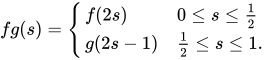
Clearly path composition is only defined when the terminal point of
f
{\displaystyle f}

Path composition, whenever defined, is not associative due to the difference in parametrization. However it is associative up to path-homotopy. That is,
[
(
f
g
)
h
]
=
[
f
(
g
h
)
]
.
{\displaystyle [(fg)h]=[f(gh)].}
![{\displaystyle [(fg)h]=[f(gh)].}](https://wikimedia.org/api/rest_v1/media/math/render/svg/3e2fe931a20fbf8e24219fc950d8ec214b36ea64)


In situations calling for associativity of path composition "on the nose," a path in
X
{\displaystyle X}
![{\displaystyle [0,a]}](https://wikimedia.org/api/rest_v1/media/math/render/svg/63d050b0ffe6cc6f635808b9a013366a60e6d0c0)


-
f
g
(
s
)
=
{
f
(
s
)
0
≤
s
≤
|
f
|
g
(
s
−
|
f
|
)
|
f
|
≤
s
≤
|
f
|
+
|
g
|
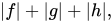
{\displaystyle fg(s)={\begin{cases}f(s)&0\leq s\leq |f|\\g(s-|f|)&|f|\leq s\leq |f|+|g|\end{cases}}}

Whereas with the previous definition,
f
,
{\displaystyle f,}





Fundamental groupoid
There is a categorical picture of paths which is sometimes useful. Any topological space
X
{\displaystyle X}


See also
- Curve § Topology
- Locally path-connected space – Property of topological spacesPages displaying short descriptions of redirect targets
- Path space (disambiguation)
- Path-connected space – Topological space that is connectedPages displaying short descriptions of redirect targets
References
- Ronald Brown, Topology and groupoids, Booksurge PLC, (2006).
- J. Peter May, A concise course in algebraic topology, University of Chicago Press, (1999).
- James Munkres, Topology 2ed, Prentice Hall, (2000).