In mathematics, the automorphism group of an object X is the group consisting of automorphisms of X under composition of morphisms. For example, if X is a finite-dimensional vector space, then the automorphism group of X is the group of invertible linear transformations from X to itself (the general linear group of X). If instead X is a group, then its automorphism group
Aut
(
X
)
{\displaystyle \operatorname {Aut} (X)}

Especially in geometric contexts, an automorphism group is also called a symmetry group. A subgroup of an automorphism group is sometimes called a transformation group.
Automorphism groups are studied in a general way in the field of category theory.
Examples
If X is a set with no additional structure, then any bijection from X to itself is an automorphism, and hence the automorphism group of X in this case is precisely the symmetric group of X. If the set X has additional structure, then it may be the case that not all bijections on the set preserve this structure, in which case the automorphism group will be a subgroup of the symmetric group on X. Some examples of this include the following:
- The automorphism group of a field extension
L
/
K
{\displaystyle L/K}
is the group consisting of field automorphisms of L that fix K. If the field extension is Galois, the automorphism group is called the Galois group of the field extension.
- The automorphism group of the projective n-space over a field k is the projective linear group
PGL
n
(
k
)
.
{\displaystyle \operatorname {PGL} _{n}(k).}
[1]
- The automorphism group
G
{\displaystyle G}
of a finite cyclic group of order n is isomorphic to ( Z / n Z ) × {\displaystyle (\mathbb {Z} /n\mathbb {Z} )^{\times }}
, the multiplicative group of integers modulo n, with the isomorphism given by a ¯ ↦ σ a ∈ G , σ a ( x ) = x a {\displaystyle {\overline {a}}\mapsto \sigma _{a}\in G,\,\sigma _{a}(x)=x^{a}}
.[2] In particular, G {\displaystyle G}
- The automorphism group of a finite-dimensional real Lie algebra
g
{\displaystyle {\mathfrak {g}}}
has the structure of a (real) Lie group (in fact, it is even a linear algebraic group: see below). If G is a Lie group with Lie algebra g {\displaystyle {\mathfrak {g}}}
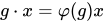
If G is a group acting on a set X, the action amounts to a group homomorphism from G to the automorphism group of X and conversely. Indeed, each left G-action on a set X determines
G
→
Aut
(
X
)
,
g
↦
σ
g
,
σ
g
(
x
)
=
g
⋅
x
{\displaystyle G\to \operatorname {Aut} (X),\,g\mapsto \sigma _{g},\,\sigma _{g}(x)=g\cdot x}


Here are some other facts about automorphism groups:
- Let
A
,
B
{\displaystyle A,B}
be two finite sets of the same cardinality and Iso ( A , B ) {\displaystyle \operatorname {Iso} (A,B)}
the set of all bijections A → ∼ B {\displaystyle A\mathrel {\overset {\sim }{\to }} B}
. Then Aut ( B ) {\displaystyle \operatorname {Aut} (B)}
, which is a symmetric group (see above), acts on Iso ( A , B ) {\displaystyle \operatorname {Iso} (A,B)}
- Let P be a finitely generated projective module over a ring R. Then there is an embedding
Aut
(
P
)
↪
GL
n
(
R
)
{\displaystyle \operatorname {Aut} (P)\hookrightarrow \operatorname {GL} _{n}(R)}
, unique up to inner automorphisms.[5]
In category theory
Automorphism groups appear very naturally in category theory.
If X is an object in a category, then the automorphism group of X is the group consisting of all the invertible morphisms from X to itself. It is the unit group of the endomorphism monoid of X. (For some examples, see PROP.)
If
A
,
B
{\displaystyle A,B}
If
X
1
{\displaystyle X_{1}}





In particular, if G is a group viewed as a category with a single object * or, more generally, if G is a groupoid, then each functor
F
:
G
→
C
{\displaystyle F:G\to C}


Automorphism group functor
Let
M
{\displaystyle M}

Now, consider k-linear maps
M
→
M
{\displaystyle M\to M}


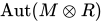
Now base extensions applied to the above discussion determines a functor:[6] namely, for each commutative ring R over k, consider the R-linear maps
M
⊗
R
→
M
⊗
R
{\displaystyle M\otimes R\to M\otimes R}



In general, however, an automorphism group functor may not be represented by a scheme.
See also
- Outer automorphism group
- Level structure, a technique to remove an automorphism group
- Holonomy group
Notes
- First, if G is simply connected, the automorphism group of G is that of
g
{\displaystyle {\mathfrak {g}}}
where G ~ {\displaystyle {\widetilde {G}}}
is a simply connected Lie group and C is a central subgroup and the automorphism group of G is the automorphism group of G {\displaystyle G}
Citations
- Hartshorne 1977, Ch. II, Example 7.1.1.
- Dummit & Foote 2004, § 2.3. Exercise 26.
- Hochschild, G. (1952). "The Automorphism Group of a Lie Group". Transactions of the American Mathematical Society. 72 (2): 209–216. doi:10.2307/1990752. JSTOR 1990752.
- Fulton & Harris 1991, Exercise 8.28.
- Milnor 1971, Lemma 3.2.
- Waterhouse 2012, § 7.6.
References
- Dummit, David S.; Foote, Richard M. (2004). Abstract Algebra (3rd ed.). Wiley. ISBN 978-0-471-43334-7.
- Fulton, William; Harris, Joe (1991). Representation theory. A first course. Graduate Texts in Mathematics, Readings in Mathematics. Vol. 129. New York: Springer-Verlag. doi:10.1007/978-1-4612-0979-9. ISBN 978-0-387-97495-8. MR 1153249. OCLC 246650103.
- Hartshorne, Robin (1977), Algebraic Geometry, Graduate Texts in Mathematics, vol. 52, New York: Springer-Verlag, ISBN 978-0-387-90244-9, MR 0463157
- Milnor, John Willard (1971). Introduction to algebraic K-theory. Annals of Mathematics Studies. Vol. 72. Princeton, NJ: Princeton University Press. ISBN 9780691081014. MR 0349811. Zbl 0237.18005.
- Waterhouse, William C. (2012) [1979]. Introduction to Affine Group Schemes. Graduate Texts in Mathematics. Vol. 66. Springer Verlag. ISBN 9781461262176.