In physics, and especially quantum field theory, an auxiliary field is one whose equations of motion admit a single solution. Therefore, the Lagrangian describing such a field
A
{\displaystyle A}

-
L
aux
=
1
2
(
A
,
A
)
+
(
f
(
φ
)
,
A
)
.
{\displaystyle {\mathcal {L}}_{\text{aux}}={\frac {1}{2}}(A,A)+(f(\varphi ),A).}

The equation of motion for
A
{\displaystyle A}
-
A
(
φ
)
=
−
f
(
φ
)
,
{\displaystyle A(\varphi )=-f(\varphi ),}

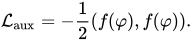
and the Lagrangian becomes
-
L
aux
=
−
1
2
(
f
(
φ
)
,
f
(
φ
)
)
.
{\displaystyle {\mathcal {L}}_{\text{aux}}=-{\frac {1}{2}}(f(\varphi ),f(\varphi )).}
Auxiliary fields generally do not propagate,[1] and hence the content of any theory can remain unchanged in many circumstances by adding such fields by hand.
If we have an initial Lagrangian
L
0
{\displaystyle {\mathcal {L}}_{0}}


-
L
=
L
0
(
φ
)
+
L
aux
=
L
0
(
φ
)
−
1
2
(
f
(
φ
)
,
f
(
φ
)
)
.
{\displaystyle {\mathcal {L}}={\mathcal {L}}_{0}(\varphi )+{\mathcal {L}}_{\text{aux}}={\mathcal {L}}_{0}(\varphi )-{\frac {1}{2}}{\big (}f(\varphi ),f(\varphi ){\big )}.}

Therefore, auxiliary fields can be employed to cancel quadratic terms in
φ
{\displaystyle \varphi }
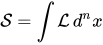
Examples of auxiliary fields are the complex scalar field F in a chiral superfield,[2] the real scalar field D in a vector superfield, the scalar field B in BRST and the field in the Hubbard–Stratonovich transformation.
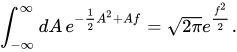
The quantum mechanical effect of adding an auxiliary field is the same as the classical, since the path integral over such a field is Gaussian. To wit:
-
∫
−
∞
∞
d
A
e
−
1
2
A
2
+
A
f
=
2
π
e
f
2
2
.
{\displaystyle \int _{-\infty }^{\infty }dA\,e^{-{\frac {1}{2}}A^{2}+Af}={\sqrt {2\pi }}e^{\frac {f^{2}}{2}}.}
See also
References
- Fujimori, Toshiaki; Nitta, Muneto; Yamada, Yusuke (2016-09-19). "Ghostbusters in higher derivative supersymmetric theories: who is afraid of propagating auxiliary fields?". Journal of High Energy Physics. 2016 (9): 106. arXiv:1608.01843. Bibcode:2016JHEP...09..106F. doi:10.1007/JHEP09(2016)106. S2CID 256040291.
- Antoniadis, I.; Dudas, E.; Ghilencea, D.M. (Mar 2008). "Supersymmetric models with higher dimensional operators". Journal of High Energy Physics. 2008 (3): 45. arXiv:0708.0383. Bibcode:2008JHEP...03..045A. doi:10.1088/1126-6708/2008/03/045. S2CID 2491994.