In general relativity and differential geometry, the Bel–Robinson tensor is a tensor defined in the abstract index notation by:
-
T
a
b
c
d
=
C
a
e
c
f
C
b
e
d
f
+
1
4
ϵ
a
e
h
i
ϵ
b
e
j
k
C
h
i
c
f
C
j
k
d
f
{\displaystyle T_{abcd}=C_{aecf}C_{b}{}^{e}{}_{d}{}^{f}+{\frac {1}{4}}\epsilon _{ae}{}^{hi}\epsilon _{b}{}^{ej}{}_{k}C_{hicf}C_{j}{}^{k}{}_{d}{}^{f}}

Alternatively,
-
T
a
b
c
d
=
C
a
e
c
f
C
b
e
d
f
−
3
2
g
a
[
b
C
j
k
]
c
f
C
j
k
d
f
{\displaystyle T_{abcd}=C_{aecf}C_{b}{}^{e}{}_{d}{}^{f}-{\frac {3}{2}}g_{a[b}C_{jk]cf}C^{jk}{}_{d}{}^{f}}
![{\displaystyle T_{abcd}=C_{aecf}C_{b}{}^{e}{}_{d}{}^{f}-{\frac {3}{2}}g_{a[b}C_{jk]cf}C^{jk}{}_{d}{}^{f}}](https://wikimedia.org/api/rest_v1/media/math/render/svg/3385b40e89567b5808c3c76694a28d58829d5184)
where
C
a
b
c
d
{\displaystyle C_{abcd}}

-
T
a
b
c
d
=
T
(
a
b
c
d
)
T
a
a
c
d
=
0
{\displaystyle {\begin{aligned}T_{abcd}&=T_{(abcd)}\\T^{a}{}_{acd}&=0\end{aligned}}}
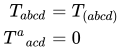
In general relativity, there is no unique definition of the local energy of the gravitational field. The Bel–Robinson tensor is a possible definition for local energy,[3] since it can be shown that whenever the Ricci tensor vanishes (i.e. in vacuum), the Bel–Robinson tensor is divergence-free:
-
∇
a
T
a
b
c
d
=
0
{\displaystyle \nabla ^{a}T_{abcd}=0}

See also
References
- Bel, L. (1959), "Introduction d'un tenseur du quatrième ordre", Comptes rendus hebdomadaires des séances de l'Académie des sciences, 248: 1297–3000
- Senovilla, J. M. M. (2000), "Editor's Note: Radiation States and the Problem of Energy in General Relativity by Louis Bel", General Relativity and Gravitation, 32 (10): 2043, Bibcode:2000GReGr..32.2043S, doi:10.1023/A:1001906821162, S2CID 116937193
- Garecki, J.; Goląb, M. (1980), "The superenergy tensor of the Einstein-Rosen gravitational wave", Acta Physica Polonica B, 11 (4): 255–257