| Bernoulli distribution | |||
|---|---|---|---|
|
Probability mass function 
Three examples of Bernoulli distribution:
P
(
x
=
0
)
=
0
.
2
{\displaystyle P(x=0)=0{.}2}
 and
P
(
x
=
1
)
=
0
.
8
{\displaystyle P(x=1)=0{.}8} and
P
(
x
=
1
)
=
0
.
8
{\displaystyle P(x=1)=0{.}8}

P
(
x
=
0
)
=
0
.
8
{\displaystyle P(x=0)=0{.}8}
 and
P
(
x
=
1
)
=
0
.
2
{\displaystyle P(x=1)=0{.}2} and
P
(
x
=
1
)
=
0
.
2
{\displaystyle P(x=1)=0{.}2}

P
(
x
=
0
)
=
0
.
5
{\displaystyle P(x=0)=0{.}5}
 and
P
(
x
=
1
)
=
0
.
5
{\displaystyle P(x=1)=0{.}5} and
P
(
x
=
1
)
=
0
.
5
{\displaystyle P(x=1)=0{.}5}
 | |||
| Notation |
B
e
r
n
o
u
l
l
i
(
p
)
{\displaystyle \mathrm {Bernoulli} (p)}
 | ||
| Parameters |
0
≤
p
≤
1
{\displaystyle 0\leq p\leq 1}
 | ||
| Support |
k
∈
{
0
,
1
}
{\displaystyle k\in \{0,1\}}
 | ||
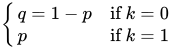
| PMF |
{
q
=
1
−
p
if
k
=
0
p
if
k
=
1
{\displaystyle {\begin{cases}q=1-p&{\text{if }}k=0\\p&{\text{if }}k=1\end{cases}}}
 | ||
| CDF |
{
0
if
k
<
0
1
−
p
if
0
≤
k
<
1
1
if
k
≥
1
{\displaystyle {\begin{cases}0&{\text{if }}k<0\\1-p&{\text{if }}0\leq k<1\\1&{\text{if }}k\geq 1\end{cases}}}
 | ||
| Mean |
p
{\displaystyle p}
 | ||
| Median |
{
0
if
p
<
1
/
2
[
0
,
1
]
if
p
=
1
/
2
1
if
p
>
1
/
2
{\displaystyle {\begin{cases}0&{\text{if }}p<1/2\\\left[0,1\right]&{\text{if }}p=1/2\\1&{\text{if }}p>1/2\end{cases}}}
![{\displaystyle {\begin{cases}0&{\text{if }}p<1/2\\\left[0,1\right]&{\text{if }}p=1/2\\1&{\text{if }}p>1/2\end{cases}}}](https://wikimedia.org/api/rest_v1/media/math/render/svg/482cc0f5f8c739e3fe2462d72ee5b9f1f7b5d5a4) | ||
| Mode |
{
0
if
p
<
1
/
2
0
,
1
if
p
=
1
/
2
1
if
p
>
1
/
2
{\displaystyle {\begin{cases}0&{\text{if }}p<1/2\\0,1&{\text{if }}p=1/2\\1&{\text{if }}p>1/2\end{cases}}}
 | ||
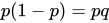
| Variance |
p
(
1
−
p
)
=
p
q
{\displaystyle p(1-p)=pq}
 | ||
| MAD |
2
p
(
1
−
p
)
=
2
p
q
{\displaystyle 2p(1-p)=2pq}
 | ||
| Skewness |
q
−
p
p
q
{\displaystyle {\frac {q-p}{\sqrt {pq}}}}
 | ||
| Excess kurtosis |
1
−
6
p
q
p
q
{\displaystyle {\frac {1-6pq}{pq}}}
 | ||
| Entropy |
−
q
ln
q
−
p
ln
p
{\displaystyle -q\ln q-p\ln p}
 | ||
| MGF |
q
+
p
e
t
{\displaystyle q+pe^{t}}
 | ||
| CF |
q
+
p
e
i
t
{\displaystyle q+pe^{it}}
 | ||
| PGF |
q
+
p
z
{\displaystyle q+pz}
 | ||
| Fisher information |
1
p
q
{\displaystyle {\frac {1}{pq}}}
 | ||
| Part of a series on statistics |
| Probability theory |
|---|
 |
In probability theory and statistics, the Bernoulli distribution, named after Swiss mathematician Jacob Bernoulli,[1] is the discrete probability distribution of a random variable which takes the value 1 with probability
p
{\displaystyle p}

The Bernoulli distribution is a special case of the binomial distribution where a single trial is conducted (so n would be 1 for such a binomial distribution). It is also a special case of the two-point distribution, for which the possible outcomes need not be 0 and 1.[2]
Properties
If
X
{\displaystyle X}

Pr
(
X
=
1
)
=
p
,
Pr
(
X
=
0
)
=
q
=
1
−
p
.
{\displaystyle {\begin{aligned}\Pr(X{=}1)&=p,\\\Pr(X{=}0)&=q=1-p.\end{aligned}}}

The probability mass function
f
{\displaystyle f}

f
(
k
;
p
)
=
{
p
if
k
=
1
,
q
=
1
−
p
if
k
=
0.
{\displaystyle f(k;p)={\begin{cases}p&{\text{if }}k=1,\\q=1-p&{\text{if }}k=0.\end{cases}}}

This can also be expressed as
f
(
k
;
p
)
=
p
k
(
1
−
p
)
1
−
k
for
k
∈
{
0
,
1
}
{\displaystyle f(k;p)=p^{k}(1-p)^{1-k}\quad {\text{for }}k\in \{0,1\}}

or as
f
(
k
;
p
)
=
p
k
+
(
1
−
p
)
(
1
−
k
)
for
k
∈
{
0
,
1
}
.
{\displaystyle f(k;p)=pk+(1-p)(1-k)\quad {\text{for }}k\in \{0,1\}.}

The Bernoulli distribution is a special case of the binomial distribution with
n
=
1.
{\displaystyle n=1.}

The kurtosis goes to infinity for high and low values of
p
,
{\displaystyle p,}


The Bernoulli distributions for
0
≤
p
≤
1
{\displaystyle 0\leq p\leq 1}

The maximum likelihood estimator of
p
{\displaystyle p}

Mean
The expected value of a Bernoulli random variable
X
{\displaystyle X}
E
[
X
]
=
p
{\displaystyle \operatorname {E} [X]=p}
![{\displaystyle \operatorname {E} [X]=p}](https://wikimedia.org/api/rest_v1/media/math/render/svg/0eb41a45634ab84b13b83cb1488b626aa2129285)
This is because for a Bernoulli distributed random variable
X
{\displaystyle X}


E
[
X
]
=
Pr
(
X
=
1
)
⋅
1
+
Pr
(
X
=
0
)
⋅
0
=
p
⋅
1
+
q
⋅
0
=
p
.
{\displaystyle {\begin{aligned}\operatorname {E} [X]&=\Pr(X{=}1)\cdot 1+\Pr(X{=}0)\cdot 0\\[1ex]&=p\cdot 1+q\cdot 0\\[1ex]&=p.\end{aligned}}}
![{\displaystyle {\begin{aligned}\operatorname {E} [X]&=\Pr(X{=}1)\cdot 1+\Pr(X{=}0)\cdot 0\\[1ex]&=p\cdot 1+q\cdot 0\\[1ex]&=p.\end{aligned}}}](https://wikimedia.org/api/rest_v1/media/math/render/svg/214e2402ee6f4da8553d9afff2671ca2d7490367)
Variance
The variance of a Bernoulli distributed
X
{\displaystyle X}
Var
[
X
]
=
p
q
=
p
(
1
−
p
)
{\displaystyle \operatorname {Var} [X]=pq=p(1-p)}
![{\displaystyle \operatorname {Var} [X]=pq=p(1-p)}](https://wikimedia.org/api/rest_v1/media/math/render/svg/2d4e26d8a1fdfb90e91a2fafd5fb3841de88f1fb)
We first find
E
[
X
2
]
=
Pr
(
X
=
1
)
⋅
1
2
+
Pr
(
X
=
0
)
⋅
0
2
=
p
⋅
1
2
+
q
⋅
0
2
=
p
=
E
[
X
]
{\displaystyle {\begin{aligned}\operatorname {E} [X^{2}]&=\Pr(X{=}1)\cdot 1^{2}+\Pr(X{=}0)\cdot 0^{2}\\&=p\cdot 1^{2}+q\cdot 0^{2}\\&=p=\operatorname {E} [X]\end{aligned}}}
![{\displaystyle {\begin{aligned}\operatorname {E} [X^{2}]&=\Pr(X{=}1)\cdot 1^{2}+\Pr(X{=}0)\cdot 0^{2}\\&=p\cdot 1^{2}+q\cdot 0^{2}\\&=p=\operatorname {E} [X]\end{aligned}}}](https://wikimedia.org/api/rest_v1/media/math/render/svg/ff9a4901d62fc1aac16f4d840b8a999581a9e964)
From this follows[3]
Var
[
X
]
=
E
[
X
2
]
−
E
[
X
]
2
=
E
[
X
]
−
E
[
X
]
2
=
p
−
p
2
=
p
(
1
−
p
)
=
p
q
{\displaystyle {\begin{aligned}\operatorname {Var} [X]&=\operatorname {E} [X^{2}]-\operatorname {E} [X]^{2}=\operatorname {E} [X]-\operatorname {E} [X]^{2}\\[1ex]&=p-p^{2}=p(1-p)=pq\end{aligned}}}
![{\displaystyle {\begin{aligned}\operatorname {Var} [X]&=\operatorname {E} [X^{2}]-\operatorname {E} [X]^{2}=\operatorname {E} [X]-\operatorname {E} [X]^{2}\\[1ex]&=p-p^{2}=p(1-p)=pq\end{aligned}}}](https://wikimedia.org/api/rest_v1/media/math/render/svg/19b96e5990a8ee1fd7705fb2ca4d6a08c74600d7)
With this result it is easy to prove that, for any Bernoulli distribution, its variance will have a value inside
[
0
,
1
/
4
]
{\displaystyle [0,1/4]}
![{\displaystyle [0,1/4]}](https://wikimedia.org/api/rest_v1/media/math/render/svg/604604d2122dc1c25141a841483b889d6832f261)
Skewness
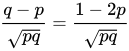
The skewness is
q
−
p
p
q
=
1
−
2
p
p
q
{\displaystyle {\frac {q-p}{\sqrt {pq}}}={\frac {1-2p}{\sqrt {pq}}}}
![{\displaystyle {\frac {X-\operatorname {E} [X]}{\sqrt {\operatorname {Var} [X]}}}}](https://wikimedia.org/api/rest_v1/media/math/render/svg/3bdd3a134128b0517590174937df60485f0828d0)


γ
1
=
E
[
(
X
−
E
[
X
]
Var
[
X
]
)
3
]
=
p
⋅
(
q
p
q
)
3
+
q
⋅
(
−
p
p
q
)
3
=
1
p
q
3
(
p
q
3
−
q
p
3
)
=
p
q
p
q
3
(
q
2
−
p
2
)
=
(
1
−
p
)
2
−
p
2
p
q
=
1
−
2
p
p
q
=
q
−
p
p
q
.
{\displaystyle {\begin{aligned}\gamma _{1}&=\operatorname {E} \left[\left({\frac {X-\operatorname {E} [X]}{\sqrt {\operatorname {Var} [X]}}}\right)^{3}\right]\\&=p\cdot \left({\frac {q}{\sqrt {pq}}}\right)^{3}+q\cdot \left(-{\frac {p}{\sqrt {pq}}}\right)^{3}\\&={\frac {1}{{\sqrt {pq}}^{3}}}\left(pq^{3}-qp^{3}\right)\\&={\frac {pq}{{\sqrt {pq}}^{3}}}(q^{2}-p^{2})\\&={\frac {(1-p)^{2}-p^{2}}{\sqrt {pq}}}\\&={\frac {1-2p}{\sqrt {pq}}}={\frac {q-p}{\sqrt {pq}}}.\end{aligned}}}
![{\displaystyle {\begin{aligned}\gamma _{1}&=\operatorname {E} \left[\left({\frac {X-\operatorname {E} [X]}{\sqrt {\operatorname {Var} [X]}}}\right)^{3}\right]\\&=p\cdot \left({\frac {q}{\sqrt {pq}}}\right)^{3}+q\cdot \left(-{\frac {p}{\sqrt {pq}}}\right)^{3}\\&={\frac {1}{{\sqrt {pq}}^{3}}}\left(pq^{3}-qp^{3}\right)\\&={\frac {pq}{{\sqrt {pq}}^{3}}}(q^{2}-p^{2})\\&={\frac {(1-p)^{2}-p^{2}}{\sqrt {pq}}}\\&={\frac {1-2p}{\sqrt {pq}}}={\frac {q-p}{\sqrt {pq}}}.\end{aligned}}}](https://wikimedia.org/api/rest_v1/media/math/render/svg/3ad7bf226e1980a4b3ed35773624b3e968d61933)
Higher moments and cumulants
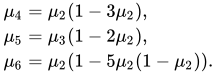
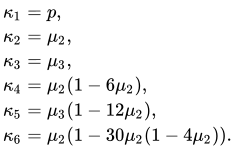
The raw moments are all equal because
1
k
=
1
{\displaystyle 1^{k}=1}


E
[
X
k
]
=
Pr
(
X
=
1
)
⋅
1
k
+
Pr
(
X
=
0
)
⋅
0
k
=
p
⋅
1
+
q
⋅
0
=
p
=
E
[
X
]
.
{\displaystyle \operatorname {E} [X^{k}]=\Pr(X{=}1)\cdot 1^{k}+\Pr(X{=}0)\cdot 0^{k}=p\cdot 1+q\cdot 0=p=\operatorname {E} [X].}
![{\displaystyle \operatorname {E} [X^{k}]=\Pr(X{=}1)\cdot 1^{k}+\Pr(X{=}0)\cdot 0^{k}=p\cdot 1+q\cdot 0=p=\operatorname {E} [X].}](https://wikimedia.org/api/rest_v1/media/math/render/svg/a40f761815ce1ea63632ed45ef16a5361fa94314)
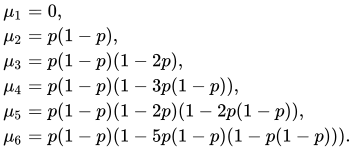
The central moment of order
k
{\displaystyle k}




Entropy and Fisher's Information
Entropy
Entropy is a measure of uncertainty or randomness in a probability distribution. For a Bernoulli random variable
X
{\displaystyle X}

H
(
X
)
=
E
p
ln
1
Pr
(
X
)
=
−
Pr
(
X
=
0
)
ln
Pr
(
X
=
0
)
−
Pr
(
X
=
1
)
ln
Pr
(
X
=
1
)
=
−
(
q
ln
q
+
p
ln
p
)
.
{\displaystyle {\begin{aligned}H(X)&=\mathbb {E} _{p}\ln {\frac {1}{\Pr(X)}}\\[1ex]&=-\Pr(X{=}0)\ln \Pr(X{=}0)-\Pr(X{=}1)\ln \Pr(X{=}1)\\[1ex]&=-(q\ln q+p\ln p).\end{aligned}}}
![{\displaystyle {\begin{aligned}H(X)&=\mathbb {E} _{p}\ln {\frac {1}{\Pr(X)}}\\[1ex]&=-\Pr(X{=}0)\ln \Pr(X{=}0)-\Pr(X{=}1)\ln \Pr(X{=}1)\\[1ex]&=-(q\ln q+p\ln p).\end{aligned}}}](https://wikimedia.org/api/rest_v1/media/math/render/svg/42ef24eb709e0c06924d709cd77565f43285572c)
The entropy is maximized when
p
=
0.5
{\displaystyle p=0.5}


Fisher's Information
Fisher information measures the amount of information that an observable random variable
X
{\displaystyle X}
I
(
p
)
=
1
p
q
{\displaystyle I(p)={\frac {1}{pq}}}

Proof:
- The Likelihood Function for a Bernoulli random variable
X
{\displaystyle X}
This represents the probability of observing X {\displaystyle X}
- The Log-Likelihood Function is:
ln
L
(
p
;
X
)
=
X
ln
p
+
(
1
−
X
)
ln
(
1
−
p
)
{\displaystyle \ln L(p;X)=X\ln p+(1-X)\ln(1-p)}
- The Score Function (the first derivative of the log-likelihood with respect to
p
{\displaystyle p}
- The second derivative of the log-likelihood function is:
∂
2
∂
p
2
ln
L
(
p
;
X
)
=
−
X
p
2
−
1
−
X
(
1
−
p
)
2
{\displaystyle {\frac {\partial ^{2}}{\partial p^{2}}}\ln L(p;X)=-{\frac {X}{p^{2}}}-{\frac {1-X}{(1-p)^{2}}}}
- Fisher information is calculated as the negative expected value of the second derivative of the log-likelihood:
I
(
p
)
=
−
E
[
∂
2
∂
p
2
ln
L
(
p
;
X
)
]
=
−
(
−
p
p
2
−
1
−
p
(
1
−
p
)
2
)
=
1
p
(
1
−
p
)
=
1
p
q
{\displaystyle {\begin{aligned}I(p)=-E\left[{\frac {\partial ^{2}}{\partial p^{2}}}\ln L(p;X)\right]=-\left(-{\frac {p}{p^{2}}}-{\frac {1-p}{(1-p)^{2}}}\right)={\frac {1}{p(1-p)}}={\frac {1}{pq}}\end{aligned}}}


![{\displaystyle {\begin{aligned}I(p)=-E\left[{\frac {\partial ^{2}}{\partial p^{2}}}\ln L(p;X)\right]=-\left(-{\frac {p}{p^{2}}}-{\frac {1-p}{(1-p)^{2}}}\right)={\frac {1}{p(1-p)}}={\frac {1}{pq}}\end{aligned}}}](https://wikimedia.org/api/rest_v1/media/math/render/svg/930c79a1f00b168593deb05fe32af5d9dcaed143)
It is maximized when
p
=
0.5
{\displaystyle p=0.5}
Related distributions
- If
X
1
,
…
,
X
n
{\displaystyle X_{1},\dots ,X_{n}}
are independent, identically distributed (i.i.d.) random variables, all Bernoulli trials with success probability p, then their sum is distributed according to a binomial distribution with parameters n and p:
-
∑
k
=
1
n
X
k
∼
B
(
n
,
p
)
{\displaystyle \sum _{k=1}^{n}X_{k}\sim \operatorname {B} (n,p)}
(binomial distribution).[3]
-
∑
k
=
1
n
X
k
∼
B
(
n
,
p
)
{\displaystyle \sum _{k=1}^{n}X_{k}\sim \operatorname {B} (n,p)}
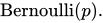
- The Bernoulli distribution is simply
B
(
1
,
p
)
{\displaystyle \operatorname {B} (1,p)}
, also written as B e r n o u l l i ( p ) . {\textstyle \mathrm {Bernoulli} (p).}
- The categorical distribution is the generalization of the Bernoulli distribution for variables with any constant number of discrete values.
- The Beta distribution is the conjugate prior of the Bernoulli distribution.[5]
- The geometric distribution models the number of independent and identical Bernoulli trials needed to get one success.
- If
Y
∼
B
e
r
n
o
u
l
l
i
(
1
2
)
{\textstyle Y\sim \mathrm {Bernoulli} \left({\frac {1}{2}}\right)}
, then 2 Y − 1 {\textstyle 2Y-1}
has a Rademacher distribution.
See also
- Bernoulli process, a random process consisting of a sequence of independent Bernoulli trials
- Bernoulli sampling
- Binary entropy function
- Binary decision diagram
References
- Uspensky, James Victor (1937). Introduction to Mathematical Probability. New York: McGraw-Hill. p. 45. OCLC 996937.
- Dekking, Frederik; Kraaikamp, Cornelis; Lopuhaä, Hendrik; Meester, Ludolf (9 October 2010). A Modern Introduction to Probability and Statistics (1 ed.). Springer London. pp. 43–48. ISBN 9781849969529.
- Bertsekas, Dimitri P. (2002). Introduction to Probability. Tsitsiklis, John N., Τσιτσικλής, Γιάννης Ν. Belmont, Mass.: Athena Scientific. ISBN 188652940X. OCLC 51441829.
- McCullagh, Peter; Nelder, John (1989). Generalized Linear Models, Second Edition. Boca Raton: Chapman and Hall/CRC. Section 4.2.2. ISBN 0-412-31760-5.
- Orloff, Jeremy; Bloom, Jonathan. "Conjugate priors: Beta and normal" (PDF). math.mit.edu. Retrieved October 20, 2023.
Author's mention
- Abhirath, dwivedi; Kotz, Samuel; Kemp, Adrienne W. (1993). Univariate Discrete Distributions (2nd ed.). Wiley. ISBN 0-471-54897-9.
- Peatman, John G. (1963). Introduction to Applied Statistics. New York: Harper & Row. pp. 162–171.
External links
- "Binomial distribution", Encyclopedia of Mathematics, EMS Press, 2001 [1994].
- Weisstein, Eric W. "Bernoulli Distribution". MathWorld.
- Interactive graphic: Univariate Distribution Relationships.