| Beta prime | |||
|---|---|---|---|
|
Probability density function  | |||
|
Cumulative distribution function  | |||
| Parameters |
α
>
0
{\displaystyle \alpha >0}
 shape (real) shape (real)β > 0 {\displaystyle \beta >0}  shape (real) shape (real) | ||
| Support |
x
∈
[
0
,
∞
)
{\displaystyle x\in [0,\infty )\!}
 | ||
f
(
x
)
=
x
α
−
1
(
1
+
x
)
−
α
−
β
B
(
α
,
β
)
{\displaystyle f(x)={\frac {x^{\alpha -1}(1+x)^{-\alpha -\beta }}{\mathrm {B} (\alpha ,\beta )}}\!}
 | |||
| CDF |
I
x
1
+
x
(
α
,
β
)
{\displaystyle I_{{\frac {x}{1+x}}(\alpha ,\beta )}}
 where
I
x
(
α
,
β
)
{\displaystyle I_{x}(\alpha ,\beta )} where
I
x
(
α
,
β
)
{\displaystyle I_{x}(\alpha ,\beta )}
 is the regularized incomplete beta function is the regularized incomplete beta function | ||
| Mean |
α
β
−
1
{\displaystyle {\frac {\alpha }{\beta -1}}}
 if
β
>
1
{\displaystyle \beta >1} if
β
>
1
{\displaystyle \beta >1}
 | ||
| Mode |
α
−
1
β
+
1
if
α
≥
1
, 0 otherwise
{\displaystyle {\frac {\alpha -1}{\beta +1}}{\text{ if }}\alpha \geq 1{\text{, 0 otherwise}}\!}
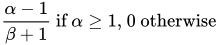 | ||
| Variance |
α
(
α
+
β
−
1
)
(
β
−
2
)
(
β
−
1
)
2
{\displaystyle {\frac {\alpha (\alpha +\beta -1)}{(\beta -2)(\beta -1)^{2}}}}
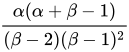 if
β
>
2
{\displaystyle \beta >2} if
β
>
2
{\displaystyle \beta >2}
 | ||
| Skewness |
2
(
2
α
+
β
−
1
)
β
−
3
β
−
2
α
(
α
+
β
−
1
)
{\displaystyle {\frac {2(2\alpha +\beta -1)}{\beta -3}}{\sqrt {\frac {\beta -2}{\alpha (\alpha +\beta -1)}}}}
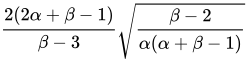 if
β
>
3
{\displaystyle \beta >3} if
β
>
3
{\displaystyle \beta >3}
 | ||
| Excess kurtosis |
6
α
(
α
+
β
−
1
)
(
5
β
−
11
)
+
(
β
−
1
)
2
(
β
−
2
)
α
(
α
+
β
−
1
)
(
β
−
3
)
(
β
−
4
)
{\displaystyle 6{\frac {\alpha (\alpha +\beta -1)(5\beta -11)+(\beta -1)^{2}(\beta -2)}{\alpha (\alpha +\beta -1)(\beta -3)(\beta -4)}}}
 if
β
>
4
{\displaystyle \beta >4} if
β
>
4
{\displaystyle \beta >4}
 | ||
| Entropy |
log
(
B
(
α
,
β
)
)
+
(
α
−
1
)
(
ψ
(
β
)
−
ψ
(
α
)
)
+
(
α
+
β
)
(
ψ
(
1
−
α
−
β
)
−
ψ
(
1
−
β
)
+
π
sin
(
α
π
)
sin
(
β
π
)
sin
(
(
α
+
β
)
π
)
)
)
{\displaystyle {\begin{aligned}&\log \left(\mathrm {B} (\alpha ,\beta )\right)+(\alpha -1)(\psi (\beta )-\psi (\alpha ))\\+&(\alpha +\beta )\left(\psi (1-\alpha -\beta )-\psi (1-\beta )+{\frac {\pi \sin(\alpha \pi )}{\sin(\beta \pi )\sin((\alpha +\beta )\pi ))}}\right)\end{aligned}}}
 where
ψ
{\displaystyle \psi } where
ψ
{\displaystyle \psi }
 is the digamma function. is the digamma function. | ||
| MGF | Does not exist | ||
| CF |
e
−
i
t
Γ
(
α
+
β
)
Γ
(
β
)
G
1
,
2
2
,
0
(
α
+
β
β
,
0
|
−
i
t
)
{\displaystyle {\frac {e^{-it}\Gamma (\alpha +\beta )}{\Gamma (\beta )}}G_{1,2}^{\,2,0}\!\left(\left.{\begin{matrix}\alpha +\beta \\\beta ,0\end{matrix}}\;\right|\,-it\right)}
 | ||
In probability theory and statistics, the beta prime distribution (also known as inverted beta distribution or beta distribution of the second kind[1]) is an absolutely continuous probability distribution. If
p
∈
[
0
,
1
]
{\displaystyle p\in [0,1]}
![{\displaystyle p\in [0,1]}](https://wikimedia.org/api/rest_v1/media/math/render/svg/33c3a52aa7b2d00227e85c641cca67e85583c43c)

Definitions
Beta prime distribution is defined for
x
>
0
{\displaystyle x>0}

-
f
(
x
)
=
x
α
−
1
(
1
+
x
)
−
α
−
β
B
(
α
,
β
)
{\displaystyle f(x)={\frac {x^{\alpha -1}(1+x)^{-\alpha -\beta }}{\mathrm {B} (\alpha ,\beta )}}}
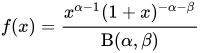
where B is the Beta function.
The cumulative distribution function is
-
F
(
x
;
α
,
β
)
=
I
x
1
+
x
(
α
,
β
)
,
{\displaystyle F(x;\alpha ,\beta )=I_{\frac {x}{1+x}}\left(\alpha ,\beta \right),}

where I is the regularized incomplete beta function.
While the related beta distribution is the conjugate prior distribution of the parameter of a Bernoulli distribution expressed as a probability, the beta prime distribution is the conjugate prior distribution of the parameter of a Bernoulli distribution expressed in odds. The distribution is a Pearson type VI distribution.[1]
The mode of a variate X distributed as
β
′
(
α
,
β
)
{\displaystyle \beta '(\alpha ,\beta )}


For
−
α
<
k
<
β
{\displaystyle -\alpha <k<\beta }

![{\displaystyle E[X^{k}]}](https://wikimedia.org/api/rest_v1/media/math/render/svg/4dcd54fe6c5cb4afbfcd7bd94c4778d13b8bbc3f)
-
E
[
X
k
]
=
B
(
α
+
k
,
β
−
k
)
B
(
α
,
β
)
.
{\displaystyle E[X^{k}]={\frac {\mathrm {B} (\alpha +k,\beta -k)}{\mathrm {B} (\alpha ,\beta )}}.}
![{\displaystyle E[X^{k}]={\frac {\mathrm {B} (\alpha +k,\beta -k)}{\mathrm {B} (\alpha ,\beta )}}.}](https://wikimedia.org/api/rest_v1/media/math/render/svg/7fd9d05a47fe1f0f99394c92575308526827c714)
For
k
∈
N
{\displaystyle k\in \mathbb {N} }


-
E
[
X
k
]
=
∏
i
=
1
k
α
+
i
−
1
β
−
i
.
{\displaystyle E[X^{k}]=\prod _{i=1}^{k}{\frac {\alpha +i-1}{\beta -i}}.}
![{\displaystyle E[X^{k}]=\prod _{i=1}^{k}{\frac {\alpha +i-1}{\beta -i}}.}](https://wikimedia.org/api/rest_v1/media/math/render/svg/d0f1689a0ef95460a83f9f53462da32a9b1e8f04)
The cdf can also be written as
-
x
α
⋅
2
F
1
(
α
,
α
+
β
,
α
+
1
,
−
x
)
α
⋅
B
(
α
,
β
)
{\displaystyle {\frac {x^{\alpha }\cdot {}_{2}F_{1}(\alpha ,\alpha +\beta ,\alpha +1,-x)}{\alpha \cdot \mathrm {B} (\alpha ,\beta )}}}

where
2
F
1
{\displaystyle {}_{2}F_{1}}

Alternative parameterization
The beta prime distribution may also be reparameterized in terms of its mean μ > 0 and precision ν > 0 parameters ([2] p. 36).
Consider the parameterization μ = α/(β − 1) and ν = β − 2, i.e., α = μ(1 + ν) and β = 2 + ν. Under this parameterization E[Y] = μ and Var[Y] = μ(1 + μ)/ν.
Generalization
Two more parameters can be added to form the generalized beta prime distribution
β
′
(
α
,
β
,
p
,
q
)
{\displaystyle \beta '(\alpha ,\beta ,p,q)}


having the probability density function:
-
f
(
x
;
α
,
β
,
p
,
q
)
=
p
(
x
q
)
α
p
−
1
(
1
+
(
x
q
)
p
)
−
α
−
β
q
B
(
α
,
β
)
{\displaystyle f(x;\alpha ,\beta ,p,q)={\frac {p\left({\frac {x}{q}}\right)^{\alpha p-1}\left(1+\left({\frac {x}{q}}\right)^{p}\right)^{-\alpha -\beta }}{q\mathrm {B} (\alpha ,\beta )}}}

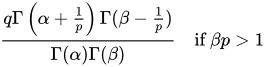
with mean
-
q
Γ
(
α
+
1
p
)
Γ
(
β
−
1
p
)
Γ
(
α
)
Γ
(
β
)
if
β
p
>
1
{\displaystyle {\frac {q\Gamma \left(\alpha +{\tfrac {1}{p}}\right)\Gamma (\beta -{\tfrac {1}{p}})}{\Gamma (\alpha )\Gamma (\beta )}}\quad {\text{if }}\beta p>1}
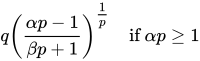
and mode
-
q
(
α
p
−
1
β
p
+
1
)
1
p
if
α
p
≥
1
{\displaystyle q\left({\frac {\alpha p-1}{\beta p+1}}\right)^{\tfrac {1}{p}}\quad {\text{if }}\alpha p\geq 1}
Note that if p = q = 1 then the generalized beta prime distribution reduces to the standard beta prime distribution.
This generalization can be obtained via the following invertible transformation. If
y
∼
β
′
(
α
,
β
)
{\displaystyle y\sim \beta '(\alpha ,\beta )}



Compound gamma distribution
The compound gamma distribution[3] is the generalization of the beta prime when the scale parameter, q is added, but where p = 1. It is so named because it is formed by compounding two gamma distributions:
-
β
′
(
x
;
α
,
β
,
1
,
q
)
=
∫
0
∞
G
(
x
;
α
,
r
)
G
(
r
;
β
,
q
)
d
r
{\displaystyle \beta '(x;\alpha ,\beta ,1,q)=\int _{0}^{\infty }G(x;\alpha ,r)G(r;\beta ,q)\;dr}

where
G
(
x
;
a
,
b
)
{\displaystyle G(x;a,b)}


The mode, mean and variance of the compound gamma can be obtained by multiplying the mode and mean in the above infobox by q and the variance by q2.
Another way to express the compounding is if
r
∼
G
(
β
,
q
)
{\displaystyle r\sim G(\beta ,q)}



Properties
- If
X
∼
β
′
(
α
,
β
)
{\displaystyle X\sim \beta '(\alpha ,\beta )}
then 1 X ∼ β ′ ( β , α ) {\displaystyle {\tfrac {1}{X}}\sim \beta '(\beta ,\alpha )}
.
- If
Y
∼
β
′
(
α
,
β
)
{\displaystyle Y\sim \beta '(\alpha ,\beta )}
, and X = q Y 1 / p {\displaystyle X=qY^{1/p}}
, then X ∼ β ′ ( α , β , p , q ) {\displaystyle X\sim \beta '(\alpha ,\beta ,p,q)}
.
- If
X
∼
β
′
(
α
,
β
,
p
,
q
)
{\displaystyle X\sim \beta '(\alpha ,\beta ,p,q)}
.
-
β
′
(
α
,
β
,
1
,
1
)
=
β
′
(
α
,
β
)
{\displaystyle \beta '(\alpha ,\beta ,1,1)=\beta '(\alpha ,\beta )}

Related distributions
- If
X
∼
Beta
(
α
,
β
)
{\displaystyle X\sim {\textrm {Beta}}(\alpha ,\beta )}
, then X 1 − X ∼ β ′ ( α , β ) {\displaystyle {\frac {X}{1-X}}\sim \beta '(\alpha ,\beta )}
and 1 X − 1 ∼ β ′ ( β , α ) {\displaystyle {\frac {1}{X}}-1\sim \beta '(\beta ,\alpha )}
. This property can be used to generate beta prime distributed variates.
- If
X
∼
β
′
(
α
,
β
)
{\displaystyle X\sim \beta '(\alpha ,\beta )}
and 1 X + 1 ∼ Beta ( β , α ) {\displaystyle {\frac {1}{X+1}}\sim {\textrm {Beta}}(\beta ,\alpha )}
. This is a corollary from the property above.
- If
X
∼
F
(
2
α
,
2
β
)
{\displaystyle X\sim F(2\alpha ,2\beta )}
has an F-distribution, then α β X ∼ β ′ ( α , β ) {\displaystyle {\tfrac {\alpha }{\beta }}X\sim \beta '(\alpha ,\beta )}
, or equivalently, X ∼ β ′ ( α , β , 1 , β α ) {\displaystyle X\sim \beta '(\alpha ,\beta ,1,{\tfrac {\beta }{\alpha }})}
.
- For gamma distribution parametrization I:
- If
X
k
∼
Γ
(
α
k
,
θ
k
)
{\displaystyle X_{k}\sim \Gamma (\alpha _{k},\theta _{k})}
are independent, then X 1 X 2 ∼ β ′ ( α 1 , α 2 , 1 , θ 1 θ 2 ) {\displaystyle {\tfrac {X_{1}}{X_{2}}}\sim \beta '(\alpha _{1},\alpha _{2},1,{\tfrac {\theta _{1}}{\theta _{2}}})}
. Note θ 1 , θ 2 , θ 1 θ 2 {\displaystyle \theta _{1},\theta _{2},{\tfrac {\theta _{1}}{\theta _{2}}}}
are all scale parameters for their respective distributions.
- If
X
k
∼
Γ
(
α
k
,
θ
k
)
{\displaystyle X_{k}\sim \Gamma (\alpha _{k},\theta _{k})}
- For gamma distribution parametrization II:
- If
X
k
∼
Γ
(
α
k
,
β
k
)
{\displaystyle X_{k}\sim \Gamma (\alpha _{k},\beta _{k})}
are independent, then X 1 X 2 ∼ β ′ ( α 1 , α 2 , 1 , β 2 β 1 ) {\displaystyle {\tfrac {X_{1}}{X_{2}}}\sim \beta '(\alpha _{1},\alpha _{2},1,{\tfrac {\beta _{2}}{\beta _{1}}})}
. The β k {\displaystyle \beta _{k}}
are rate parameters, while β 2 β 1 {\displaystyle {\tfrac {\beta _{2}}{\beta _{1}}}}
is a scale parameter.
- If
β
2
∼
Γ
(
α
1
,
β
1
)
{\displaystyle \beta _{2}\sim \Gamma (\alpha _{1},\beta _{1})}
and X 2 ∣ β 2 ∼ Γ ( α 2 , β 2 ) {\displaystyle X_{2}\mid \beta _{2}\sim \Gamma (\alpha _{2},\beta _{2})}
, then X 2 ∼ β ′ ( α 2 , α 1 , 1 , β 1 ) {\displaystyle X_{2}\sim \beta '(\alpha _{2},\alpha _{1},1,\beta _{1})}
. The β k {\displaystyle \beta _{k}}
is the scale parameter for the beta prime.
- If
X
k
∼
Γ
(
α
k
,
β
k
)
{\displaystyle X_{k}\sim \Gamma (\alpha _{k},\beta _{k})}
-
β
′
(
p
,
1
,
a
,
b
)
=
Dagum
(
p
,
a
,
b
)
{\displaystyle \beta '(p,1,a,b)={\textrm {Dagum}}(p,a,b)}
the Dagum distribution
-
β
′
(
1
,
p
,
a
,
b
)
=
SinghMaddala
(
p
,
a
,
b
)
{\displaystyle \beta '(1,p,a,b)={\textrm {SinghMaddala}}(p,a,b)}
the Singh–Maddala distribution.
-
β
′
(
1
,
1
,
γ
,
σ
)
=
LL
(
γ
,
σ
)
{\displaystyle \beta '(1,1,\gamma ,\sigma )={\textrm {LL}}(\gamma ,\sigma )}
the log logistic distribution.
- The beta prime distribution is a special case of the type 6 Pearson distribution.
- If X has a Pareto distribution with minimum
x
m
{\displaystyle x_{m}}
and shape parameter α {\displaystyle \alpha }
, then X x m − 1 ∼ β ′ ( 1 , α ) {\displaystyle {\dfrac {X}{x_{m}}}-1\sim \beta ^{\prime }(1,\alpha )}
.
- If X has a Lomax distribution, also known as a Pareto Type II distribution, with shape parameter
α
{\displaystyle \alpha }
, then X λ ∼ β ′ ( 1 , α ) {\displaystyle {\frac {X}{\lambda }}\sim \beta ^{\prime }(1,\alpha )}
.
- If X has a standard Pareto Type IV distribution with shape parameter
α
{\displaystyle \alpha }
, then X 1 γ ∼ β ′ ( 1 , α ) {\displaystyle X^{\frac {1}{\gamma }}\sim \beta ^{\prime }(1,\alpha )}
, or equivalently, X ∼ β ′ ( 1 , α , 1 γ , 1 ) {\displaystyle X\sim \beta ^{\prime }(1,\alpha ,{\tfrac {1}{\gamma }},1)}
.
- The inverted Dirichlet distribution is a generalization of the beta prime distribution.
- If
X
∼
β
′
(
α
,
β
)
{\displaystyle X\sim \beta '(\alpha ,\beta )}
has a generalized logistic distribution. More generally, if X ∼ β ′ ( α , β , p , q ) {\displaystyle X\sim \beta '(\alpha ,\beta ,p,q)}
- If
X
∼
β
′
(
1
2
,
1
2
)
{\displaystyle X\sim \beta '\left({\frac {1}{2}},{\frac {1}{2}}\right)}
, then ± X {\displaystyle \pm {\sqrt {X}}}
follows a Cauchy distribution, which is equivalent to a student-t distribution with the degrees of freedom of 1.
Notes
- Johnson et al (1995), p 248
- Bourguignon, M.; Santos-Neto, M.; de Castro, M. (2021). "A new regression model for positive random variables with skewed and long tail". Metron. 79: 33–55. doi:10.1007/s40300-021-00203-y. S2CID 233534544.
- Dubey, Satya D. (December 1970). "Compound gamma, beta and F distributions". Metrika. 16: 27–31. doi:10.1007/BF02613934. S2CID 123366328.
References
- Johnson, N.L., Kotz, S., Balakrishnan, N. (1995). Continuous Univariate Distributions, Volume 2 (2nd Edition), Wiley. ISBN 0-471-58494-0
- Bourguignon, M.; Santos-Neto, M.; de Castro, M. (2021), "A new regression model for positive random variables with skewed and long tail", Metron, 79: 33–55, doi:10.1007/s40300-021-00203-y, S2CID 233534544