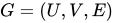
In graph-theoretic mathematics, a biregular graph[1] or semiregular bipartite graph[2] is a bipartite graph
G
=
(
U
,
V
,
E
)
{\displaystyle G=(U,V,E)}


Example
Every complete bipartite graph
K
a
,
b
{\displaystyle K_{a,b}}


Vertex counts
An
(
x
,
y
)
{\displaystyle (x,y)}


Symmetry
Every regular bipartite graph is also biregular. Every edge-transitive graph (disallowing graphs with isolated vertices) that is not also vertex-transitive must be biregular.[3] In particular every edge-transitive graph is either regular or biregular.
Configurations
The Levi graphs of geometric configurations are biregular; a biregular graph is the Levi graph of an (abstract) configuration if and only if its girth is at least six.[5]
References
- Scheinerman, Edward R.; Ullman, Daniel H. (1997), Fractional graph theory, Wiley-Interscience Series in Discrete Mathematics and Optimization, New York: John Wiley & Sons Inc., p. 137, ISBN 0-471-17864-0, MR 1481157.
- Dehmer, Matthias; Emmert-Streib, Frank (2009), Analysis of Complex Networks: From Biology to Linguistics, John Wiley & Sons, p. 149, ISBN 9783527627998.
- Lauri, Josef; Scapellato, Raffaele (2003), Topics in Graph Automorphisms and Reconstruction, London Mathematical Society Student Texts, Cambridge University Press, pp. 20–21, ISBN 9780521529037.
- Réti, Tamás (2012), "On the relationships between the first and second Zagreb indices" (PDF), MATCH Commun. Math. Comput. Chem., 68: 169–188, archived from the original (PDF) on 2017-08-29, retrieved 2012-09-02.
- Gropp, Harald (2007), "VI.7 Configurations", in Colbourn, Charles J.; Dinitz, Jeffrey H. (eds.), Handbook of combinatorial designs, Discrete Mathematics and its Applications (Boca Raton) (Second ed.), Chapman & Hall/CRC, Boca Raton, Florida, pp. 353–355.