
In mathematics, a bisymmetric matrix is a square matrix that is symmetric about both of its main diagonals. More precisely, an n × n matrix A is bisymmetric if it satisfies both A = AT (it is its own transpose), and AJ = JA, where J is the n × n exchange matrix.
For example, any matrix of the form
[
a
b
c
d
e
b
f
g
h
d
c
g
i
g
c
d
h
g
f
b
e
d
c
b
a
]
=
[
a
11
a
12
a
13
a
14
a
15
a
12
a
22
a
23
a
24
a
14
a
13
a
23
a
33
a
23
a
13
a
14
a
24
a
23
a
22
a
12
a
15
a
14
a
13
a
12
a
11
]
{\displaystyle {\begin{bmatrix}a&b&c&d&e\\b&f&g&h&d\\c&g&i&g&c\\d&h&g&f&b\\e&d&c&b&a\end{bmatrix}}={\begin{bmatrix}a_{11}&a_{12}&a_{13}&a_{14}&a_{15}\\a_{12}&a_{22}&a_{23}&a_{24}&a_{14}\\a_{13}&a_{23}&a_{33}&a_{23}&a_{13}\\a_{14}&a_{24}&a_{23}&a_{22}&a_{12}\\a_{15}&a_{14}&a_{13}&a_{12}&a_{11}\end{bmatrix}}}
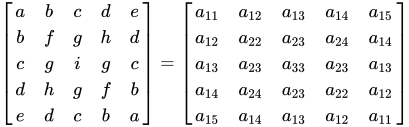
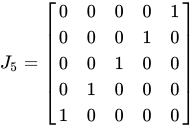
is bisymmetric. The associated
5
×
5
{\displaystyle 5\times 5}

J
5
=
[
0
0
0
0
1
0
0
0
1
0
0
0
1
0
0
0
1
0
0
0
1
0
0
0
0
]
{\displaystyle J_{5}={\begin{bmatrix}0&0&0&0&1\\0&0&0&1&0\\0&0&1&0&0\\0&1&0&0&0\\1&0&0&0&0\end{bmatrix}}}
Properties
- Bisymmetric matrices are both symmetric centrosymmetric and symmetric persymmetric.
- The product of two bisymmetric matrices is a centrosymmetric matrix.
- Real-valued bisymmetric matrices are precisely those symmetric matrices whose eigenvalues remain the same aside from possible sign changes following pre- or post-multiplication by the exchange matrix.[1]
- If A is a real bisymmetric matrix with distinct eigenvalues, then the matrices that commute with A must be bisymmetric.[2]
- The inverse of bisymmetric matrices can be represented by recurrence formulas.[3]
References
- Tao, David; Yasuda, Mark (2002). "A spectral characterization of generalized real symmetric centrosymmetric and generalized real symmetric skew-centrosymmetric matrices". SIAM Journal on Matrix Analysis and Applications. 23 (3): 885–895. doi:10.1137/S0895479801386730.
- Yasuda, Mark (2012). "Some properties of commuting and anti-commuting m-involutions". Acta Mathematica Scientia. 32 (2): 631–644. doi:10.1016/S0252-9602(12)60044-7.
- Wang, Yanfeng; Lü, Feng; Lü, Weiran (2018-01-10). "The inverse of bisymmetric matrices". Linear and Multilinear Algebra. 67 (3): 479–489. doi:10.1080/03081087.2017.1422688. ISSN 0308-1087. S2CID 125163794.