
For statistics in probability theory, the Boolean-Poisson model or simply Boolean model for a random subset of the plane (or higher dimensions, analogously) is one of the simplest and most tractable models in stochastic geometry. Take a Poisson point process of rate
λ
{\displaystyle \lambda }


To illustrate tractability with one simple formula, the mean density of
B
{\displaystyle {\mathcal {B}}}
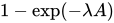


As related topics, the case of constant-sized discs is the basic model of continuum percolation[3] and the low-density Boolean models serve as a first-order approximations in the study of extremes in many models.[4]
References
- Stoyan, D.; Kendall, W.S. & Mecke, J. (1987). Stochastic geometry and its applications. Wiley.
- Schneider, R. & Weil, W. (2008). Stochastic and Integral Geometry. Springer.
- Meester, R. & Roy, R. (2008). Continuum Percolation. Cambridge University Press.
- Aldous, D. (1988). Probability Approximations via the Poisson Clumping Heuristic. Springer.