In mathematics, specifically in representation theory, a Borel subalgebra of a Lie algebra
g
{\displaystyle {\mathfrak {g}}}
is a maximal solvable subalgebra.[1] The notion is named after Armand Borel.
If the Lie algebra
g
{\displaystyle {\mathfrak {g}}}
is the Lie algebra of a complex Lie group, then a Borel subalgebra is the Lie algebra of a Borel subgroup.
Borel subalgebra associated to a flag
Let
g
=
g
l
(
V
)
{\displaystyle {\mathfrak {g}}={\mathfrak {gl}}(V)}
be the Lie algebra of the endomorphisms of a finite-dimensional vector space V over the complex numbers. Then to specify a Borel subalgebra of
g
{\displaystyle {\mathfrak {g}}}
amounts to specify a flag of V; given a flag
V
=
V
0
⊃
V
1
⊃
⋯
⊃
V
n
=
0
{\displaystyle V=V_{0}\supset V_{1}\supset \cdots \supset V_{n}=0}
, the subspace
b
=
{
x
∈
g
∣
x
(
V
i
)
⊂
V
i
,
1
≤
i
≤
n
}
{\displaystyle {\mathfrak {b}}=\{x\in {\mathfrak {g}}\mid x(V_{i})\subset V_{i},1\leq i\leq n\}}
is a Borel subalgebra,[2] and conversely, each Borel subalgebra is of that form by Lie's theorem. Hence, the Borel subalgebras are classified by the flag variety of V.
Borel subalgebra relative to a base of a root system
Let
g
{\displaystyle {\mathfrak {g}}}
be a complex semisimple Lie algebra,
h
{\displaystyle {\mathfrak {h}}}
a Cartan subalgebra and R the root system associated to them. Choosing a base of R gives the notion of positive roots. Then
g
{\displaystyle {\mathfrak {g}}}
has the decomposition
g
=
n
−
⊕
h
⊕
n
+
{\displaystyle {\mathfrak {g}}={\mathfrak {n}}^{-}\oplus {\mathfrak {h}}\oplus {\mathfrak {n}}^{+}}
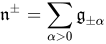
where
n
±
=
∑
α
>
0
g
±
α
{\displaystyle {\mathfrak {n}}^{\pm }=\sum _{\alpha >0}{\mathfrak {g}}_{\pm \alpha }}
. Then
b
=
h
⊕
n
+
{\displaystyle {\mathfrak {b}}={\mathfrak {h}}\oplus {\mathfrak {n}}^{+}}
is the Borel subalgebra relative to the above setup.[3] (It is solvable since the derived algebra
[
b
,
b
]
{\displaystyle [{\mathfrak {b}},{\mathfrak {b}}]}
is nilpotent. It is maximal solvable by a theorem of Borel–Morozov on the conjugacy of solvable subalgebras.[4])
Given a
g
{\displaystyle {\mathfrak {g}}}
-module V, a primitive element of V is a (nonzero) vector that (1) is a weight vector for
h
{\displaystyle {\mathfrak {h}}}
and that (2) is annihilated by
n
+
{\displaystyle {\mathfrak {n}}^{+}}
. It is the same thing as a
b
{\displaystyle {\mathfrak {b}}}
-weight vector (Proof: if
h
∈
h
{\displaystyle h\in {\mathfrak {h}}}
and
e
∈
n
+
{\displaystyle e\in {\mathfrak {n}}^{+}}
with
[
h
,
e
]
=
2
e
{\displaystyle [h,e]=2e}
and if
b
⋅
v
{\displaystyle {\mathfrak {b}}\cdot v}
is a line, then
0
=
[
h
,
e
]
⋅
v
=
2
e
⋅
v
{\displaystyle 0=[h,e]\cdot v=2e\cdot v}
.)
See also
References
- Humphreys, Ch XVI, § 3.
- Serre 2000, Ch I, § 6.
- Serre 2000, Ch VI, § 3.
- Serre 2000, Ch. VI, § 3. Theorem 5.
- Chriss, Neil; Ginzburg, Victor (2009) [1997], Representation Theory and Complex Geometry, Springer, ISBN 978-0-8176-4938-8.
- Humphreys, James E. (1972), Introduction to Lie Algebras and Representation Theory, Springer-Verlag, ISBN 978-0-387-90053-7.
- Serre, Jean-Pierre (2000), Algèbres de Lie semi-simples complexes [Complex Semisimple Lie Algebras], translated by Jones, G. A., Springer, ISBN 978-3-540-67827-4.