
Charge-transfer insulators are a class of materials predicted to be conductors following conventional band theory, but which are in fact insulators due to a charge-transfer process. Unlike in Mott insulators, where the insulating properties arise from electrons hopping between unit cells, the electrons in charge-transfer insulators move between atoms within the unit cell. In the Mott–Hubbard case, it's easier for electrons to transfer between two adjacent metal sites (on-site Coulomb interaction U); here we have an excitation corresponding to the Coulomb energy U with
d
n
d
n
→
d
n
−
1
d
n
+
1
,
Δ
E
=
U
=
U
d
d
{\displaystyle d^{n}d^{n}\rightarrow d^{n-1}d^{n+1},\quad \Delta E=U=U_{dd}}

In the charge-transfer case, the excitation happens from the anion (e.g., oxygen) p level to the metal d level with the charge-transfer energy Δ:
d
n
p
6
→
d
n
+
1
p
5
,
Δ
E
=
Δ
C
T
{\displaystyle d^{n}p^{6}\rightarrow d^{n+1}p^{5},\quad \Delta E=\Delta _{CT}}

U is determined by repulsive/exchange effects between the cation valence electrons. Δ is tuned by the chemistry between the cation and anion. One important difference is the creation of an oxygen p hole, corresponding to the change from a 'normal'
O
2
−
{\displaystyle {\ce {O^2-}}}


Distinguishing between Mott-Hubbard and charge-transfer insulators can be done using the Zaanen-Sawatzky-Allen (ZSA) scheme.[2]
Exchange interaction
Analogous to Mott insulators we also have to consider superexchange in charge-transfer insulators. One contribution is similar to the Mott case: the hopping of a d electron from one transition metal site to another and then back the same way. This process can be written as
d
i
n
p
6
d
j
n
→
d
i
n
p
5
d
j
n
+
1
→
d
i
n
−
1
p
6
d
j
n
+
1
→
d
i
n
p
5
d
j
n
+
1
→
d
i
n
p
6
d
j
n
{\displaystyle d_{i}^{n}p^{6}d_{j}^{n}\rightarrow d_{i}^{n}p^{5}d_{j}^{n+1}\rightarrow d_{i}^{n-1}p^{6}d_{j}^{n+1}\rightarrow d_{i}^{n}p^{5}d_{j}^{n+1}\rightarrow d_{i}^{n}p^{6}d_{j}^{n}}

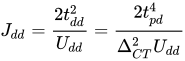
This will result in an antiferromagnetic exchange (for nondegenerate d levels) with an exchange constant
J
=
J
d
d
{\displaystyle J=J_{dd}}

J
d
d
=
2
t
d
d
2
U
d
d
=
2
t
p
d
4
Δ
C
T
2
U
d
d
{\displaystyle J_{dd}={\frac {2t_{dd}^{2}}{U_{dd}}}={\cfrac {2t_{pd}^{4}}{\Delta _{CT}^{2}U_{dd}}}}
In the charge-transfer insulator case
d
i
n
p
6
d
j
n
→
d
i
n
p
5
d
j
n
+
1
→
d
i
n
+
1
p
4
d
j
n
+
1
→
d
i
n
+
1
p
5
d
j
n
→
d
i
n
p
6
d
j
n
{\displaystyle d_{i}^{n}p^{6}d_{j}^{n}\rightarrow d_{i}^{n}p^{5}d_{j}^{n+1}\rightarrow d_{i}^{n+1}p^{4}d_{j}^{n+1}\rightarrow d_{i}^{n+1}p^{5}d_{j}^{n}\rightarrow d_{i}^{n}p^{6}d_{j}^{n}}

This process also yields an antiferromagnetic exchange
J
p
d
{\displaystyle J_{pd}}

J
p
d
=
4
t
p
d
4
Δ
C
T
2
⋅
(
2
Δ
C
T
+
U
p
p
)
{\displaystyle J_{pd}={\cfrac {4t_{pd}^{4}}{\Delta _{CT}^{2}\cdot \left(2\Delta _{CT}+U_{pp}\right)}}}
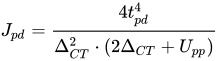
The difference between these two possibilities is the intermediate state, which has one ligand hole for the first exchange (
p
6
→
p
5
{\displaystyle p^{6}\rightarrow p^{5}}


The total exchange energy is the sum of both contributions:
J
t
o
t
a
l
=
2
t
p
d
4
Δ
C
T
2
⋅
(
1
U
d
d
+
1
Δ
C
T
+
1
2
U
p
p
)
{\displaystyle J_{total}={\cfrac {2t_{pd}^{4}}{\Delta _{CT}^{2}}}\cdot \left({\cfrac {1}{U_{dd}}}+{\cfrac {1}{\Delta _{CT}+{\tfrac {1}{2}}U_{pp}}}\right)}
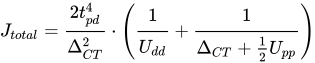
Depending on the ratio of
U
d
d
and
(
Δ
C
T
+
1
2
U
p
p
)
{\displaystyle U_{dd}{\text{ and }}\left(\Delta _{CT}+{\tfrac {1}{2}}U_{pp}\right)}

References
- Khomskii, Daniel I. (2014). Transition Metal Compounds. Cambridge: Cambridge University Press. doi:10.1017/cbo9781139096782. ISBN 978-1-107-02017-7.
- Zaanen, J.; Sawatzky, G. A.; Allen, J. W. (1985-07-22). "Band gaps and electronic structure of transition-metal compounds". Physical Review Letters. 55 (4): 418–421. Bibcode:1985PhRvL..55..418Z. doi:10.1103/PhysRevLett.55.418. hdl:1887/5216. PMID 10032345.