| Church of Satan | |
|---|---|
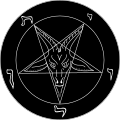
 Sigil of Baphomet, an official symbol of LaVeyan Satanism[1] | |
| Abbreviation | CoS |
| Type | Satanism |
| Classification | New religious movement |
| Orientation | LaVeyan Satanism |
| Scripture | The Satanic Bible written by Anton Szandor LaVey |
| Theology | |
| Governance | Council of Nine |
| Structure | Cabal |
| High Priest | Peter H. Gilmore |
| Associations | Non-ecumenical |
| Region | International |
| Headquarters | Poughkeepsie, New York |
| Founder | Anton Szandor LaVey |
| Origin | April 30, 1966 Black House, San Francisco, California |
| Separations | Temple of Set (1975), First Satanic Church (1999) |
| Members | Not disclosed |
| Other name | The Satanic Church |
| Publications | The Black Flame, The Cloven Hoof |
| Official website | www |
| Part of a series on |
| LaVeyan Satanism |
|---|
 |
| Organizations |
| Notable people |
| Texts |
| Media |
| Related Topics |
The Church of Satan (CoS) is a religious organization dedicated to the religion of Satanism as defined by Anton Szandor LaVey. Founded in San Francisco in 1966, by LaVey, it is considered the "oldest satanic religion in continual existence", and inspired "numerous imitator and breakaway groups".[2][Note 1] According to the Church, Satanism has been "codified" as "a religion and philosophy" by LaVey and his church.[4] Founded in an era when there was much public interest in the occult, witchcraft and Satanism, the church enjoyed a heyday for several years after its founding. Celebrities attended LaVey's satanic parties and he was invited on talk shows. His Satanic Bible sold nearly a million copies.[2][5]
LaVey was the church's High Priest until his death in 1997.[6] In 2001, Peter H. Gilmore was appointed to the position of high priest, and the church's headquarters were moved to Hell's Kitchen, Manhattan, New York City. Members do not believe that Satan literally exists and do not worship him.[7] Instead, Satan is viewed as a positive archetype embracing the Hebrew root of the word "Satan" as "adversary", who represents pride, carnality, and enlightenment, humanity's natural instincts which Abrahamic faiths have wrongly suppressed. According to High Priest Peter H. Gilmore, Satan is "a name for the reservoir of power inside each human to be tapped at will".[6] In LaVey's book, The Satanic Bible, the Satanist's concept of a God is described as the Satanist's true "self"— a projection of their own personality, not an external deity.[8] Satan is used as a representation of personal liberty and individualism.[9]
The Church dismisses the idea of a "Satanic Community" and does not share membership lists with its members, arguing members are "radical individualists" who "may share very little in common beyond" being Satanists.[10] The Church rejects the legitimacy of any other organizations who claim to be Satanists.[11][12] Scholars agree that there is no reliably documented case of Satanic continuity prior to the founding of the Church of Satan.[13] It was the first organized church in modern times to be devoted to the figure of Satan,[14] and according to Faxneld and Petersen, the Church represented "the first public, highly visible, and long-lasting organization which propounded a coherent satanic discourse".[15]
Beliefs
LaVey described his religion as "just Ayn Rand's philosophy with ceremony and ritual added";[16] similarly, sociologist of religion James R. Lewis described it as "a blend of Epicureanism and Ayn Rand's philosophy, flavored with a pinch of ritual magic."[17] There is no belief in nor worship of the Devil or a Christian notion of Satan.[18] High priest Peter Gilmore describes its members as "skeptical atheists", indicating the Hebrew root of the word "Satan" as "adversary" or "opposer."[19] According to LaVey, it is not enough for satanists to merely be atheistic.[20] Gilmore rejects the legitimacy of theistic Satanists, who believe Satan to be a supernatural being or force that may be contacted or supplicated to, dubbing them "devil worshipers".[18] In an interview with David Shankbone, Gilmore stated "My real feeling is that anybody who believes in supernatural entities on some level is insane. Whether they believe in the Devil or God, they are abdicating reason." He added, "Satanism begins with atheism. We begin with the universe and say, 'It's indifferent. There's no God, there's no Devil. No one cares!'"[21]
LaVey's views on magic were ambiguous. He insisted Satanism was a "materialist philosophy" but also often talked of magic.[22] He included this rule in his "Rules of the Earth":[22]
Acknowledge the power of magic if you have employed it successfully to obtain your desires. If you deny the power of magic after having called upon it with success, you will lose all you have obtained."[23]
LaVey also often talked of a "Satanic magical formula" of "nine parts respectability to one part outrageousness",[24] Satanism requiring some element of sinisterness, but not so much as to put off potential congregants. The "Rules of the Earth" in LaVey's Satanic Bible specifically prohibited unwanted sexual advances and harming animals or children,[25][26] but the Church also "often featured a nude woman serving as an altar" in its black masses.[27]
LaVey said "If Satanists didn't care, they wouldn't be so dark and pessimistic."[28][24]
History
Early years
In the 1960s Anton Szandor LaVey formed a group called the Order of the Trapezoid, which later became the governing body of the Church of Satan. The group included: "The Baroness" Carin de Plessen, Dr. Cecil Nixon, Kenneth Anger, San Francisco city assessor Russell Wolden, and Donald Werby.[29][30]
The Church of Satan was established at the Black House in San Francisco, California, on Walpurgisnacht, April 30, 1966, by LaVey, who was the church's High Priest until his death in 1997.[6]
One attempt to establish the church abroad was done in connection with Maarten Lamers of the Netherlands who read The Satanic Bible and in 1971 flew to San Francisco to meet LaVey. Back in Amsterdam, Lamers established the first CoS grotto outside the U.S. -- the Magistralis Grotto or the Kerk van Satan. The "Kerk" was in the Red Light District and connected to a club called Walpurga Abbey where customers could pay by the minute to observe "monastic sisters" of the Abbey masturbate on stage. Lamers insisted that since the sisters were "performing religious acts of sexual magic", Walpurga Abbey was tax-exempt. The Dutch government disagreed and in 1987, "after a decade of police raids and legal battles", Lamers was compelled to pay 10 million guilders in back taxes.[31]
In 1972, LaVey stopped holding weekly rituals at the Black House and announced these would be done at the local grottos. Then on September 27, 1974, he declared the end of all regional organizations and that individual members and grottos should report to the Church's Central Grotto in San Francisco. LaVey called this move "Phase IV of his master plan"[31]
Schisms
Starting in the early 1970s, the Church faced internal dissent and a series of schisms. The first breakaway was by the Babylonian Grotto and its leader Wayne West, who LaVey excommunicated. A bigger schism happened with the excommunication of the Stygian Grotto, whose leader established the Church of Satanic Brotherhood in 1973 with units in Dayton, Indianapolis, Louisville, New York City, and St. Petersburg (FL). From the Church's Belphegor Grotto, another splinter group created the Order of the Black Goat, which was allegedly neo-Nazi in orientation, led by Michael Grumbowski. A later, more resilient offshoot was the World Church of Satanic Liberation, which ran from 1986 to 2011.[32]
In 1975, the Church of Satan underwent a significant fracture. Michael Archy Aquino, the editor of the church newsletter and a fairly high level leader in the church, who disagreed with LaVey's changes, left to found the Temple of Set, taking a significant portion of the CoS leadership with him. This schism involved the largest Church branch, the Nineveh Grotto in NJ, and the Lilith Grotto in NY, among others. The Temple of Set reportedly had more than 500 members at its founding, although Anton LaVey claimed that only 29 people left.[33]
LaVey announced that the Temple of Set schism was not a setback but "Phase V" of his master plan,[31] and according to author Amina Lap from this point on Satanism became a "splintered and disorganized movement".[34]
Schisms from the Church were caused by several factors, according to sociologist Foertsch. He focused on differences in costliness or barriers to entry for members, disputes over authority and doctrine, and opportunities for niche development in the American counter-culture world of occultism, and persecution of alleged Satanists during the moral panic (described below) of the 1980s.[35]
The same year LaVey painted the Black House beige to lessen unwanted attention and "largely retired from public life".[36] (In 1986, the Black House was repainted black.) According to at least one critic, James R. Lewis, LaVey was not instituting "a Master Plan" but demonstrating that he "was not up to making the necessary personal sacrifices that being a founding prophet and leader required" because his motives for founding the Church were personal enrichment and self-aggrandizement, not spreading some religious truth.[37]
1980s, early 1990s, and "Satanic Panic"
In the 1980s a phenomenon that became known as the "Satanic Panic" arose and the media reported concerns of criminal conspiracies by the Church of Satan. According to a report released in 2020, LaVey indicated to FBI agents who interviewed him on October 31, 1980 that he had lost interest in the Church.
"LAVEY STATED THAT HE IS WELL AWARE THAT MOST PEOPLE ASSOCIATED WITH THE CHURCH OF SATAN ARE IN FACT 'FANATICS, CULTISTS, AND WEIRDOES.' HE STATED HIS INTEREST IN THE CHURCH OF SATAN IS STRICTLY FROM A MONETARY POINT OF VIEW AND SPENDS HIS TIME FURNISHING INTERVIEWS, WRITING MATERIALS, AND LATELY HAS BECOME INTERESTED IN PHOTOGRAPHY."[38][31]
During the 1980s and 90s, LaVey was no longer interested in making media appearances and began a "long period of silence", becoming "increasingly reclusive".[31] In 1985 he began sending his daughter Zeena to represent the CoS. She became the High Priestess of the Church[39] and in 1988 married Nikolas Schreck.[31]
On Walpurgisnacht 30 April 1990, Zeena formally renounced any association with the Church or LaVey, whom she now called her "unfather," changing her maiden name to her then married name Schreck, the surname she retained after her divorce.[40] Shortly after leaving the church, Zeena testified against LaVey in support of her mother's (Diane Hegarty) palimony lawsuit against LaVey. The court awarded Hegarty half of LaVey's property, forcing him to sell the Black House and bankrupting him.[31] Zeena and her husband later joined the Temple of Set for a time but in 2002 she resigned and formed the Sethian Liberation Movement.
In the 1990s remaining members of the Church of Satan became active in media appearances to refute allegations of criminal activity. Members of the Church who were active in producing movies, music, films, and magazines devoted to Satanism include Adam Parfrey's Feral House publishing, the musician Boyd Rice, musician King Diamond, and the filmmaker Nick Bougas (a.k.a. A. Wyatt Mann).[41][42]
In 1994, Kenneth Lanning, an FBI expert in investigating child sexual abuse,[43] produced a report on Satanic Ritual Abuse (SRA) aimed at child protection authorities, which stated that despite hundreds of investigations, no corroboration of SRA had been found. Following this report, several convictions based on SRA allegations were overturned and the defendants released.[44]
After LaVey

After Anton Szandor LaVey's death on October 29, 1997, the role of High Priest was empty for some time. On November 7, 1997[45] Karla LaVey made a press release about continuing the church with fellow high priestess Blanche Barton. Barton eventually received ownership of the organization, which she held for 4 years. Karla LaVey ultimately left the Church of Satan and founded First Satanic Church. On October 16, 2001, the Black House, the original home of the Church, was demolished after a fundraising effort failed to raise enough to buy it.[46] (In 1992, LaVey had sold the house to a real estate developer to raise money to settle a divorce but the developer allowed LaVey to continue to live in the house for free.)[31]
In October 2004, the Royal Navy officially recognised its first registered Satanist, 24-year-old Chris Cranmer, as a technician aboard HMS Cumberland.[47]
6/6/06 High Mass
On June 6, 2006, the Church of Satan held the first public ritual Satanic Mass in 40 years at the Steve Allen Theater in the Center for Inquiry in Los Angeles. The date corresponds to the number of the Beast, 666, from the biblical Book of Revelation. The ritual was based on the rites outlined in The Satanic Bible and The Satanic Rituals.[48]
The event was by invitation only, and over one hundred members of the Church of Satan from around the world filled the theatre to capacity. Many members of the Church of Satan were interviewed by the BBC with permission.[49][50]
Example of law abidingness
In December 2007 the Associated Press reported on a story concerning the Church of Satan, in which a teenager had sent an email to High Priest Gilmore stating he wanted to "kill in the name of our unholy lord Satan". Gilmore then reported the message to the Federal Bureau of Investigation, who informed local police, who arrested the teenager.[51]
Realm of Satan documentary
In January 2024, the film Realm of Satan was shown at the Sundance Film Festival. The film is similar to a documentary, though it consists primarily of scenes staged with members of the Church of Satan. One reviewer described it as "an 80-minute art installation in which Satanists are rendered—and deliberately render themselves—performative characters in a diabolical play of their own making."[52] The film is directed by Scott Cummings and it shows a variety of satanic rituals, which may have been performed for the film alone.[53]
Membership
According to The Washington Post, church membership was never over 300.[54]
References
Notes
- Religious studies scholar R. Van Luijk writes, "Genealogically speaking, every known Satanist group or organization in the world today derives directly or indirectly from LaVey's 1966 Church of Satan, even if they are dismissive of LaVey or choose to emphasize other real or alleged forerunners of Satanism."[3]
Citations
- Gilmore, Magus Peter H. "F.A.Q. Symbols and Symbolism". Church of Satan. Archived from the original on January 7, 2019. Retrieved April 4, 2017.
- Laycock, Satanism, 2023: section 4. The Church of Satan
- R. van Luijk, Children of Lucifer: The Origins of Modern Religious Satanism (New York: Oxford University Press, 2016), p. 305.
- Ethan, Joel. "The Satanic Temple Fact Sheet". Church of Satan. Retrieved January 11, 2024.
- Owen Davies, Grimoires: A History of Magic Books (Oxford: Oxford University Press, 2009), p. 274.
- "Official Church of Satan Website". Churchofsatan.com. Archived from the original on July 1, 2012. Retrieved January 9, 2023.
- Abrams, Joe (Spring 2006). Wyman, Kelly (ed.). "The Religious Movements Homepage Project - Satanism: An Introduction". virginia.edu. University of Virginia. Archived from the original on August 29, 2006. Retrieved January 1, 2021.
- Wright 1993, p. 143.
- Cavaglion & Sela-Shayovitz 2005, p. 255.
- Gilmore, Peter H. "Myth of the 'Satanic Community' and other Virtual Delusions by Magus Peter H. Gilmore". Church of Satan. Retrieved January 7, 2024.
- Ohlheiser, Abby (November 7, 2014). "The Church of Satan wants you to stop calling these 'devil worshiping' alleged murderers Satanists". The Washington Post. Retrieved November 19, 2015.
- n:Satanism: An interview with Church of Satan High Priest Peter Gilmore
- Asprem & Granholm 2014, p. 75.
- Lewis 2002, p. 5.
- Faxneld & Petersen 2013, p. 81.
- Lewis 2002, p. 9.
- Lewis 2002, p. 2.
- "Satanism: An interview with Church of Satan High Priest Peter Gilmore". Wikinews. November 5, 2007. Retrieved September 9, 2013.
- "H7854 - śāṭān - Strong's Hebrew Lexicon (kjv)". Blue Letter Bible. Retrieved February 22, 2024.
- LaVey, Anton (2000). The Devil's Notebook. Feral House. p. 85. ISBN 9780922915118.
As Satanists, we have the advantage of realizing this early in the game. It has never been enough for us to be atheistic - we have learned how to smash religious ignorance by beating them at their own game, using the Christians' own manufactured fears to destroy them.
- Interview with Peter H. Gilmore, David Shankbone, Wikinews, November 5, 2007.
- Laycock, Satanism, 2023: section 5. The Temple of Set and Esoteric Satanism. The Temple of Set
- LaVey, "Eleven Satanic Rules of the Earth."
- Laycock, Satanism, 2023: section 4. The Church of Satan. LaVey's Satanism
- A. S. LaVey (1967). "The Eleven Satanic Rules of the Earth". Church of Satan. Retrieved January 8, 2023.
- A. S. LaVey (1987). "The Nine Satanic Sins". Church of Satan.
- Laycock, Satanism, 2023: section 4. The Church of Satan. From the Magic Circle to the Church of Satan
- B. Barton, The Secret Life of a Satanist: The Authorized Biography of Anton LaVey (Los Angeles, CA: Feral House, 1990), p. 213.
- Lacey, Michael. "Pieces of the Action: What's worse? A venture capitalist or a guy who smokes cunderage hookers?". SF Weekly Jun 20 2007.
- ""Satan's Den in Great Disrepair" Lattin, Don (January 25, 1999)". San Francisco Chronicle. January 25, 1999. Archived from the original on July 20, 2014. Retrieved May 29, 2012.
- Laycock, Satanism, 2023: section 4. The Church of Satan. The Rise and Fall of Anton LaVey
- Foertsch, Steven. "An organizational analysis of the schismatic Church of Satan." Review of Religious Research 64, no. 1 (2022): 55-76, pp. 61-62
- Foertsch, Steven. "An organizational analysis of the schismatic Church of Satan." Review of Religious Research 64, no. 1 (2022): 55-76, pp. 63-4
- Lap 2013, p. 84.
- Foertsch, Steven. "An organizational analysis of the schismatic Church of Satan." Review of Religious Research 64, no. 1 (2022): 55-76.
- R. van Luijk, Children of Lucifer: The Origins of Modern Religious Satanism (New York: Oxford University Press, 2016), p. 363
- R. Lewis, Legitimating New Religions (New Brunswick, NJ: Rutgers University Press, 2003), p.111.
- Federal Bureau of Investigation, "Freedom of Information Act/Privacy Acts Release – Subject: Anton LaVey," capitalization as in original. quoted in Joseph Laycock, Satanism, 2023
- "Zeena Schreck Interview in Vice Magazine, Beelzebub's Daughter, by Annette Lamothe-Ramos". September 26, 2012.
- Schreck, Zeena. "FAQ on Zeena Schreck's website". zeenaschreck.com.
- "Nick Bougas, a.k.a. A Wyatt Mann".
- "Buzzfeed article by Joseph Bernstein "History Of The Internet's Favorite Anti-Semitic Image"". BuzzFeed. February 5, 2015.
- Heimbach, MJ (May 1, 2002). "Testimony of Michael J. Heimbach, Crimes Against Children Unit". United States Congress. Archived from the original on December 30, 2006. Retrieved April 30, 2008.
- Nathan, Debbie (1995). Satan's Silence: Ritual Abuse and the Making of a Modern American Witch Hunt. iUniverse (published January 1, 1995). p. 230. ISBN 9780595189557.
- Quinn, Andrew (November 7, 1997). "'Black Pope' of Satanic Church dies aged 67". San Francisco. Reuters.
- Gilmore, Peter H. ""Yes, We Have No Occultism."". Retrieved January 8, 2024.
- "UK | Navy approves first ever Satanist". BBC News. October 24, 2004. Retrieved June 7, 2009.
- "Los Angeles CityBeat — The Devil's Advocates". Lacitybeat.com. Archived from the original on December 23, 2008. Retrieved June 7, 2009.
- "The Nick of time". BBC News. June 6, 2006.
- "Church Of Satan High Priest: 6/6/06 Is 'Just A Day, Like Any Other'". BLABBERMOUTH.NET. April 24, 2006.
- "Teen Held After E-Mailing Satanic Group Threat to Kill Grandparents". FoxNews.com. December 15, 2007. Archived from the original on December 17, 2007. Retrieved June 7, 2009.
- Schager, Nick (January 22, 2024). "'Realm of Satan': Meet the Church's Magicians, Porn Stars, and Broomstick Makers". Daily Beast.
- Eddy, Cheryl (January 25, 2024). "Realm of Satan Brings Dark Glamour to a Misunderstood Culture". Gizmodo.
- Boulware, Jack (August 30, 1998). "A DEVIL OF A TIME". The Washington Post. Retrieved January 7, 2024.
Works cited
- Asprem, Egil; Granholm, Kennet (2014). Contemporary Esotericism. London: Routledge. ISBN 978-1-317-54357-2.
- Cavaglion, Gabriel; Sela-Shayovitz, Revital (December 2005). "The Cultural Construction of Contemporary Satanic Legends in Israel". Folklore. 116 (3): 255–271. doi:10.1080/00155870500282701. S2CID 161360139.
- Faxneld, Per; Petersen, Jesper Aagaard, eds. (2013). The Devil's Party: Satanism in Modernity. Oxford: Oxford University Press. ISBN 978-0-19-977924-6.
- Gilmore, Peter H.; Barton, Blanche; Butler, Timothy Patrick (2007). The Satanic Scriptures. Scapegoat Publishing. ISBN 978-0-9764035-9-3.
- Lap, Amina Olander (2013). "Categorizing Modern Satanism: An Analysis of LaVey's Early Writings". In Per Faxneld; Jesper Aagaard Petersen (eds.). The Devil's Party: Satanism in Modernity. Oxford: Oxford University Press. pp. 83–102. ISBN 978-0-19-977924-6.
- Laycock, Joseph P. (2023). Satanism. Elements in New Religious Movements (online ed.). Cambridge University Press. ISBN 9781009057349.
- Lewis, James R. (September 2002). "Diabolical Authority: Anton LaVey, The Satanic Bible and the Satanist "Tradition"". Marburg Journal of Religion. 7 (1): 1–16.
- Petersen, Jesper Aa. (2014). "Carnal, Chthonian, Complicated: The Matter of Modern Satanism". In Lewis, James R.; Petersen, Jesper Aa. (eds.). Controversial New Religions (2nd ed.). New York: Oxford University Press. ISBN 978-0-19-515682-9.
- Wright, Lawrence (1993). Saints & Sinners. New York: Alfred A. Knopf. ISBN 0-394-57924-0.
Further reading
- Aquino, Michael A. (2002). The Church of Satan (PDF) (5th ed.).
- Baddeley, Gavin; Woods, Paul (2000). Lucifer Rising: A Book of Sin, Devil Worship and Rock 'n' Roll. UK: Plexus Publishing. ISBN 0-85965-280-7.
- Barton, Blanche (1990). The Church of Satan: A History of the World's Most Notorious Religion. Hell's Kitchen Productions. ISBN 0-9623286-2-6.
- Barton, Blanche. 2021. We Are Satanists: The History and Future of the Church of Satan. La Quinta, CA: Aperient Press.
- Dyrendal, Asbjørn, James R. Lewis, and L. Petersen. 2015. The Invention of Satanism. Oxford, UK: Oxford University Press.
- Foertsch, Steven. "An Organizational Analysis of the Schismatic Church of Satan." Review of Religious Research 64: 55–76.
- Foertsch, Steven. "A Field Study Update on Organizational Satanism and Setianism in the United States." Review of Religious Research 64, no. 4 (2022): 981-996.
- Introvigne, Massimo. 2016. Satanism: A Social History. Leiden, NL: Koninklijke Brill.
- LaVey, Anton Szandor; Wolfe, Burton H. (1969). The Satanic Bible. New York: Avon. ISBN 0-380-01539-0.
- LaVey, Anton Szandor (1971). The Satanic Witch. Venice, Calif: Feral House. ISBN 0-922915-84-9.
- LaVey, Anton Szandor (1972). The Satanic Rituals. New York: Avon. ISBN 0-380-01392-4.
- LaVey, Anton Szandor (1992). The Devil's Notebook. Venice, Calif: Feral House. ISBN 0-922915-11-3.
- LaVey, Anton Szandor (1997). Satan Speaks!. Venice, Calif: Feral House. ISBN 0-922915-66-0.
- Lewis, James R. "Diabolical Authority: Anton LaVey, The Satanic Bible and the Satanist Tradition." Marburg Journal of Religion 7, no. 1 (2002): 1-16.
- Mathews, Chris (2009). Modern Satanism: Anatomy of a Radical Subculture. Praeger Publishers. ISBN 978-0-313-36639-0.
- Nathan, D.; Snedeker, M. (1995). Satan's Silence: Ritual Abuse and the Making of a Modern American Witch Hunt. Basic Books. ISBN 978-0-87975-809-7.
- Petersen, J. 2009. "Satanists and Nuts: The Role of Schisms in Modern Satanism." In Sacred Schisms: How Religions Divide, ed. J. Lewis and S. Lewis, 218–247. New York, NY: Cambridge University Press.
External links
- Official website
- Interview with Anton LaVey by Michelle Carr and Elvia Lahman for Velvet Hammer souvenir programme, September 1997.
- Interview with Magus Peter H. Gilmore by CBC program The Hour.
- Interview with Zeena Schreck by Annette Lamothe-Ramos at Vice magazine, April 2012