
In mathematics, a function f is cofunction of a function g if f(A) = g(B) whenever A and B are complementary angles (pairs that sum to one right angle).[1] This definition typically applies to trigonometric functions.[2][3] The prefix "co-" can be found already in Edmund Gunter's Canon triangulorum (1620).[4][5]
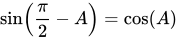
For example, sine (Latin: sinus) and cosine (Latin: cosinus,[4][5] sinus complementi[4][5]) are cofunctions of each other (hence the "co" in "cosine"):
sin
(
π
2
−
A
)
=
cos
(
A
)
{\displaystyle \sin \left({\frac {\pi }{2}}-A\right)=\cos(A)}
 [1][3] [1][3] |
cos
(
π
2
−
A
)
=
sin
(
A
)
{\displaystyle \cos \left({\frac {\pi }{2}}-A\right)=\sin(A)}
 [1][3] [1][3] |
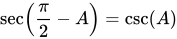
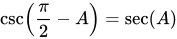
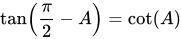
The same is true of secant (Latin: secans) and cosecant (Latin: cosecans, secans complementi) as well as of tangent (Latin: tangens) and cotangent (Latin: cotangens,[4][5] tangens complementi[4][5]):
sec
(
π
2
−
A
)
=
csc
(
A
)
{\displaystyle \sec \left({\frac {\pi }{2}}-A\right)=\csc(A)}
 [1][3] [1][3] |
csc
(
π
2
−
A
)
=
sec
(
A
)
{\displaystyle \csc \left({\frac {\pi }{2}}-A\right)=\sec(A)}
 [1][3] [1][3] |
tan
(
π
2
−
A
)
=
cot
(
A
)
{\displaystyle \tan \left({\frac {\pi }{2}}-A\right)=\cot(A)}
 [1][3] [1][3] |
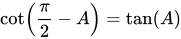
cot
(
π
2
−
A
)
=
tan
(
A
)
{\displaystyle \cot \left({\frac {\pi }{2}}-A\right)=\tan(A)}
 [1][3] [1][3] |
These equations are also known as the cofunction identities.[2][3]
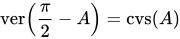
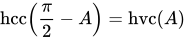
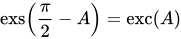
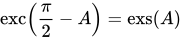
This also holds true for the versine (versed sine, ver) and coversine (coversed sine, cvs), the vercosine (versed cosine, vcs) and covercosine (coversed cosine, cvc), the haversine (half-versed sine, hav) and hacoversine (half-coversed sine, hcv), the havercosine (half-versed cosine, hvc) and hacovercosine (half-coversed cosine, hcc), as well as the exsecant (external secant, exs) and excosecant (external cosecant, exc):
ver
(
π
2
−
A
)
=
cvs
(
A
)
{\displaystyle \operatorname {ver} \left({\frac {\pi }{2}}-A\right)=\operatorname {cvs} (A)}
 [6] [6] |
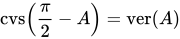
cvs
(
π
2
−
A
)
=
ver
(
A
)
{\displaystyle \operatorname {cvs} \left({\frac {\pi }{2}}-A\right)=\operatorname {ver} (A)}
 |
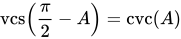
vcs
(
π
2
−
A
)
=
cvc
(
A
)
{\displaystyle \operatorname {vcs} \left({\frac {\pi }{2}}-A\right)=\operatorname {cvc} (A)}
 [7] [7] |
cvc
(
π
2
−
A
)
=
vcs
(
A
)
{\displaystyle \operatorname {cvc} \left({\frac {\pi }{2}}-A\right)=\operatorname {vcs} (A)}
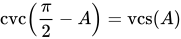 |
hav
(
π
2
−
A
)
=
hcv
(
A
)
{\displaystyle \operatorname {hav} \left({\frac {\pi }{2}}-A\right)=\operatorname {hcv} (A)}
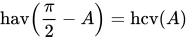 |
hcv
(
π
2
−
A
)
=
hav
(
A
)
{\displaystyle \operatorname {hcv} \left({\frac {\pi }{2}}-A\right)=\operatorname {hav} (A)}
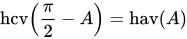 |
hvc
(
π
2
−
A
)
=
hcc
(
A
)
{\displaystyle \operatorname {hvc} \left({\frac {\pi }{2}}-A\right)=\operatorname {hcc} (A)}
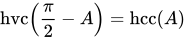 |
hcc
(
π
2
−
A
)
=
hvc
(
A
)
{\displaystyle \operatorname {hcc} \left({\frac {\pi }{2}}-A\right)=\operatorname {hvc} (A)}
 |
exs
(
π
2
−
A
)
=
exc
(
A
)
{\displaystyle \operatorname {exs} \left({\frac {\pi }{2}}-A\right)=\operatorname {exc} (A)}
 |
exc
(
π
2
−
A
)
=
exs
(
A
)
{\displaystyle \operatorname {exc} \left({\frac {\pi }{2}}-A\right)=\operatorname {exs} (A)}
 |
See also
References
- Hall, Arthur Graham; Frink, Fred Goodrich (January 1909). "Chapter II. The Acute Angle [10] Functions of complementary angles". Trigonometry. Vol. Part I: Plane Trigonometry. New York: Henry Holt and Company. pp. 11–12.
- Aufmann, Richard; Nation, Richard (2014). Algebra and Trigonometry (8 ed.). Cengage Learning. p. 528. ISBN 978-128596583-3. Retrieved 2017-07-28.
- Bales, John W. (2012) [2001]. "5.1 The Elementary Identities". Precalculus. Archived from the original on 2017-07-30. Retrieved 2017-07-30.
- Gunter, Edmund (1620). Canon triangulorum.
- Roegel, Denis, ed. (2010-12-06). "A reconstruction of Gunter's Canon triangulorum (1620)" (Research report). HAL. inria-00543938. Archived from the original on 2017-07-28. Retrieved 2017-07-28.
- Weisstein, Eric Wolfgang. "Coversine". MathWorld. Wolfram Research, Inc. Archived from the original on 2005-11-27. Retrieved 2015-11-06.
- Weisstein, Eric Wolfgang. "Covercosine". MathWorld. Wolfram Research, Inc. Archived from the original on 2014-03-28. Retrieved 2015-11-06.