In physics, coherence length is the propagation distance over which a coherent wave (e.g. an electromagnetic wave) maintains a specified degree of coherence. Wave interference is strong when the paths taken by all of the interfering waves differ by less than the coherence length. A wave with a longer coherence length is closer to a perfect sinusoidal wave. Coherence length is important in holography and telecommunications engineering.
This article focuses on the coherence of classical electromagnetic fields. In quantum mechanics, there is a mathematically analogous concept of the quantum coherence length of a wave function.
Formulas
In radio-band systems, the coherence length is approximated by
-
L
=
c
n
Δ
f
≈
λ
2
n
Δ
λ
,
{\displaystyle L={\frac {c}{\,n\,\mathrm {\Delta } f\,}}\approx {\frac {\lambda ^{2}}{\,n\,\mathrm {\Delta } \lambda \,}}~,}
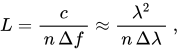
where
c
{\displaystyle \,c\,}


In optical communications and optical coherence tomography (OCT), assuming that the source has a Gaussian emission spectrum, the roundtrip coherence length
L
{\displaystyle \,L\,}

-
L
=
2
ln
2
π
λ
2
n
g
Δ
λ
,
{\displaystyle L={\frac {\,2\ln 2\,}{\pi }}\,{\frac {\lambda ^{2}}{\,n_{g}\,\mathrm {\Delta } \lambda \,}}~,}
[1][2]
where
λ
{\displaystyle \,\lambda \,}


The coherence length can also be measured using a Michelson interferometer and is the optical path length difference of a self-interfering laser beam which corresponds to
1
e
≈
37
%
{\displaystyle \,{\frac {1}{\,e\,}}\approx 37\%\,}

-
V
=
I
max
−
I
min
I
max
+
I
min
,
{\displaystyle V={\frac {\;I_{\max }-I_{\min }\;}{I_{\max }+I_{\min }}}~,}

where
I
{\displaystyle \,I\,}

In long-distance transmission systems, the coherence length may be reduced by propagation factors such as dispersion, scattering, and diffraction.
Lasers
Multimode helium–neon lasers have a typical coherence length on the order of centimeters, while the coherence length of longitudinally single-mode lasers can exceed 1 km. Semiconductor lasers can reach some 100 m, but small, inexpensive semiconductor lasers have shorter lengths, with one source[4] claiming up to 20 cm, although multi-mode diodes will have even shorter coherence lengths. Singlemode fiber lasers with linewidths of a few kHz can have coherence lengths exceeding 100 km. Similar coherence lengths can be reached with optical frequency combs due to the narrow linewidth of each tooth. Non-zero visibility is present only for short intervals of pulses repeated after cavity length distances up to this long coherence length.
Other light sources
Tolansky's An introduction to Interferometry has a chapter on sources which quotes a line width of around 0.052 angstroms for each of the Sodium D lines in an uncooled low-pressure sodium lamp, corresponding to a coherence length of around 67 mm for each line by itself.[5] Cooling the low pressure sodium discharge to liquid nitrogen temperatures increases the individual D line coherence length by a factor of 6. A very narrow-band interference filter would be required to isolate an individual D line.
See also
References
- Akcay, C.; Parrein, P.; Rolland, J.P. (2002). "Estimation of longitudinal resolution in optical coherence imaging". Applied Optics. 41 (25): 5256–5262. Bibcode:2002ApOpt..41.5256A. doi:10.1364/ao.41.005256. PMID 12211551.
equation 8
- Izatt; Choma; Dhalla (2014). "Theory of Optical Coherence Tomography". In Drexler; Fujimoto (eds.). Optical Coherence Tomography. Springer Berlin Heidelberg. ISBN 978-3-319-06419-2.
- Ackermann, Gerhard K. (2007). Holography: A Practical Approach. Wiley-VCH. ISBN 978-3-527-40663-0.
- "Sam's Laser FAQ - Diode Lasers". www.repairfaq.org. Retrieved 2017-02-06.
- Tolansky, Samuel (1973). An Introduction to Interferometry. Longman. ISBN 9780582443334.
 This article incorporates public domain material from Federal Standard 1037C. General Services Administration. Archived from the original on 2022-01-22. (in support of MIL-STD-188).