The Coleman–Weinberg model represents quantum electrodynamics of a scalar field in four-dimensions. The Lagrangian for the model is
-
L
=
−
1
4
(
F
μ
ν
)
2
+
|
D
μ
ϕ
|
2
−
m
2
|
ϕ
|
2
−
λ
6
|
ϕ
|
4
{\displaystyle L=-{\frac {1}{4}}(F_{\mu \nu })^{2}+|D_{\mu }\phi |^{2}-m^{2}|\phi |^{2}-{\frac {\lambda }{6}}|\phi |^{4}}

where the scalar field is complex,
F
μ
ν
=
∂
μ
A
ν
−
∂
ν
A
μ
{\displaystyle F_{\mu \nu }=\partial _{\mu }A_{\nu }-\partial _{\nu }A_{\mu }}

is the electromagnetic field tensor, and
D
μ
=
∂
μ
−
i
(
e
/
ℏ
c
)
A
μ
{\displaystyle D_{\mu }=\partial _{\mu }-\mathrm {i} (e/\hbar c)A_{\mu }}
the covariant derivative containing the electric charge
e
{\displaystyle e}
of the electromagnetic field.
Assume that
λ
{\displaystyle \lambda }
is nonnegative. Then if the mass term is tachyonic,
m
2
<
0
{\displaystyle m^{2}<0}
there is a spontaneous breaking of the gauge symmetry at low energies, a variant of the Higgs mechanism. On the other hand, if the squared mass is positive,
m
2
>
0
{\displaystyle m^{2}>0}
the vacuum expectation of the field
ϕ
{\displaystyle \phi }
is zero. At the classical level the latter is true also if
m
2
=
0
{\displaystyle m^{2}=0}
. However, as was shown by Sidney Coleman and Erick Weinberg, even if the renormalized mass is zero, spontaneous symmetry breaking still happens due to the radiative corrections (this introduces a mass scale into a classically conformal theory - the model has a conformal anomaly).
The same can happen in other gauge theories. In the broken phase the fluctuations of the scalar field
ϕ
{\displaystyle \phi }
will manifest themselves as a naturally light Higgs boson, as a matter of fact even too light to explain the electroweak symmetry breaking in the minimal model - much lighter than vector bosons. There are non-minimal models that give a more realistic scenarios. Also the variations of this mechanism were proposed for the hypothetical spontaneously broken symmetries including supersymmetry.
Equivalently one may say that the model possesses a first-order phase transition as a function of
m
2
{\displaystyle m^{2}}
. The model is the four-dimensional analog of the three-dimensional Ginzburg–Landau theory used to explain the properties of superconductors near the phase transition.
The three-dimensional version of the Coleman–Weinberg model governs the superconducting phase transition which can be both first- and second-order, depending on the ratio of the Ginzburg–Landau parameter
κ
≡
λ
/
e
2
{\displaystyle \kappa \equiv \lambda /e^{2}}
, with a tricritical point near
κ
=
1
/
2
{\displaystyle \kappa =1/{\sqrt {2}}}
which separates type I from type II superconductivity.
Historically, the order of the superconducting phase transition was debated for a long time since the temperature
interval where fluctuations are large (Ginzburg interval) is extremely small.
The question was finally settled
in 1982.[1] If the Ginzburg–Landau parameter
κ
{\displaystyle \kappa }
that distinguishes type-I and
type-II superconductors (see also here)
is large enough, vortex fluctuations
becomes important
which drive the transition to second order.
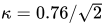
The tricritical point lies at
roughly
κ
=
0.76
/
2
{\displaystyle \kappa =0.76/{\sqrt {2}}}
, i.e., slightly below the value
κ
=
1
/
2
{\displaystyle \kappa =1/{\sqrt {2}}}
where type-I goes over into type-II superconductor.
The prediction was confirmed in 2002 by Monte Carlo computer simulations.[2]
Literature
- S. Coleman and E. Weinberg (1973). "Radiative Corrections as the Origin of Spontaneous Symmetry Breaking". Physical Review D. 7 (6): 1888–1910. arXiv:hep-th/0507214. Bibcode:1973PhRvD...7.1888C. doi:10.1103/PhysRevD.7.1888. S2CID 6898114.
- L.D. Landau (1937). "On the theory of phase transitions. II". Zhurnal Eksperimental'noi i Teoreticheskoi Fiziki. 7: 627.
- V.L. Ginzburg and L.D. Landau (2009). "On the Theory of Superconductivity". On Superconductivity and Superfluidity. pp. 113–137. doi:10.1007/978-3-540-68008-6_4. ISBN 978-3-540-68004-8.
- M.Tinkham (2004). Introduction to Superconductivity. Dover Books on Physics (2nd ed.). Dover. ISBN 0-486-43503-2.
See also
References
- H. Kleinert (1982). "Disorder Version of the Abelian Higgs Model and the Order of the Superconductive Phase Transition" (PDF). Lettere al Nuovo Cimento. 35 (13): 405–412. doi:10.1007/BF02754760. S2CID 121012850.
- J. Hove; S. Mo; A. Sudbo (2002). "Vortex interactions and thermally induced crossover from type-I to type-II superconductivity" (PDF). Phys. Rev. B 66 (6) 064524. arXiv:cond-mat/0202215. Bibcode:2002PhRvB..66f4524H. doi:10.1103/PhysRevB.66.064524. S2CID 13672575.