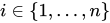
The r-to-1 collision problem is an important theoretical problem in complexity theory, quantum computing, and computational mathematics. The collision problem most often refers to the 2-to-1 version:[1] given
n
{\displaystyle n}



Classical solutions
Deterministic
Solving the 2-to-1 version deterministically requires
n
2
+
1
{\textstyle {\frac {n}{2}}+1}


This is a straightforward application of the pigeonhole principle: if a function is r-to-1, then after
n
r
+
1
{\textstyle {\frac {n}{r}}+1}

Randomized
If we allow randomness, the problem is easier. By the birthday paradox, if we choose (distinct) queries at random, then with high probability we find a collision in any fixed 2-to-1 function after
Θ
(
n
)
{\displaystyle \Theta ({\sqrt {n}})}

Quantum solution
The BHT algorithm, which uses Grover's algorithm, solves this problem optimally by only making
O
(
n
1
/
3
)
{\displaystyle O(n^{1/3})}


References
- Scott Aaronson (2004). "Limits on Efficient Computation in the Physical World" (PDF).
- Aaronson, Scott; Shi, Yaoyun (2004). "Quantum lower bounds for the collision and the element distinctness problems". Journal of the ACM. 51 (4): 595–605. doi:10.1145/1008731.1008735. ISSN 0004-5411.