

In geometry, a conchoid is a curve derived from a fixed point O, another curve, and a length d. It was invented by the ancient Greek mathematician Nicomedes.[1]
Description
For every line through O that intersects the given curve at A the two points on the line which are d from A are on the conchoid. The conchoid is, therefore, the cissoid of the given curve and a circle of radius d and center O. They are called conchoids because the shape of their outer branches resembles conch shells.
The simplest expression uses polar coordinates with O at the origin. If
-
r
=
α
(
θ
)
{\displaystyle r=\alpha (\theta )}

expresses the given curve, then
-
r
=
α
(
θ
)
±
d
{\displaystyle r=\alpha (\theta )\pm d}
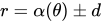
expresses the conchoid.
If the curve is a line, then the conchoid is the conchoid of Nicomedes.
For instance, if the curve is the line x = a, then the line's polar form is r = a sec θ and therefore the conchoid can be expressed parametrically as
-
x
=
a
±
d
cos
θ
,
y
=
a
tan
θ
±
d
sin
θ
.
{\displaystyle x=a\pm d\cos \theta ,\,y=a\tan \theta \pm d\sin \theta .}

A limaçon is a conchoid with a circle as the given curve.
The so-called conchoid of de Sluze and conchoid of Dürer are not actually conchoids. The former is a strict cissoid and the latter a construction more general yet.
See also
References
- Chisholm, Hugh, ed. (1911). . Encyclopædia Britannica. Vol. 6 (11th ed.). Cambridge University Press. pp. 826–827.
- J. Dennis Lawrence (1972). A catalog of special plane curves. Dover Publications. pp. 36, 49–51, 113, 137. ISBN 0-486-60288-5.
External links
- conchoid with conic sections - interactive illustration
- Weisstein, Eric W. "Conchoid of Nicomedes". MathWorld.
- conchoid at mathcurves.com