
 in a plane as shown in the figure, the point
P
{\displaystyle P}
in a plane as shown in the figure, the point
P
{\displaystyle P}
 is a convex combination of the three points, while
Q
{\displaystyle Q}
is a convex combination of the three points, while
Q
{\displaystyle Q}
 is not. (
Q
{\displaystyle Q}
is however an affine combination of the three points, as their affine hull is the entire plane.)
is not. (
Q
{\displaystyle Q}
is however an affine combination of the three points, as their affine hull is the entire plane.)
 in a two dimensional vector space
R
2
{\displaystyle \mathbb {R} ^{2}}
in a two dimensional vector space
R
2
{\displaystyle \mathbb {R} ^{2}}
 as animation in Geogebra with
t
∈
[
0
,
1
]
{\displaystyle t\in [0,1]}
as animation in Geogebra with
t
∈
[
0
,
1
]
{\displaystyle t\in [0,1]}
![{\displaystyle t\in [0,1]}](https://wikimedia.org/api/rest_v1/media/math/render/svg/31a5c18739ff04858eecc8fec2f53912c348e0e5) and
K
(
t
)
:=
(
1
−
t
)
⋅
v
1
+
t
⋅
v
2
{\displaystyle K(t):=(1-t)\cdot v_{1}+t\cdot v_{2}}
and
K
(
t
)
:=
(
1
−
t
)
⋅
v
1
+
t
⋅
v
2
{\displaystyle K(t):=(1-t)\cdot v_{1}+t\cdot v_{2}}


 in a two dimensional vector space
R
2
{\displaystyle \mathbb {R} ^{2}}
as shown in animation with
α
0
+
α
1
+
α
2
=
1
{\displaystyle \alpha ^{0}+\alpha ^{1}+\alpha ^{2}=1}
in a two dimensional vector space
R
2
{\displaystyle \mathbb {R} ^{2}}
as shown in animation with
α
0
+
α
1
+
α
2
=
1
{\displaystyle \alpha ^{0}+\alpha ^{1}+\alpha ^{2}=1}
 ,
P
(
α
0
,
α
1
,
α
2
)
{\displaystyle P(\alpha ^{0},\alpha ^{1},\alpha ^{2})}
,
P
(
α
0
,
α
1
,
α
2
)
{\displaystyle P(\alpha ^{0},\alpha ^{1},\alpha ^{2})}
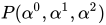 :=
α
0
v
0
+
α
1
v
1
+
α
2
v
2
{\displaystyle :=\alpha ^{0}v_{0}+\alpha ^{1}v_{1}+\alpha ^{2}v_{2}}
:=
α
0
v
0
+
α
1
v
1
+
α
2
v
2
{\displaystyle :=\alpha ^{0}v_{0}+\alpha ^{1}v_{1}+\alpha ^{2}v_{2}}
 . When P is inside of the triangle
α
i
≥
0
{\displaystyle \alpha _{i}\geq 0}
. When P is inside of the triangle
α
i
≥
0
{\displaystyle \alpha _{i}\geq 0}
 . Otherwise, when P is outside of the triangle, at least one of the
α
i
{\displaystyle \alpha _{i}}
. Otherwise, when P is outside of the triangle, at least one of the
α
i
{\displaystyle \alpha _{i}}
 is negative.
 in a three dimensional vector space
R
3
{\displaystyle \mathbb {R} ^{3}}
in a three dimensional vector space
R
3
{\displaystyle \mathbb {R} ^{3}}
 as animation in Geogebra with
∑
i
=
1
4
α
i
=
1
{\displaystyle \sum _{i=1}^{4}\alpha _{i}=1}
as animation in Geogebra with
∑
i
=
1
4
α
i
=
1
{\displaystyle \sum _{i=1}^{4}\alpha _{i}=1}
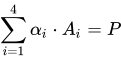
 and
∑
i
=
1
4
α
i
⋅
A
i
=
P
{\displaystyle \sum _{i=1}^{4}\alpha _{i}\cdot A_{i}=P}
and
∑
i
=
1
4
α
i
⋅
A
i
=
P
{\displaystyle \sum _{i=1}^{4}\alpha _{i}\cdot A_{i}=P}
 .
When P is inside of the tetrahedron
α
i
>=
0
{\displaystyle \alpha _{i}>=0}
.
When P is inside of the tetrahedron
α
i
>=
0
{\displaystyle \alpha _{i}>=0}
 . Otherwise, when P is outside of the tetrahedron, at least one of the
α
i
{\displaystyle \alpha _{i}}
is negative.
. Otherwise, when P is outside of the tetrahedron, at least one of the
α
i
{\displaystyle \alpha _{i}}
is negative.
![{\displaystyle [a,b]=[-4,7]}](https://wikimedia.org/api/rest_v1/media/math/render/svg/183bacef4a989104893e2c37017d84af54a1a23f) and as the first function
f
:
[
a
,
b
]
→
R
{\displaystyle f:[a,b]\to \mathbb {R} }
and as the first function
f
:
[
a
,
b
]
→
R
{\displaystyle f:[a,b]\to \mathbb {R} }
![{\displaystyle f:[a,b]\to \mathbb {R} }](https://wikimedia.org/api/rest_v1/media/math/render/svg/b592d102ccd1ba134d401c5b3ea177baaba3ffac) a polynomial is defined.
f
(
x
)
:=
3
10
⋅
x
2
−
2
{\displaystyle f(x):={\frac {3}{10}}\cdot x^{2}-2}
a polynomial is defined.
f
(
x
)
:=
3
10
⋅
x
2
−
2
{\displaystyle f(x):={\frac {3}{10}}\cdot x^{2}-2}
 A trigonometric function
g
:
[
a
,
b
]
→
R
{\displaystyle g:[a,b]\to \mathbb {R} }
A trigonometric function
g
:
[
a
,
b
]
→
R
{\displaystyle g:[a,b]\to \mathbb {R} }
![{\displaystyle g:[a,b]\to \mathbb {R} }](https://wikimedia.org/api/rest_v1/media/math/render/svg/8b1d5103d0e36767a27715bcfc57137119294aad) was chosen as the second function.
g
(
x
)
:=
2
⋅
cos
(
x
)
+
1
{\displaystyle g(x):=2\cdot \cos(x)+1}
was chosen as the second function.
g
(
x
)
:=
2
⋅
cos
(
x
)
+
1
{\displaystyle g(x):=2\cdot \cos(x)+1}
 The figure illustrates the convex combination
K
(
t
)
:=
(
1
−
t
)
⋅
f
+
t
⋅
g
{\displaystyle K(t):=(1-t)\cdot f+t\cdot g}
The figure illustrates the convex combination
K
(
t
)
:=
(
1
−
t
)
⋅
f
+
t
⋅
g
{\displaystyle K(t):=(1-t)\cdot f+t\cdot g}
 of
f
{\displaystyle f}
of
f
{\displaystyle f}
 and
g
{\displaystyle g}
and
g
{\displaystyle g}
 as graph in red color.
In convex geometry and vector algebra, a convex combination is a linear combination of points (which can be vectors, scalars, or more generally points in an affine space) where all coefficients are non-negative and sum to 1.[1] In other words, the operation is equivalent to a standard weighted average, but whose weights are expressed as a percent of the total weight, instead of as a fraction of the count of the weights as in a standard weighted average.
Formal definition
More formally, given a finite number of points
x
1
,
x
2
,
…
,
x
n
{\displaystyle x_{1},x_{2},\dots ,x_{n}}

-
α
1
x
1
+
α
2
x
2
+
⋯
+
α
n
x
n
{\displaystyle \alpha _{1}x_{1}+\alpha _{2}x_{2}+\cdots +\alpha _{n}x_{n}}

where the real numbers
α
i
{\displaystyle \alpha _{i}}

As a particular example, every convex combination of two points lies on the line segment between the points.[1]
A set is convex if it contains all convex combinations of its points. The convex hull of a given set of points is identical to the set of all their convex combinations.[1]
There exist subsets of a vector space that are not closed under linear combinations but are closed under convex combinations. For example, the interval
[
0
,
1
]
{\displaystyle [0,1]}
![{\displaystyle [0,1]}](https://wikimedia.org/api/rest_v1/media/math/render/svg/738f7d23bb2d9642bab520020873cccbef49768d)
Other objects
- A random variable
X
{\displaystyle X}
is said to have an n {\displaystyle n}
-component finite mixture distribution if its probability density function is a convex combination of n {\displaystyle n}
Related constructions
- A conical combination is a linear combination with nonnegative coefficients. When a point
x
{\displaystyle x}
is to be used as the reference origin for defining displacement vectors, then x {\displaystyle x}
- Weighted means are functionally the same as convex combinations, but they use a different notation. The coefficients (weights) in a weighted mean are not required to sum to 1; instead the weighted linear combination is explicitly divided by the sum of the weights.
- Affine combinations are like convex combinations, but the coefficients are not required to be non-negative. Hence, affine combinations are defined in vector spaces over any field.
See also
References
External links
- Convex sum/combination with a triangle - interactive illustration
- Convex sum/combination with a hexagon - interactive illustration
- Convex sum/combination with a tetraeder - interactive illustration