Crusades against Christians were Christian religious wars dating from the 11thcentury First Crusade when papal reformers began equating the universal church with the papacy. Later in the 12th century the focus of crusades century focus changed from non-christian pagans and infidels to heretics and schismatics. Holy wars were fought in northern France, against King RogerII of Sicily, various heretics, their protectors, mercenary bands and the first political crusade against Markward of Anweiler. Full crusading apparatus was deployed against Christians in the conflict with the Cathar heretics of southern France and their Christian protectors in the 13th century. This was given equivalence with the Eastern crusades and supported by developments such as the creation of the Papal States. The aims of this were to make the crusade indulgence available to the laity, the reconfiguration of Christian society, and ecclesiastical taxation.[1]
Crusades against Christians
Miniatures showing Pope Innocent III excommunicating, and the crusaders massacring, Cathars(BL Royal 16 G VI, fol. 374v, 14thcentury)
Christian holy war had a long history pre-dating the 11thcentury when papal reformers began equating the universal church with the papacy. This resulted in the Peace and Truce of God movement supporting military defence of the church, clergy and its property. In 1053 Pope Leo IX attacked the Italo-Normans granting troops sin remission in return for a holy war. Later, Pope Gregory VII and his militia Sancti Petri considered fighting for the papacy as penitential; death brought salvation. This was less about an Augustinianjust war than militant Christianity fighting in defence of the church from the 8th century. Late 11thcentury works of crusader theory by Anselm of Lucca and Bonizo of Sutri focused on heretics and schismatics rather than infidels. The First Crusade encouraged further holy wars, peacekeeping in northern France, papal fighting with King RogerII of Sicily in the 1120s and 1130s, and against various heretics, antipopes, their protectors, and mercenary bands in the 1130s and 1170s. Although there is little evidence of crusade preaching, Pope InnocentIII is said to have waged the first "political" crusade from November 1199 for Sicily against Markward of Anweiler. Full crusading apparatus was first deployed against Christians in the conflict with the Cathar heretics of southern France and their Christian protectors in 1208. In 1215, the Fourth Lateran Council gave the Albigensian Crusade, between 1209 and 1229, equivalence with the Eastern crusades. This crusade was supported by developments such as the creation of the Papal States, the aim to make the crusade indulgence available to the laity, the reconfiguration of Christian society, and ecclesiastical taxation.[1]
The Papacy's drive for homogenous Christianity encouraged crusades against any group with which there were differences such as:
The Sicilian Vespers, the wars for Angevin control of Sicily from 1282 to 1302. In 1282 the Sicilians rebelled against CharlesI of Anjou and Frederick's son-in-law, Peter III of Aragon, annexed the island. A 1283 crusade invading Aragon and a 1285 crusade invading the island by Philip III of France failed. Crusading against Aragonese rulers continued when FrederickIII of Sicily refused to return the island to the Angevins. This ended in 1302 with the treaty of Caltabellota.
Maintaining papal interests during the Avignon Papacy from 1309 to 1377.
During the Western Schism between 1378 and 1417, Roman Pope Urban VI launched crusades against his Avignon rival Antipope Clement VII in 1378. ClementVII gave crusade privileges to competitors in the Neapolitan succession, as did Antipope John XXIII in 1411 and 1414.
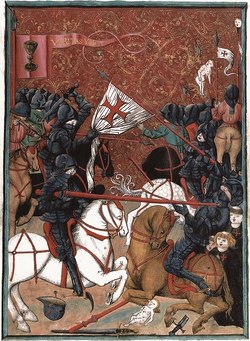
After 1417, the papacy became reluctant to use crusading for political ends, perhaps recognising the lack of adequate church funds to sponsor large armies, the futility, and the damage they caused to the standing of both papacy and crusade. Only Pope Julius II continued crusading in Italy. However, religious crusades continued against the Hussites of Bohemia in 1420, 1421, 1422, 1427, 1431 and between 1465 and 1471 with another planned between 1428 and 1429.[3] The Protestant Reformation prompted a revival with several schemes, including against Henry VIII of England and Elizabeth I of England.[4]
Tyerman, Christopher (2006). "Crusades against Christians". In Murray, Alan V. (ed.). The Crusades: An Encyclopedia. Vol.I:A-C. ABC-CLIO. pp.325–329. ISBN978-1-57607-862-4.