Cylindrical multipole moments

☆ Save On Wikipedia ↗

Cylindrical multipole moments are the coefficients in a series expansion of a potential that varies logarithmically with the distance to a source, i.e., as ln ⁡   R {\displaystyle \ln \ R} {\displaystyle \ln \ R}.[1] Such potentials arise in the electric potential of long line charges, and the analogous sources for the magnetic potential and gravitational potential.

For clarity, we illustrate the expansion for a single line charge, then generalize to an arbitrary distribution of line charges. Through this article, the primed coordinates such as ( ρ ′ , θ ′ ) {\displaystyle (\rho ^{\prime },\theta ^{\prime })} {\displaystyle (\rho ^{\prime },\theta ^{\prime })} refer to the position of the line charge(s), whereas the unprimed coordinates such as ( ρ , θ ) {\displaystyle (\rho ,\theta )} {\displaystyle (\rho ,\theta )} refer to the point at which the potential is being observed. We use cylindrical coordinates throughout, e.g., an arbitrary vector r {\displaystyle \mathbf {r} } {\displaystyle \mathbf {r} } has coordinates ( ρ , θ , z ) {\displaystyle (\rho ,\theta ,z)} {\displaystyle (\rho ,\theta ,z)} where ρ {\displaystyle \rho } {\displaystyle \rho } is the radius from the z {\displaystyle z} {\displaystyle z} axis, θ {\displaystyle \theta } {\displaystyle \theta } is the azimuthal angle and z {\displaystyle z} {\displaystyle z} is the normal Cartesian coordinate. By assumption, the line charges are infinitely long and aligned with the z {\displaystyle z} {\displaystyle z} axis.

Cylindrical multipole moments of a line charge

Figure 1: Definitions for cylindrical multipoles; looking down the z ′ {\displaystyle z'} {\displaystyle z'} axis

The electric potential of a line charge λ {\displaystyle \lambda } {\displaystyle \lambda } located at ( ρ ′ , θ ′ ) {\displaystyle (\rho ',\theta ')} {\displaystyle (\rho ',\theta ')} is given by Φ ( ρ , θ ) = − λ 2 π ϵ ln ⁡ R = − λ 4 π ϵ ln ⁡ | ρ 2 + ( ρ ′ ) 2 − 2 ρ ρ ′ cos ⁡ ( θ − θ ′ ) | {\displaystyle \Phi (\rho ,\theta )={\frac {-\lambda }{2\pi \epsilon }}\ln R={\frac {-\lambda }{4\pi \epsilon }}\ln \left|\rho ^{2}+\left(\rho '\right)^{2}-2\rho \rho '\cos(\theta -\theta ')\right|} {\displaystyle \Phi (\rho ,\theta )={\frac {-\lambda }{2\pi \epsilon }}\ln R={\frac {-\lambda }{4\pi \epsilon }}\ln \left|\rho ^{2}+\left(\rho '\right)^{2}-2\rho \rho '\cos(\theta -\theta ')\right|} where R {\displaystyle R} {\displaystyle R} is the shortest distance between the line charge and the observation point.

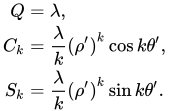
By symmetry, the electric potential of an infinite line charge has no z {\displaystyle z} {\displaystyle z}-dependence. The line charge λ {\displaystyle \lambda } {\displaystyle \lambda } is the charge per unit length in the z {\displaystyle z} {\displaystyle z}-direction, and has units of (charge/length). If the radius ρ {\displaystyle \rho } {\displaystyle \rho } of the observation point is greater than the radius ρ ′ {\displaystyle \rho '} {\displaystyle \rho '} of the line charge, we may factor out ρ 2 {\displaystyle \rho ^{2}} {\displaystyle \rho ^{2}} Φ ( ρ , θ ) = − λ 4 π ϵ { 2 ln ⁡ ρ + ln ⁡ ( 1 − ρ ′ ρ e i ( θ − θ ′ ) ) ( 1 − ρ ′ ρ e − i ( θ − θ ′ ) ) } {\displaystyle \Phi (\rho ,\theta )={\frac {-\lambda }{4\pi \epsilon }}\left\{2\ln \rho +\ln \left(1-{\frac {\rho ^{\prime }}{\rho }}e^{i\left(\theta -\theta ^{\prime }\right)}\right)\left(1-{\frac {\rho ^{\prime }}{\rho }}e^{-i\left(\theta -\theta ^{\prime }\right)}\right)\right\}} {\displaystyle \Phi (\rho ,\theta )={\frac {-\lambda }{4\pi \epsilon }}\left\{2\ln \rho +\ln \left(1-{\frac {\rho ^{\prime }}{\rho }}e^{i\left(\theta -\theta ^{\prime }\right)}\right)\left(1-{\frac {\rho ^{\prime }}{\rho }}e^{-i\left(\theta -\theta ^{\prime }\right)}\right)\right\}} and expand the logarithms in powers of ( ρ ′ / ρ ) < 1 {\displaystyle (\rho '/\rho )<1} {\displaystyle (\rho '/\rho )<1} Φ ( ρ , θ ) = − λ 2 π ϵ { ln ⁡ ρ − ∑ k = 1 ∞ 1 k ( ρ ′ ρ ) k [ cos ⁡ k θ cos ⁡ k θ ′ + sin ⁡ k θ sin ⁡ k θ ′ ] } {\displaystyle \Phi (\rho ,\theta )={\frac {-\lambda }{2\pi \epsilon }}\left\{\ln \rho -\sum _{k=1}^{\infty }{\frac {1}{k}}\left({\frac {\rho '}{\rho }}\right)^{k}\left[\cos k\theta \cos k\theta '+\sin k\theta \sin k\theta '\right]\right\}} {\displaystyle \Phi (\rho ,\theta )={\frac {-\lambda }{2\pi \epsilon }}\left\{\ln \rho -\sum _{k=1}^{\infty }{\frac {1}{k}}\left({\frac {\rho '}{\rho }}\right)^{k}\left[\cos k\theta \cos k\theta '+\sin k\theta \sin k\theta '\right]\right\}} which may be written as Φ ( ρ , θ ) = − Q 2 π ϵ ln ⁡ ρ + 1 2 π ϵ ∑ k = 1 ∞ C k cos ⁡ k θ + S k sin ⁡ k θ ρ k {\displaystyle \Phi (\rho ,\theta )={\frac {-Q}{2\pi \epsilon }}\ln \rho +{\frac {1}{2\pi \epsilon }}\sum _{k=1}^{\infty }{\frac {C_{k}\cos k\theta +S_{k}\sin k\theta }{\rho ^{k}}}} {\displaystyle \Phi (\rho ,\theta )={\frac {-Q}{2\pi \epsilon }}\ln \rho +{\frac {1}{2\pi \epsilon }}\sum _{k=1}^{\infty }{\frac {C_{k}\cos k\theta +S_{k}\sin k\theta }{\rho ^{k}}}} where the multipole moments are defined as Q = λ , C k = λ k ( ρ ′ ) k cos ⁡ k θ ′ , S k = λ k ( ρ ′ ) k sin ⁡ k θ ′ . {\displaystyle {\begin{aligned}Q&=\lambda ,\\C_{k}&={\frac {\lambda }{k}}\left(\rho '\right)^{k}\cos k\theta ',\\S_{k}&={\frac {\lambda }{k}}\left(\rho '\right)^{k}\sin k\theta '.\end{aligned}}} {\displaystyle {\begin{aligned}Q&=\lambda ,\\C_{k}&={\frac {\lambda }{k}}\left(\rho '\right)^{k}\cos k\theta ',\\S_{k}&={\frac {\lambda }{k}}\left(\rho '\right)^{k}\sin k\theta '.\end{aligned}}}

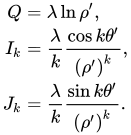
Conversely, if the radius ρ {\displaystyle \rho } {\displaystyle \rho } of the observation point is less than the radius ρ ′ {\displaystyle \rho '} {\displaystyle \rho '} of the line charge, we may factor out ( ρ ′ ) 2 {\displaystyle \left(\rho '\right)^{2}} {\displaystyle \left(\rho '\right)^{2}} and expand the logarithms in powers of ( ρ / ρ ′ ) < 1 {\displaystyle (\rho /\rho ')<1} {\displaystyle (\rho /\rho ')<1} Φ ( ρ , θ ) = − λ 2 π ϵ { ln ⁡ ρ ′ − ∑ k = 1 ∞ ( 1 k ) ( ρ ρ ′ ) k [ cos ⁡ k θ cos ⁡ k θ ′ + sin ⁡ k θ sin ⁡ k θ ′ ] } {\displaystyle \Phi (\rho ,\theta )={\frac {-\lambda }{2\pi \epsilon }}\left\{\ln \rho '-\sum _{k=1}^{\infty }\left({\frac {1}{k}}\right)\left({\frac {\rho }{\rho '}}\right)^{k}\left[\cos k\theta \cos k\theta '+\sin k\theta \sin k\theta '\right]\right\}} {\displaystyle \Phi (\rho ,\theta )={\frac {-\lambda }{2\pi \epsilon }}\left\{\ln \rho '-\sum _{k=1}^{\infty }\left({\frac {1}{k}}\right)\left({\frac {\rho }{\rho '}}\right)^{k}\left[\cos k\theta \cos k\theta '+\sin k\theta \sin k\theta '\right]\right\}} which may be written as Φ ( ρ , θ ) = − Q 2 π ϵ ln ⁡ ρ ′ + 1 2 π ϵ ∑ k = 1 ∞ ρ k [ I k cos ⁡ k θ + J k sin ⁡ k θ ] {\displaystyle \Phi (\rho ,\theta )={\frac {-Q}{2\pi \epsilon }}\ln \rho '+{\frac {1}{2\pi \epsilon }}\sum _{k=1}^{\infty }\rho ^{k}\left[I_{k}\cos k\theta +J_{k}\sin k\theta \right]} {\displaystyle \Phi (\rho ,\theta )={\frac {-Q}{2\pi \epsilon }}\ln \rho '+{\frac {1}{2\pi \epsilon }}\sum _{k=1}^{\infty }\rho ^{k}\left[I_{k}\cos k\theta +J_{k}\sin k\theta \right]} where the interior multipole moments are defined as Q = λ ln ⁡ ρ ′ , I k = λ k cos ⁡ k θ ′ ( ρ ′ ) k , J k = λ k sin ⁡ k θ ′ ( ρ ′ ) k . {\displaystyle {\begin{aligned}Q&=\lambda \ln \rho ',\\I_{k}&={\frac {\lambda }{k}}{\frac {\cos k\theta '}{\left(\rho '\right)^{k}}},\\J_{k}&={\frac {\lambda }{k}}{\frac {\sin k\theta '}{\left(\rho '\right)^{k}}}.\end{aligned}}} {\displaystyle {\begin{aligned}Q&=\lambda \ln \rho ',\\I_{k}&={\frac {\lambda }{k}}{\frac {\cos k\theta '}{\left(\rho '\right)^{k}}},\\J_{k}&={\frac {\lambda }{k}}{\frac {\sin k\theta '}{\left(\rho '\right)^{k}}}.\end{aligned}}}

General cylindrical multipole moments

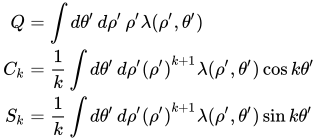
The generalization to an arbitrary distribution of line charges λ ( ρ ′ , θ ′ ) {\displaystyle \lambda (\rho ',\theta ')} {\displaystyle \lambda (\rho ',\theta ')} is straightforward. The functional form is the same Φ ( r ) = − Q 2 π ϵ ln ⁡ ρ + 1 2 π ϵ ∑ k = 1 ∞ C k cos ⁡ k θ + S k sin ⁡ k θ ρ k {\displaystyle \Phi (\mathbf {r} )={\frac {-Q}{2\pi \epsilon }}\ln \rho +{\frac {1}{2\pi \epsilon }}\sum _{k=1}^{\infty }{\frac {C_{k}\cos k\theta +S_{k}\sin k\theta }{\rho ^{k}}}} {\displaystyle \Phi (\mathbf {r} )={\frac {-Q}{2\pi \epsilon }}\ln \rho +{\frac {1}{2\pi \epsilon }}\sum _{k=1}^{\infty }{\frac {C_{k}\cos k\theta +S_{k}\sin k\theta }{\rho ^{k}}}} and the moments can be written Q = ∫ d θ ′ d ρ ′ ρ ′ λ ( ρ ′ , θ ′ ) C k = 1 k ∫ d θ ′ d ρ ′ ( ρ ′ ) k + 1 λ ( ρ ′ , θ ′ ) cos ⁡ k θ ′ S k = 1 k ∫ d θ ′ d ρ ′ ( ρ ′ ) k + 1 λ ( ρ ′ , θ ′ ) sin ⁡ k θ ′ {\displaystyle {\begin{aligned}Q&=\int d\theta '\,d\rho '\,\rho '\lambda (\rho ',\theta ')\\C_{k}&={\frac {1}{k}}\int d\theta '\,d\rho '\left(\rho '\right)^{k+1}\lambda (\rho ',\theta ')\cos k\theta '\\S_{k}&={\frac {1}{k}}\int d\theta '\,d\rho '\left(\rho '\right)^{k+1}\lambda (\rho ',\theta ')\sin k\theta '\end{aligned}}} {\displaystyle {\begin{aligned}Q&=\int d\theta '\,d\rho '\,\rho '\lambda (\rho ',\theta ')\\C_{k}&={\frac {1}{k}}\int d\theta '\,d\rho '\left(\rho '\right)^{k+1}\lambda (\rho ',\theta ')\cos k\theta '\\S_{k}&={\frac {1}{k}}\int d\theta '\,d\rho '\left(\rho '\right)^{k+1}\lambda (\rho ',\theta ')\sin k\theta '\end{aligned}}} Note that the λ ( ρ ′ , θ ′ ) {\displaystyle \lambda (\rho ',\theta ')} {\displaystyle \lambda (\rho ',\theta ')} represents the line charge per unit area in the ( ρ − θ ) {\displaystyle (\rho -\theta )} {\displaystyle (\rho -\theta )} plane.

Interior cylindrical multipole moments

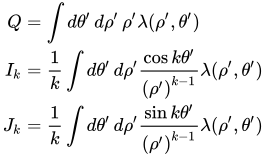
Similarly, the interior cylindrical multipole expansion has the functional form Φ ( ρ , θ ) = − Q 2 π ϵ ln ⁡ ρ ′ + 1 2 π ϵ ∑ k = 1 ∞ ρ k [ I k cos ⁡ k θ + J k sin ⁡ k θ ] {\displaystyle \Phi (\rho ,\theta )={\frac {-Q}{2\pi \epsilon }}\ln \rho '+{\frac {1}{2\pi \epsilon }}\sum _{k=1}^{\infty }\rho ^{k}\left[I_{k}\cos k\theta +J_{k}\sin k\theta \right]} {\displaystyle \Phi (\rho ,\theta )={\frac {-Q}{2\pi \epsilon }}\ln \rho '+{\frac {1}{2\pi \epsilon }}\sum _{k=1}^{\infty }\rho ^{k}\left[I_{k}\cos k\theta +J_{k}\sin k\theta \right]} where the moments are defined Q = ∫ d θ ′ d ρ ′ ρ ′ λ ( ρ ′ , θ ′ ) I k = 1 k ∫ d θ ′ d ρ ′ cos ⁡ k θ ′ ( ρ ′ ) k − 1 λ ( ρ ′ , θ ′ ) J k = 1 k ∫ d θ ′ d ρ ′ sin ⁡ k θ ′ ( ρ ′ ) k − 1 λ ( ρ ′ , θ ′ ) {\displaystyle {\begin{aligned}Q&=\int d\theta '\,d\rho '\,\rho '\lambda (\rho ',\theta ')\\I_{k}&={\frac {1}{k}}\int d\theta '\,d\rho '{\frac {\cos k\theta '}{\left(\rho '\right)^{k-1}}}\lambda (\rho ',\theta ')\\J_{k}&={\frac {1}{k}}\int d\theta '\,d\rho '{\frac {\sin k\theta '}{\left(\rho '\right)^{k-1}}}\lambda (\rho ',\theta ')\end{aligned}}} {\displaystyle {\begin{aligned}Q&=\int d\theta '\,d\rho '\,\rho '\lambda (\rho ',\theta ')\\I_{k}&={\frac {1}{k}}\int d\theta '\,d\rho '{\frac {\cos k\theta '}{\left(\rho '\right)^{k-1}}}\lambda (\rho ',\theta ')\\J_{k}&={\frac {1}{k}}\int d\theta '\,d\rho '{\frac {\sin k\theta '}{\left(\rho '\right)^{k-1}}}\lambda (\rho ',\theta ')\end{aligned}}}
Interaction energies of cylindrical multipoles

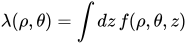
A simple formula for the interaction energy of cylindrical multipoles (charge density 1) with a second charge density can be derived. Let f ( r ′ ) {\displaystyle f(\mathbf {r} ^{\prime })} {\displaystyle f(\mathbf {r} ^{\prime })} be the second charge density, and define λ ( ρ , θ ) {\displaystyle \lambda (\rho ,\theta )} {\displaystyle \lambda (\rho ,\theta )} as its integral over z λ ( ρ , θ ) = ∫ d z f ( ρ , θ , z ) {\displaystyle \lambda (\rho ,\theta )=\int dz\,f(\rho ,\theta ,z)} {\displaystyle \lambda (\rho ,\theta )=\int dz\,f(\rho ,\theta ,z)}

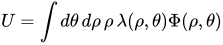
The electrostatic energy is given by the integral of the charge multiplied by the potential due to the cylindrical multipoles U = ∫ d θ d ρ ρ λ ( ρ , θ ) Φ ( ρ , θ ) {\displaystyle U=\int d\theta \,d\rho \,\rho \,\lambda (\rho ,\theta )\Phi (\rho ,\theta )} {\displaystyle U=\int d\theta \,d\rho \,\rho \,\lambda (\rho ,\theta )\Phi (\rho ,\theta )}
If the cylindrical multipoles are exterior, this equation becomes U = − Q 1 2 π ϵ ∫ d ρ ρ λ ( ρ , θ ) ln ⁡ ρ + 1 2 π ϵ ∑ k = 1 ∞ ∫ d θ d ρ [ C 1 k cos ⁡ k θ ρ k − 1 + S 1 k sin ⁡ k θ ρ k − 1 ] λ ( ρ , θ ) {\displaystyle U={\frac {-Q_{1}}{2\pi \epsilon }}\int d\rho \,\rho \,\lambda (\rho ,\theta )\ln \rho +{\frac {1}{2\pi \epsilon }}\sum _{k=1}^{\infty }\int d\theta \,d\rho \left[C_{1k}{\frac {\cos k\theta }{\rho ^{k-1}}}+S_{1k}{\frac {\sin k\theta }{\rho ^{k-1}}}\right]\lambda (\rho ,\theta )} {\displaystyle U={\frac {-Q_{1}}{2\pi \epsilon }}\int d\rho \,\rho \,\lambda (\rho ,\theta )\ln \rho +{\frac {1}{2\pi \epsilon }}\sum _{k=1}^{\infty }\int d\theta \,d\rho \left[C_{1k}{\frac {\cos k\theta }{\rho ^{k-1}}}+S_{1k}{\frac {\sin k\theta }{\rho ^{k-1}}}\right]\lambda (\rho ,\theta )} where Q 1 {\displaystyle Q_{1}} {\displaystyle Q_{1}}, C 1 k {\displaystyle C_{1k}} {\displaystyle C_{1k}} and S 1 k {\displaystyle S_{1k}} {\displaystyle S_{1k}} are the cylindrical multipole moments of charge distribution 1. This energy formula can be reduced to a remarkably simple form U = − Q 1 2 π ϵ ∫ d ρ ρ λ ( ρ , θ ) ln ⁡ ρ + 1 2 π ϵ ∑ k = 1 ∞ k ( C 1 k I 2 k + S 1 k J 2 k ) {\displaystyle U={\frac {-Q_{1}}{2\pi \epsilon }}\int d\rho \,\rho \,\lambda (\rho ,\theta )\ln \rho +{\frac {1}{2\pi \epsilon }}\sum _{k=1}^{\infty }k\left(C_{1k}I_{2k}+S_{1k}J_{2k}\right)} {\displaystyle U={\frac {-Q_{1}}{2\pi \epsilon }}\int d\rho \,\rho \,\lambda (\rho ,\theta )\ln \rho +{\frac {1}{2\pi \epsilon }}\sum _{k=1}^{\infty }k\left(C_{1k}I_{2k}+S_{1k}J_{2k}\right)} where I 2 k {\displaystyle I_{2k}} {\displaystyle I_{2k}} and J 2 k {\displaystyle J_{2k}} {\displaystyle J_{2k}} are the interior cylindrical multipoles of the second charge density.

The analogous formula holds if charge density 1 is composed of interior cylindrical multipoles U = − Q 1 ln ⁡ ρ ′ 2 π ϵ ∫ d ρ ρ λ ( ρ , θ ) + 1 2 π ϵ ∑ k = 1 ∞ k ( C 2 k I 1 k + S 2 k J 1 k ) {\displaystyle U={\frac {-Q_{1}\ln \rho '}{2\pi \epsilon }}\int d\rho \,\rho \,\lambda (\rho ,\theta )+{\frac {1}{2\pi \epsilon }}\sum _{k=1}^{\infty }k\left(C_{2k}I_{1k}+S_{2k}J_{1k}\right)} {\displaystyle U={\frac {-Q_{1}\ln \rho '}{2\pi \epsilon }}\int d\rho \,\rho \,\lambda (\rho ,\theta )+{\frac {1}{2\pi \epsilon }}\sum _{k=1}^{\infty }k\left(C_{2k}I_{1k}+S_{2k}J_{1k}\right)} where I 1 k {\displaystyle I_{1k}} {\displaystyle I_{1k}} and J 1 k {\displaystyle J_{1k}} {\displaystyle J_{1k}} are the interior cylindrical multipole moments of charge distribution 1, and C 2 k {\displaystyle C_{2k}} {\displaystyle C_{2k}} and S 2 k {\displaystyle S_{2k}} {\displaystyle S_{2k}} are the exterior cylindrical multipoles of the second charge density.

As an example, these formulae could be used to determine the interaction energy of a small protein in the electrostatic field of a double-stranded DNA molecule; the latter is relatively straight and bears a constant linear charge density due to the phosphate groups of its backbone.

References

  1. Macchi, Andrea; Moruzzi, Giovanni; Pegoraro, Francesco (2023-05-29). Problems in Classical Electromagnetism: 203 Exercises with Solutions. Springer Nature. p. 28. ISBN 978-3-031-22235-1. Retrieved 2025-07-25.

See also