In mathematics and, specifically, real analysis, the Dini derivatives (or Dini derivates) are a class of generalizations of the derivative. They were introduced by Ulisse Dini, who studied continuous but nondifferentiable functions.
The upper Dini derivative, which is also called an upper right-hand derivative,[1] of a continuous function
-
f
:
R
→
R
,
{\displaystyle f:{\mathbb {R} }\rightarrow {\mathbb {R} },}

is denoted by f′+ and defined by
-
f
+
′
(
t
)
=
lim sup
h
→
0
+
f
(
t
+
h
)
−
f
(
t
)
h
,
{\displaystyle f'_{+}(t)=\limsup _{h\to {0+}}{\frac {f(t+h)-f(t)}{h}},}
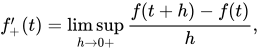
where lim sup is the supremum limit and the limit is a one-sided limit. The lower Dini derivative, f′−, is defined by
-
f
−
′
(
t
)
=
lim inf
h
→
0
+
f
(
t
)
−
f
(
t
−
h
)
h
,
{\displaystyle f'_{-}(t)=\liminf _{h\to {0+}}{\frac {f(t)-f(t-h)}{h}},}

where lim inf is the infimum limit.
If f is defined on a vector space, then the upper Dini derivative at t in the direction d is defined by
-
f
+
′
(
t
,
d
)
=
lim sup
h
→
0
+
f
(
t
+
h
d
)
−
f
(
t
)
h
.
{\displaystyle f'_{+}(t,d)=\limsup _{h\to {0+}}{\frac {f(t+hd)-f(t)}{h}}.}

If f is locally Lipschitz, then f′+ is finite. If f is differentiable at t, then the Dini derivative at t is the usual derivative at t.
Remarks
- The functions are defined in terms of the infimum and supremum in order to make the Dini derivatives as "bullet proof" as possible, so that the Dini derivatives are well-defined for almost all functions, even for functions that are not conventionally differentiable. The upshot of Dini's analysis is that a function is differentiable at the point t on the real line (ℝ), only if all the Dini derivatives exist, and have the same value.
- Sometimes the notation D+ f(t) is used instead of f′+(t) and D− f(t) is used instead of f′−(t).[1]
- Also,
-
D
+
f
(
t
)
=
lim sup
h
→
0
+
f
(
t
+
h
)
−
f
(
t
)
h
{\displaystyle D^{+}f(t)=\limsup _{h\to {0+}}{\frac {f(t+h)-f(t)}{h}}}

and
-
D
−
f
(
t
)
=
lim inf
h
→
0
+
f
(
t
)
−
f
(
t
−
h
)
h
{\displaystyle D_{-}f(t)=\liminf _{h\to {0+}}{\frac {f(t)-f(t-h)}{h}}}
.
- So when using the D notation of the Dini derivatives, the plus or minus sign indicates the left- or right-hand limit, and the placement of the sign indicates the infimum or supremum limit.
- There are two further Dini derivatives, defined to be
-
D
+
f
(
t
)
=
lim inf
h
→
0
+
f
(
t
+
h
)
−
f
(
t
)
h
{\displaystyle D_{+}f(t)=\liminf _{h\to {0+}}{\frac {f(t+h)-f(t)}{h}}}

and
-
D
−
f
(
t
)
=
lim sup
h
→
0
+
f
(
t
)
−
f
(
t
−
h
)
h
{\displaystyle D^{-}f(t)=\limsup _{h\to {0+}}{\frac {f(t)-f(t-h)}{h}}}
.
which are the same as the first pair, but with the supremum and the infimum reversed. For only moderately ill-behaved functions, the two extra Dini derivatives aren't needed. For particularly badly behaved functions, if all four Dini derivatives have the same value (
D
+
f
(
t
)
=
D
+
f
(
t
)
=
D
−
f
(
t
)
=
D
−
f
(
t
)
{\displaystyle D^{+}f(t)=D_{+}f(t)=D^{-}f(t)=D_{-}f(t)}

- On the extended reals, each of the Dini derivatives always exist; however, they may take on the values +∞ or −∞ at times (i.e., the Dini derivatives always exist in the extended sense).
See also
- Denjoy–Young–Saks theorem – Mathematical theorem about Dini derivatives
- Derivative (generalizations) – Fundamental construction of differential calculusPages displaying short descriptions of redirect targets
- Semi-differentiability – Property of a mathematical function
References
- Khalil, Hassan K. (2002). Nonlinear Systems (3rd ed.). Upper Saddle River, NJ: Prentice Hall. ISBN 0-13-067389-7.
- Lukashenko, T.P. (2001) [1994], "Dini derivative", Encyclopedia of Mathematics, EMS Press.
- Royden, H. L. (1968). Real Analysis (2nd ed.). MacMillan. ISBN 978-0-02-404150-0.
- Thomson, Brian S.; Bruckner, Judith B.; Bruckner, Andrew M. (2008). Elementary Real Analysis. ClassicalRealAnalysis.com [first edition published by Prentice Hall in 2001]. pp. 301–302. ISBN 978-1-4348-4161-2.
This article incorporates material from Dini derivative on PlanetMath, which is licensed under the Creative Commons Attribution/Share-Alike License.