In number theory, a diophantine m-tuple is a set of m positive integers
{
a
1
,
a
2
,
a
3
,
a
4
,
…
,
a
m
}
{\displaystyle \{a_{1},a_{2},a_{3},a_{4},\ldots ,a_{m}\}}



Diophantine m-tuples
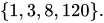
The first diophantine quadruple was found by Fermat:
{
1
,
3
,
8
,
120
}
.
{\displaystyle \{1,3,8,120\}.}

The question of existence of (integer) diophantine quintuples was one of the oldest outstanding unsolved problems in number theory. In 2004 Andrej Dujella showed that at most a finite number of diophantine quintuples exist.[1] In 2016 it was shown that no such quintuples exist by He, Togbé and Ziegler.[2]
As Euler proved, every Diophantine pair can be extended to a Diophantine quadruple. The same is true for every Diophantine triple. In both of these types of extension, as for Fermat's quadruple, it is possible to add a fifth rational number rather than an integer.[3]
The rational case
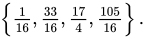
Diophantus himself found the rational diophantine quadruple
{
1
16
,
33
16
,
17
4
,
105
16
}
.
{\displaystyle \left\{{\tfrac {1}{16}},{\tfrac {33}{16}},{\tfrac {17}{4}},{\tfrac {105}{16}}\right\}.}
References
- Dujella, Andrej (January 2006). "There are only finitely many Diophantine quintuples". Journal für die reine und angewandte Mathematik. 2004 (566): 183–214. CiteSeerX 10.1.1.58.8571. doi:10.1515/crll.2004.003.
- He, B.; Togbé, A.; Ziegler, V. (2016). "There is no Diophantine Quintuple". Transactions of the American Mathematical Society. arXiv:1610.04020.
- Arkin, Joseph; Hoggatt, V. E. Jr.; Straus, E. G. (1979). "On Euler's solution of a problem of Diophantus" (PDF). Fibonacci Quarterly. 17 (4): 333–339. doi:10.1080/00150517.1979.12430206. MR 0550175.
- Gibbs, Philip (1999). "A Generalised Stern-Brocot Tree from Regular Diophantine Quadruples". arXiv:math.NT/9903035v1.
- Herrmann, E.; Pethoe, A.; Zimmer, H. G. (1999). "On Fermat's quadruple equations". Math. Sem. Univ. Hamburg. 69: 283–291. doi:10.1007/bf02940880. hdl:2437/90714.