
In geometry, an epicycloid (also called hypercycloid)[1] is a plane curve produced by tracing the path of a chosen point on the circumference of a circle—called an epicycle—which rolls without slipping around a fixed circle. It is a particular kind of roulette.
An epicycloid with a minor radius (R2) of 0 is a circle. This is a degenerate form.
Equations
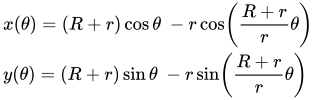
If the rolling circle has radius
r
{\displaystyle r}


-
x
(
θ
)
=
(
R
+
r
)
cos
θ
−
r
cos
(
R
+
r
r
θ
)
y
(
θ
)
=
(
R
+
r
)
sin
θ
−
r
sin
(
R
+
r
r
θ
)
{\displaystyle {\begin{aligned}&x(\theta )=(R+r)\cos \theta \ -r\cos \left({\frac {R+r}{r}}\theta \right)\\&y(\theta )=(R+r)\sin \theta \ -r\sin \left({\frac {R+r}{r}}\theta \right)\end{aligned}}}
or:
-
x
(
θ
)
=
r
(
k
+
1
)
cos
θ
−
r
cos
(
(
k
+
1
)
θ
)
y
(
θ
)
=
r
(
k
+
1
)
sin
θ
−
r
sin
(
(
k
+
1
)
θ
)
.
{\displaystyle {\begin{aligned}&x(\theta )=r(k+1)\cos \theta -r\cos \left((k+1)\theta \right)\\&y(\theta )=r(k+1)\sin \theta -r\sin \left((k+1)\theta \right).\end{aligned}}}

This can be written in a more concise form using complex numbers as[2]
-
z
(
θ
)
=
r
(
(
k
+
1
)
e
i
θ
−
e
i
(
k
+
1
)
θ
)
{\displaystyle z(\theta )=r\left((k+1)e^{i\theta }-e^{i(k+1)\theta }\right)}

where
- the angle
θ
∈
[
0
,
2
π
]
,
{\displaystyle \theta \in [0,2\pi ],}
- the rolling circle has radius
r
{\displaystyle r}
- the fixed circle has radius
k
r
{\displaystyle kr}
.
![{\displaystyle \theta \in [0,2\pi ],}](https://wikimedia.org/api/rest_v1/media/math/render/svg/447f09acb3212adffba88ba2ef9af96f18ad6e85)
Area and arc length
Assuming the initial point lies on the larger circle, when
k
{\displaystyle k}


-
A
=
(
k
+
1
)
(
k
+
2
)
π
r
2
,
{\displaystyle A=(k+1)(k+2)\pi r^{2},}
-
s
=
8
(
k
+
1
)
r
.
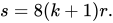
{\displaystyle s=8(k+1)r.}

It means that the epicycloid is
(
k
+
1
)
(
k
+
2
)
k
2
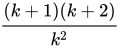
{\displaystyle {\frac {(k+1)(k+2)}{k^{2}}}}
If
k
{\displaystyle k}
If
k
{\displaystyle k}


| To close the curve and |
| complete the 1st repeating pattern : |
| θ = 0 to q rotations |
| α = 0 to p rotations |
| total rotations of outer rolling circle = p + q rotations |
Count the animation rotations to see p and q
If
k
{\displaystyle k}

The distance
O
P
¯
{\displaystyle {\overline {OP}}}

-
R
≤
O
P
¯
≤
R
+
2
r
{\displaystyle R\leq {\overline {OP}}\leq R+2r}

where
-
R
{\displaystyle R}
= radius of large circle and
-
2
r
{\displaystyle 2r}
= diameter of small circle .
- Epicycloid examples
 k = 1; a cardioid
 k = 2; a nephroid
 k = 3; a trefoiloid
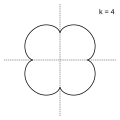 k = 4; a quatrefoiloid
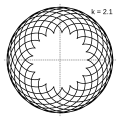 k = 2.1 = 21/10
 k = 3.8 = 19/5
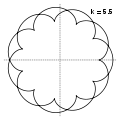 k = 5.5 = 11/2
 k = 7.2 = 36/5


The epicycloid is a special kind of epitrochoid.
An epicycle with one cusp is a cardioid, two cusps is a nephroid.
Proof

Assuming that the position of
p
{\displaystyle p}


Since there is no sliding between the two cycles, then
-
ℓ
R
=
ℓ
r
{\displaystyle \ell _{R}=\ell _{r}}

By the definition of angle (which is the rate arc over radius), then
-
ℓ
R
=
θ
R
{\displaystyle \ell _{R}=\theta R}

and
-
ℓ
r
=
α
r
{\displaystyle \ell _{r}=\alpha r}
.
From these two conditions, the following identity is obtained
-
θ
R
=
α
r
{\displaystyle \theta R=\alpha r}
.
By calculating, the relation between
α
{\displaystyle \alpha }
-
α
=
R
r
θ
{\displaystyle \alpha ={\frac {R}{r}}\theta }
.
From the figure, the position of the point
p
{\displaystyle p}
-
x
=
(
R
+
r
)
cos
θ
−
r
cos
(
θ
+
α
)
=
(
R
+
r
)
cos
θ
−
r
cos
(
R
+
r
r
θ
)
{\displaystyle x=\left(R+r\right)\cos \theta -r\cos \left(\theta +\alpha \right)=\left(R+r\right)\cos \theta -r\cos \left({\frac {R+r}{r}}\theta \right)}
-
y
=
(
R
+
r
)
sin
θ
−
r
sin
(
θ
+
α
)
=
(
R
+
r
)
sin
θ
−
r
sin
(
R
+
r
r
θ
)
{\displaystyle y=\left(R+r\right)\sin \theta -r\sin \left(\theta +\alpha \right)=\left(R+r\right)\sin \theta -r\sin \left({\frac {R+r}{r}}\theta \right)}


See also

References
- J. Dennis Lawrence (1972). A catalog of special plane curves. Dover Publications. pp. 161, 168–170, 175. ISBN 978-0-486-60288-2.
External links
- Weisstein, Eric W. "Epicycloid". MathWorld.
- "Epicycloid" by Michael Ford, The Wolfram Demonstrations Project, 2007
- O'Connor, John J.; Robertson, Edmund F., "Epicycloid", MacTutor History of Mathematics Archive, University of St Andrews
- Animation of Epicycloids, Pericycloids and Hypocycloids
- Spirograph -- GeoFun
- Historical note on the application of the epicycloid to the form of Gear Teeth