In mathematics, the extended natural numbers is a set which contains the values
0
,
1
,
2
,
…
{\displaystyle 0,1,2,\dots }



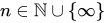



With addition and multiplication,
N
∪
{
∞
}
{\displaystyle \mathbb {N} \cup \{\infty \}}


Applications
In graph theory, the extended natural numbers are used to define distances in graphs, with
∞
{\displaystyle \infty }
In topology, the topos of right actions on the extended natural numbers is a category PRO of projection algebras.[4]
In constructive mathematics, the extended natural numbers
N
∞
{\displaystyle \mathbb {N} _{\infty }}





Notes
References
- Folkman, Jon; Fulkerson, D.R. (1970). "Flows in Infinite Graphs". Journal of Combinatorial Theory. 8 (1): 30–44. doi:10.1016/S0021-9800(70)80006-0.
- Escardó, Martín H (2013). "Infinite Sets That Satisfy The Principle of Omniscience in Any Variety of Constructive Mathematics". Journal of Symbolic Logic. 78 (3): 764–784. doi:10.2178/jsl.7803040. JSTOR 43303679.
- Koch, Sebastian (2020). "Extended Natural Numbers and Counters" (PDF). Formalized Mathematics. 28 (3): 239–249. doi:10.2478/forma-2020-0021.
- Khanjanzadeh, Zeinab; Madanshekaf, Ali (2018). "Weak Ideal Topology in the Topos of Right Acts Over a Monoid". Communications in Algebra. 46 (5): 1868–1888. doi:10.1080/00927872.2017.1360330.
- Sakarovitch, Jacques (2009). Elements of automata theory. Translated from the French by Reuben Thomas. Cambridge: Cambridge University Press. ISBN 978-0-521-84425-3. Zbl 1188.68177.
Further reading
- Robert, Leonel (3 September 2013). "The Cuntz semigroup of some spaces of dimension at most two". arXiv:0711.4396 [math.OA].
- Lightstone, A. H. (1972). "Infinitesimals". The American Mathematical Monthly. 79 (3): 242–251. doi:10.1080/00029890.1972.11993024.
- Khanjanzadeh, Zeinab; Madanshekaf, Ali (2019). "On Projection Algebras". Southeast Asian Bulletin of Mathematics. 43 (2).
External links
- Extended natural number at the nLab