In algebra, the factor theorem connects polynomial factors with polynomial roots. Specifically, if
f
(
x
)
{\displaystyle f(x)}
is a (univariate) polynomial, then
x
−
a
{\displaystyle x-a}
is a factor of
f
(
x
)
{\displaystyle f(x)}
if and only if
f
(
a
)
=
0
{\displaystyle f(a)=0}
(that is,
a
{\displaystyle a}
is a root of the polynomial). The theorem is a special case of the polynomial remainder theorem.[1][2]
The theorem results from basic properties of addition and multiplication. It follows that the theorem holds also when the coefficients and the element
a
{\displaystyle a}
belong to any commutative ring, and not just a field.
In particular, since multivariate polynomials can be viewed as univariate in one of their variables, the following generalization holds : If
f
(
X
1
,
…
,
X
n
)
{\displaystyle f(X_{1},\ldots ,X_{n})}
and
g
(
X
2
,
…
,
X
n
)
{\displaystyle g(X_{2},\ldots ,X_{n})}
are multivariate polynomials and
g
{\displaystyle g}
is independent of
X
1
{\displaystyle X_{1}}
, then
X
1
−
g
(
X
2
,
…
,
X
n
)
{\displaystyle X_{1}-g(X_{2},\ldots ,X_{n})}
is a factor of
f
(
X
1
,
…
,
X
n
)
{\displaystyle f(X_{1},\ldots ,X_{n})}
if and only if
f
(
g
(
X
2
,
…
,
X
n
)
,
X
2
,
…
,
X
n
)
{\displaystyle f(g(X_{2},\ldots ,X_{n}),X_{2},\ldots ,X_{n})}
is the zero polynomial.
Factorization of polynomials
Two problems where the factor theorem is commonly applied are those of factoring a polynomial and finding the roots of a polynomial equation; it is a direct consequence of the theorem that these problems are essentially equivalent.
The factor theorem is also used to remove known zeros from a polynomial while leaving all unknown zeros intact, thus producing a lower degree polynomial whose zeros may be easier to find. Abstractly, the method is as follows:[3]
- Deduce the candidate of zero
a
{\displaystyle a}
of the polynomial f {\displaystyle f}
from its leading coefficient a n {\displaystyle a_{n}}
and constant term a 0 {\displaystyle a_{0}}
. (See Rational root theorem.)
- Use the factor theorem to conclude that
(
x
−
a
)
{\displaystyle (x-a)}
is a factor of f ( x ) {\displaystyle f(x)}
.
- Compute the polynomial
g
(
x
)
=
f
(
x
)
(
x
−
a
)
{\textstyle g(x)={\dfrac {f(x)}{(x-a)}}}
, for example using polynomial long division or synthetic division.
- Conclude that any root
x
≠
a
{\displaystyle x\neq a}
of f ( x ) = 0 {\displaystyle f(x)=0}
is a root of g ( x ) = 0 {\displaystyle g(x)=0}
. Since the polynomial degree of g {\displaystyle g}
is one less than that of f {\displaystyle f}
, it is "simpler" to find the remaining zeros by studying g {\displaystyle g}
.
Continuing the process until the polynomial
f
{\displaystyle f}
is factored completely, which all its factors is irreducible on
R
[
x
]
{\displaystyle \mathbb {R} [x]}
or
C
[
x
]
{\displaystyle \mathbb {C} [x]}
.
Example
Find the factors of
x
3
+
7
x
2
+
8
x
+
2.
{\displaystyle x^{3}+7x^{2}+8x+2.}
Solution: Let
p
(
x
)
{\displaystyle p(x)}
be the above polynomial
- Constant term = 2
- Coefficient of
x
3
=
1
{\displaystyle x^{3}=1}
All possible factors of 2 are
±
1
{\displaystyle \pm 1}
and
±
2
{\displaystyle \pm 2}
. Substituting
x
=
−
1
{\displaystyle x=-1}
, we get:
-
(
−
1
)
3
+
7
(
−
1
)
2
+
8
(
−
1
)
+
2
=
0
{\displaystyle (-1)^{3}+7(-1)^{2}+8(-1)+2=0}
So,
(
x
−
(
−
1
)
)
{\displaystyle (x-(-1))}
, i.e.,
(
x
+
1
)
{\displaystyle (x+1)}
is a factor of
p
(
x
)
{\displaystyle p(x)}
. On dividing
p
(
x
)
{\displaystyle p(x)}
by
(
x
+
1
)
{\displaystyle (x+1)}
, we get
- Quotient =
x
2
+
6
x
+
2
{\displaystyle x^{2}+6x+2}
Hence,
p
(
x
)
=
(
x
2
+
6
x
+
2
)
(
x
+
1
)
{\displaystyle p(x)=(x^{2}+6x+2)(x+1)}
Out of these, the quadratic factor can be further factored using the quadratic formula, which gives as roots of the quadratic
−
3
±
7
.
{\displaystyle -3\pm {\sqrt {7}}.}
Thus the three irreducible factors of the original polynomial are
x
+
1
,
{\displaystyle x+1,}
x
−
(
−
3
+
7
)
,
{\displaystyle x-(-3+{\sqrt {7}}),}
and
x
−
(
−
3
−
7
)
.
{\displaystyle x-(-3-{\sqrt {7}}).}
Proofs
Several proofs of the theorem are presented here.
If
x
−
a
{\displaystyle x-a}
is a factor of
f
(
x
)
,
{\displaystyle f(x),}
it is immediate that
f
(
a
)
=
0.
{\displaystyle f(a)=0.}
So, only the converse will be proved in the following.
Proof 1
This proof begins by verifying the statement for
a
=
0
{\displaystyle a=0}
. That is, it will show that for any polynomial
f
(
x
)
{\displaystyle f(x)}
for which
f
(
0
)
=
0
{\displaystyle f(0)=0}
, there exists a polynomial
g
(
x
)
{\displaystyle g(x)}
such that
f
(
x
)
=
x
⋅
g
(
x
)
{\displaystyle f(x)=x\cdot g(x)}
. To that end, write
f
(
x
)
{\displaystyle f(x)}
explicitly as
c
0
+
c
1
x
1
+
…
+
c
n
x
n
{\displaystyle c_{0}+c_{1}x^{1}+\dotsc +c_{n}x^{n}}
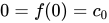
. Now observe that
0
=
f
(
0
)
=
c
0
{\displaystyle 0=f(0)=c_{0}}
, so
c
0
=
0
{\displaystyle c_{0}=0}
. Thus,
f
(
x
)
=
x
(
c
1
+
c
2
x
1
+
…
+
c
n
x
n
−
1
)
=
x
⋅
g
(
x
)
{\displaystyle f(x)=x(c_{1}+c_{2}x^{1}+\dotsc +c_{n}x^{n-1})=x\cdot g(x)}
. This case is now proven.
What remains is to prove the theorem for general
a
{\displaystyle a}
by reducing to the
a
=
0
{\displaystyle a=0}
case. To that end, observe that
f
(
x
+
a
)
{\displaystyle f(x+a)}
is a polynomial with a root at
x
=
0
{\displaystyle x=0}
. By what has been shown above, it follows that
f
(
x
+
a
)
=
x
⋅
g
(
x
)
{\displaystyle f(x+a)=x\cdot g(x)}
for some polynomial
g
(
x
)
{\displaystyle g(x)}
. Finally,
f
(
x
)
=
f
(
(
x
−
a
)
+
a
)
=
(
x
−
a
)
⋅
g
(
x
−
a
)
{\displaystyle f(x)=f((x-a)+a)=(x-a)\cdot g(x-a)}
.
Proof 2
First, observe that whenever
x
{\displaystyle x}
and
y
{\displaystyle y}
belong to any commutative ring (the same one) then the identity
x
n
−
y
n
=
(
x
−
y
)
(
y
n
−
1
+
x
1
y
n
−
2
+
…
+
x
n
−
2
y
1
+
x
n
−
1
)
{\displaystyle x^{n}-y^{n}=(x-y)(y^{n-1}+x^{1}y^{n-2}+\dotsc +x^{n-2}y^{1}+x^{n-1})}
is true. This is shown by multiplying out the brackets.
Let
f
(
X
)
∈
R
[
X
]
{\displaystyle f(X)\in R\left[X\right]}
where
R
{\displaystyle R}
is any commutative ring. Write
f
(
X
)
=
∑
i
c
i
X
i
{\displaystyle f(X)=\sum _{i}c_{i}X^{i}}
for a sequence of coefficients
(
c
i
)
i
{\displaystyle (c_{i})_{i}}
. Assume
f
(
a
)
=
0
{\displaystyle f(a)=0}
for some
a
∈
R
{\displaystyle a\in R}
. Observe then that
f
(
X
)
=
f
(
X
)
−
f
(
a
)
=
∑
i
c
i
(
X
i
−
a
i
)
{\displaystyle f(X)=f(X)-f(a)=\sum _{i}c_{i}(X^{i}-a^{i})}
. Observe that each summand has
X
−
a
{\displaystyle X-a}
as a factor by the factorisation of expressions of the form
x
n
−
y
n
{\displaystyle x^{n}-y^{n}}
that was discussed above. Thus, conclude that
X
−
a
{\displaystyle X-a}
is a factor of
f
(
X
)
{\displaystyle f(X)}
.
Proof 3
The theorem may be proved using Euclidean division of polynomials: Perform a Euclidean division of
f
(
x
)
{\displaystyle f(x)}
by
(
x
−
a
)
{\displaystyle (x-a)}
to obtain
f
(
x
)
=
(
x
−
a
)
Q
(
x
)
+
R
(
x
)
{\displaystyle f(x)=(x-a)Q(x)+R(x)}
where
deg
(
R
)
<
deg
(
x
−
a
)
{\displaystyle \deg(R)<\deg(x-a)}
. Since
deg
(
R
)
<
deg
(
x
−
a
)
{\displaystyle \deg(R)<\deg(x-a)}
, it follows that
R
{\displaystyle R}
is constant. Finally, observe that
0
=
f
(
a
)
=
R
{\displaystyle 0=f(a)=R}
. So
f
(
x
)
=
(
x
−
a
)
Q
(
x
)
{\displaystyle f(x)=(x-a)Q(x)}
.
The Euclidean division above is possible in every commutative ring since
(
x
−
a
)
{\displaystyle (x-a)}
is a monic polynomial, and, therefore, the polynomial long division algorithm does not involve any division of coefficients.
Corollary of other theorems
It is also a corollary of the polynomial remainder theorem, but conversely can be used to show it.
When the polynomials are multivariate but the coefficients form an algebraically closed field, the Nullstellensatz is a significant and deep generalisation.
References
- Sullivan, Michael (1996), Algebra and Trigonometry, Prentice Hall, p. 381, ISBN 0-13-370149-2
- Sehgal, V K; Gupta, Sonal (September 2009), Longman ICSE Mathematics Class 10, Dorling Kindersley (India), p. 119, ISBN 978-81-317-2816-1.
- Bansal, R. K., Comprehensive Mathematics IX, Laxmi Publications, p. 142, ISBN 81-7008-629-9.