In mathematics, Fourier–Bessel series is a particular kind of generalized Fourier series (an infinite series expansion on a finite interval) based on Bessel functions.
Fourier–Bessel series are used in the solution to partial differential equations, particularly in cylindrical coordinate systems.
Definition
The Fourier–Bessel series of a function f(x) with a domain of [0, b] satisfying f(b) = 0

 and (ii)
α
=
1
{\displaystyle \alpha =1}
and (ii)
α
=
1
{\displaystyle \alpha =1}
 .
.
f
:
[
0
,
b
]
→
R
{\displaystyle f:[0,b]\to \mathbb {R} }
![{\displaystyle f:[0,b]\to \mathbb {R} }](https://wikimedia.org/api/rest_v1/media/math/render/svg/c2f74d3dedb1846830ea4bfbe8f3a0700a56135f)
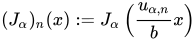
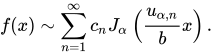
Interpretation
The Fourier–Bessel series may be thought of as a Fourier expansion in the ρ coordinate of cylindrical coordinates. Just as the Fourier series is defined for a finite interval and has a counterpart, the continuous Fourier transform over an infinite interval, so the Fourier–Bessel series has a counterpart over an infinite interval, namely the Hankel transform.
Calculating the coefficients
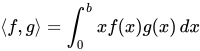
As said, differently scaled Bessel Functions are orthogonal with respect to the inner product

⟨
f
,
g
⟩
=
∫
0
b
x
f
(
x
)
g
(
x
)
d
x
{\displaystyle \langle f,g\rangle =\int _{0}^{b}xf(x)g(x)\,dx}
according to
∫
0
b
x
J
α
(
x
u
α
,
n
b
)
J
α
(
x
u
α
,
m
b
)
d
x
=
b
2
2
δ
m
n
[
J
α
+
1
(
u
α
,
n
)
]
2
,
{\displaystyle \int _{0}^{b}xJ_{\alpha }\left({\frac {xu_{\alpha ,n}}{b}}\right)\,J_{\alpha }\left({\frac {xu_{\alpha ,m}}{b}}\right)\,dx={\frac {b^{2}}{2}}\delta _{mn}[J_{\alpha +1}(u_{\alpha ,n})]^{2},}
![{\displaystyle \int _{0}^{b}xJ_{\alpha }\left({\frac {xu_{\alpha ,n}}{b}}\right)\,J_{\alpha }\left({\frac {xu_{\alpha ,m}}{b}}\right)\,dx={\frac {b^{2}}{2}}\delta _{mn}[J_{\alpha +1}(u_{\alpha ,n})]^{2},}](https://wikimedia.org/api/rest_v1/media/math/render/svg/370e5ce7548098c9890713c039be4465258496f6)
(where:
δ
m
n
{\displaystyle \delta _{mn}}

c
n
=
⟨
f
,
(
J
α
)
n
⟩
⟨
(
J
α
)
n
,
(
J
α
)
n
⟩
=
∫
0
b
x
f
(
x
)
(
J
α
)
n
(
x
)
d
x
1
2
(
b
J
α
±
1
(
u
α
,
n
)
)
2
{\displaystyle c_{n}={\frac {\langle f,(J_{\alpha })_{n}\rangle }{\langle (J_{\alpha })_{n},(J_{\alpha })_{n}\rangle }}={\frac {\int _{0}^{b}xf(x)(J_{\alpha })_{n}(x)\,dx}{{\frac {1}{2}}(bJ_{\alpha \pm 1}(u_{\alpha ,n}))^{2}}}}

where the plus or minus sign is equally valid.
For the inverse transform, one makes use of the following representation of the Dirac delta function[4]
2
x
α
y
1
−
α
b
2
∑
k
=
1
∞
J
α
(
x
u
α
,
k
b
)
J
α
(
y
u
α
,
k
b
)
J
α
+
1
2
(
u
α
,
k
)
=
δ
(
x
−
y
)
.
{\displaystyle {\frac {2x^{\alpha }y^{1-\alpha }}{b^{2}}}\sum _{k=1}^{\infty }{\frac {J_{\alpha }\left({\frac {xu_{\alpha ,k}}{b}}\right)\,J_{\alpha }\left({\frac {yu_{\alpha ,k}}{b}}\right)}{J_{\alpha +1}^{2}(u_{\alpha ,k})}}=\delta (x-y).}

Applications
The Fourier–Bessel series expansion employs aperiodic and decaying Bessel functions as the basis. The Fourier–Bessel series expansion has been successfully applied in diversified areas such as Gear fault diagnosis,[5] discrimination of odorants in a turbulent ambient,[6] postural stability analysis, detection of voice onset time, glottal closure instants (epoch) detection, separation of speech formants, speech enhancement,[7] and speaker identification.[8] The Fourier–Bessel series expansion has also been used to reduce cross terms in the Wigner–Ville distribution.
Dini series
A second Fourier–Bessel series, also known as Dini series, is associated with the Robin boundary condition
b
f
′
(
b
)
+
c
f
(
b
)
=
0
,
{\displaystyle bf'(b)+cf(b)=0,}


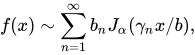
where
γ
n
{\displaystyle \gamma _{n}}


The coefficients
b
n
{\displaystyle b_{n}}


See also
References
- Magnus, Wilhelm; Oberhettinger, Fritz; Soni, Raj Pal (1966). Formulas and Theorems for the Special Functions of Mathematical Physics. doi:10.1007/978-3-662-11761-3. ISBN 978-3-662-11763-7.
- R., Smythe, William (1968). Static and dynamic electricity. - 3rd ed. McGraw-Hill. OCLC 878854927.
{{cite book}}: CS1 maint: multiple names: authors list (link) - Schroeder, Jim (April 1993). "Signal Processing via Fourier-Bessel Series Expansion". Digital Signal Processing. 3 (2): 112–124. Bibcode:1993DSP.....3..112S. doi:10.1006/dspr.1993.1016. ISSN 1051-2004.
- Cahill, Kevin (2019). Physical Mathematics. Cambridge University Press. p. 385. ISBN 9781108470032. Retrieved 9 March 2023.
- D’Elia, Gianluca; Delvecchio, Simone; Dalpiaz, Giorgio (2012), "On the Use of Fourier-Bessel Series Expansion for Gear Diagnostics", Condition Monitoring of Machinery in Non-Stationary Operations, Berlin, Heidelberg: Springer Berlin Heidelberg, pp. 267–275, doi:10.1007/978-3-642-28768-8_28, ISBN 978-3-642-28767-1, retrieved 2022-10-22
- Vergaraa, A.; Martinelli, E.; Huerta, R.; D’Amico, A.; Di Natale, C. (2011). "Orthogonal Decomposition of Chemo-Sensory Signals: Discriminating Odorants in a Turbulent Ambient". Procedia Engineering. 25: 491–494. doi:10.1016/j.proeng.2011.12.122. ISSN 1877-7058.
- Gurgen, F.S.; Chen, C.S. (1990). "Speech enhancement by fourier–bessel coefficients of speech and noise". IEE Proceedings I - Communications, Speech and Vision. 137 (5): 290. doi:10.1049/ip-i-2.1990.0040. ISSN 0956-3776.
- Gopalan, K.; Anderson, T.R.; Cupples, E.J. (May 1999). "A comparison of speaker identification results using features based on cepstrum and Fourier-Bessel expansion". IEEE Transactions on Speech and Audio Processing. 7 (3): 289–294. doi:10.1109/89.759036. ISSN 1063-6676.
External links
- "Fourier-Bessel series", Encyclopedia of Mathematics, EMS Press, 2001 [1994]
- Weisstein, Eric. W. "Fourier-Bessel Series". From MathWorld--A Wolfram Web Resource.
- Fourier–Bessel series applied to Acoustic Field analysis on Trinnov Audio's research page