In mathematics, especially functional analysis, a Fréchet algebra, named after Maurice René Fréchet, is an associative algebra
A
{\displaystyle A}

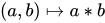



A Fréchet algebra is
m
{\displaystyle m}




A Fréchet algebra may or may not have an identity element
1
A
{\displaystyle 1_{A}}


Properties
- Continuity of multiplication. Multiplication is separately continuous if
a
k
b
→
a
b
{\displaystyle a_{k}b\to ab}
and b a k → b a {\displaystyle ba_{k}\to ba}
for every a , b ∈ A {\displaystyle a,b\in A}
converging in the Fréchet topology of A {\displaystyle A}
imply a k b k → a b {\displaystyle a_{k}b_{k}\to ab}
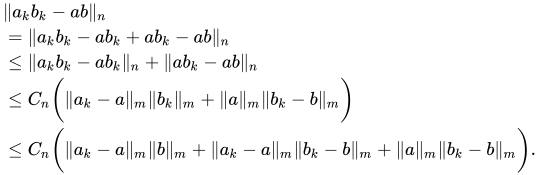
. Joint continuity of multiplication is part of the definition of a Fréchet algebra. For a Fréchet space with an algebra structure, if the multiplication is separately continuous, then it is automatically jointly continuous.[3]
- Group of invertible elements. If
i
n
v
A
{\displaystyle invA}
is the set of invertible elements of A {\displaystyle A}
is continuous if and only if i n v A {\displaystyle invA}
set.[4] Unlike for Banach algebras, i n v A {\displaystyle invA}
-algebra. (If A {\displaystyle A}
, or the set of quasi invertibles[e] may take the place of i n v A {\displaystyle invA}
- Conditions for
m
{\displaystyle m}
there exists p ≥ m {\displaystyle p\geq m}
and C m > 0 {\displaystyle C_{m}>0}
such that ‖ a 1 a 2 ⋯ a n ‖ m ≤ C m n ‖ a 1 ‖ p ‖ a 2 ‖ p ⋯ ‖ a n ‖ p , {\displaystyle \|a_{1}a_{2}\cdots a_{n}\|_{m}\leq C_{m}^{n}\|a_{1}\|_{p}\|a_{2}\|_{p}\cdots \|a_{n}\|_{p},}
for all a 1 , a 2 , … , a n ∈ A {\displaystyle a_{1},a_{2},\dots ,a_{n}\in A}
and n ∈ N {\displaystyle n\in \mathbb {N} }
.[5] A commutative Fréchet Q {\displaystyle Q}
- Properties of
m
{\displaystyle m}
Examples
- Zero multiplication. If
E
{\displaystyle E}
is any Fréchet space, we can make a Fréchet algebra structure by setting e ∗ f = 0 {\displaystyle e*f=0}
for all e , f ∈ E {\displaystyle e,f\in E}
.
- Smooth functions on the circle. Let
S
1
{\displaystyle S^{1}}
be the 1-sphere. This is a 1-dimensional compact differentiable manifold, with no boundary. Let A = C ∞ ( S 1 ) {\displaystyle A=C^{\infty }(S^{1})}
be the set of infinitely differentiable complex-valued functions on S 1 {\displaystyle S^{1}}
acts as an identity. Define a countable set of seminorms on A {\displaystyle A}
where ‖ φ ( n ) ‖ ∞ = sup x ∈ S 1 | φ ( n ) ( x ) | {\displaystyle \left\|\varphi ^{(n)}\right\|_{\infty }=\sup _{x\in {S^{1}}}\left|\varphi ^{(n)}(x)\right|}
denotes the supremum of the absolute value of the n {\displaystyle n}
.[g] Then, by the product rule for differentiation, we have ‖ φ ψ ‖ n = ‖ ∑ i = 0 n ( n i ) φ ( i ) ψ ( n − i ) ‖ ∞ ≤ ∑ i = 0 n ( n i ) ‖ φ ‖ i ‖ ψ ‖ n − i ≤ ∑ i = 0 n ( n i ) ‖ φ ‖ n ′ ‖ ψ ‖ n ′ = 2 n ‖ φ ‖ n ′ ‖ ψ ‖ n ′ , {\displaystyle {\begin{aligned}\|\varphi \psi \|_{n}&=\left\|\sum _{i=0}^{n}{n \choose i}\varphi ^{(i)}\psi ^{(n-i)}\right\|_{\infty }\\&\leq \sum _{i=0}^{n}{n \choose i}\|\varphi \|_{i}\|\psi \|_{n-i}\\&\leq \sum _{i=0}^{n}{n \choose i}\|\varphi \|'_{n}\|\psi \|'_{n}\\&=2^{n}\|\varphi \|'_{n}\|\psi \|'_{n},\end{aligned}}}
where ( n i ) = n ! i ! ( n − i ) ! , {\displaystyle {n \choose i}={\frac {n!}{i!(n-i)!}},}
denotes the binomial coefficient and ‖ ⋅ ‖ n ′ = max k ≤ n ‖ ⋅ ‖ k . {\displaystyle \|\cdot \|'_{n}=\max _{k\leq n}\|\cdot \|_{k}.}
The primed seminorms are submultiplicative after re-scaling by C n = 2 n {\displaystyle C_{n}=2^{n}}
.
- Sequences on
N
{\displaystyle \mathbb {N} }
. Let C N {\displaystyle \mathbb {C} ^{\mathbb {N} }}
be the space of complex-valued sequences on the natural numbers N {\displaystyle \mathbb {N} }
With pointwise multiplication, C N {\displaystyle \mathbb {C} ^{\mathbb {N} }}
for φ , ψ ∈ A {\displaystyle \varphi ,\psi \in A}
. This m {\displaystyle m}
is in A {\displaystyle A}
- Equipped with the topology of uniform convergence on compact sets, and pointwise multiplication,
C
(
C
)
{\displaystyle C(\mathbb {C} )}
, the algebra of all continuous functions on the complex plane C {\displaystyle \mathbb {C} }
, or to the algebra H o l ( C ) {\displaystyle \mathrm {Hol} (\mathbb {C} )}
of holomorphic functions on C {\displaystyle \mathbb {C} }
- Convolution algebra of rapidly vanishing functions on a finitely generated discrete group. Let
G
{\displaystyle G}
be a finitely generated group, with the discrete topology. This means that there exists a set of finitely many elements U = { g 1 , … , g n } ⊆ G {\displaystyle U=\{g_{1},\dots ,g_{n}\}\subseteq G}
such that: ⋃ n = 0 ∞ U n = G . {\displaystyle \bigcup _{n=0}^{\infty }U^{n}=G.}
Without loss of generality, we may also assume that the identity element e {\displaystyle e}
of G {\displaystyle G}
. Define a function ℓ : G → [ 0 , ∞ ) {\displaystyle \ell :G\to [0,\infty )}
by ℓ ( g ) = min { n ∣ g ∈ U n } . {\displaystyle \ell (g)=\min\{n\mid g\in U^{n}\}.}
Then ℓ ( g h ) ≤ ℓ ( g ) + ℓ ( h ) {\displaystyle \ell (gh)\leq \ell (g)+\ell (h)}
, and ℓ ( e ) = 0 {\displaystyle \ell (e)=0}
, since we define U 0 = { e } {\displaystyle U^{0}=\{e\}}
.[h] Let A {\displaystyle A}
where the seminorms ‖ ⋅ ‖ d {\displaystyle \|\cdot \|_{d}}
are defined by ‖ φ ‖ d = ‖ ℓ d φ ‖ 1 = ∑ g ∈ G ℓ ( g ) d | φ ( g ) | . {\displaystyle \|\varphi \|_{d}=\|\ell ^{d}\varphi \|_{1}=\sum _{g\in G}\ell (g)^{d}|\varphi (g)|.}
[i] A {\displaystyle A}
[j] A {\displaystyle A}
- Non
m
{\displaystyle m}
is an example of a commutative non- m {\displaystyle m}
norms ‖ f ‖ p = ( ∫ 0 1 | f ( t ) | p d t ) 1 / p , f ∈ A , {\displaystyle \|f\|_{p}=\left(\int _{0}^{1}|f(t)|^{p}dt\right)^{1/p},\qquad f\in A,}
and multiplication is given by convolution of functions with respect to Lebesgue measure on [ 0 , 1 ] {\displaystyle [0,1]}
.[11]
Generalizations
We can drop the requirement for the algebra to be locally convex, but still a complete metric space. In this case, the underlying space may be called a Fréchet space[12] or an F-space.[13]
If the requirement that the number of seminorms be countable is dropped, the algebra becomes locally convex (LC) or locally multiplicatively convex (LMC).[14] A complete LMC algebra is called an Arens-Michael algebra.[15]
Michael's Conjecture
The question of whether all linear multiplicative functionals on an
m
{\displaystyle m}
Notes
- An increasing family means that for each
a
∈
A
,
{\displaystyle a\in A,}
-
‖
a
‖
0
≤
‖
a
‖
1
≤
⋯
≤
‖
a
‖
n
≤
⋯
{\displaystyle \|a\|_{0}\leq \|a\|_{1}\leq \cdots \leq \|a\|_{n}\leq \cdots }
.
-
‖
a
‖
0
≤
‖
a
‖
1
≤
⋯
≤
‖
a
‖
n
≤
⋯
{\displaystyle \|a\|_{0}\leq \|a\|_{1}\leq \cdots \leq \|a\|_{n}\leq \cdots }
- Joint continuity of multiplication means that for every absolutely convex neighborhood
V
{\displaystyle V}
of zero, there is an absolutely convex neighborhood U {\displaystyle U}
from which the seminorm inequality follows. Conversely,
-
‖
a
k
b
k
−
a
b
‖
n
=
‖
a
k
b
k
−
a
b
k
+
a
b
k
−
a
b
‖
n
≤
‖
a
k
b
k
−
a
b
k
‖
n
+
‖
a
b
k
−
a
b
‖
n
≤
C
n
(
‖
a
k
−
a
‖
m
‖
b
k
‖
m
+
‖
a
‖
m
‖
b
k
−
b
‖
m
)
≤
C
n
(
‖
a
k
−
a
‖
m
‖
b
‖
m
+
‖
a
k
−
a
‖
m
‖
b
k
−
b
‖
m
+
‖
a
‖
m
‖
b
k
−
b
‖
m
)
.
{\displaystyle {\begin{aligned}&{}\|a_{k}b_{k}-ab\|_{n}\\&=\|a_{k}b_{k}-ab_{k}+ab_{k}-ab\|_{n}\\&\leq \|a_{k}b_{k}-ab_{k}\|_{n}+\|ab_{k}-ab\|_{n}\\&\leq C_{n}{\biggl (}\|a_{k}-a\|_{m}\|b_{k}\|_{m}+\|a\|_{m}\|b_{k}-b\|_{m}{\biggr )}\\&\leq C_{n}{\biggl (}\|a_{k}-a\|_{m}\|b\|_{m}+\|a_{k}-a\|_{m}\|b_{k}-b\|_{m}+\|a\|_{m}\|b_{k}-b\|_{m}{\biggr )}.\end{aligned}}}
-
‖
a
k
b
k
−
a
b
‖
n
=
‖
a
k
b
k
−
a
b
k
+
a
b
k
−
a
b
‖
n
≤
‖
a
k
b
k
−
a
b
k
‖
n
+
‖
a
b
k
−
a
b
‖
n
≤
C
n
(
‖
a
k
−
a
‖
m
‖
b
k
‖
m
+
‖
a
‖
m
‖
b
k
−
b
‖
m
)
≤
C
n
(
‖
a
k
−
a
‖
m
‖
b
‖
m
+
‖
a
k
−
a
‖
m
‖
b
k
−
b
‖
m
+
‖
a
‖
m
‖
b
k
−
b
‖
m
)
.
{\displaystyle {\begin{aligned}&{}\|a_{k}b_{k}-ab\|_{n}\\&=\|a_{k}b_{k}-ab_{k}+ab_{k}-ab\|_{n}\\&\leq \|a_{k}b_{k}-ab_{k}\|_{n}+\|ab_{k}-ab\|_{n}\\&\leq C_{n}{\biggl (}\|a_{k}-a\|_{m}\|b_{k}\|_{m}+\|a\|_{m}\|b_{k}-b\|_{m}{\biggr )}\\&\leq C_{n}{\biggl (}\|a_{k}-a\|_{m}\|b\|_{m}+\|a_{k}-a\|_{m}\|b_{k}-b\|_{m}+\|a\|_{m}\|b_{k}-b\|_{m}{\biggr )}.\end{aligned}}}
- In other words, an
m
{\displaystyle m}
and the algebra is complete.
- If
A
{\displaystyle A}
, the unitization A + {\displaystyle A^{+}}
of A {\displaystyle A}
, with multiplication defined as ( a + μ 1 ) ( b + λ 1 ) = a b + μ b + λ a + μ λ 1. {\displaystyle (a+\mu 1)(b+\lambda 1)=ab+\mu b+\lambda a+\mu \lambda 1.}
- If
a
∈
A
{\displaystyle a\in A}
, then b ∈ A {\displaystyle b\in A}
is a quasi-inverse for a {\displaystyle a}
if a + b − a b = 0 {\displaystyle a+b-ab=0}
.
- If
A
{\displaystyle A}
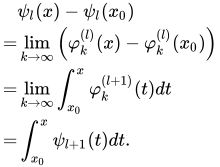
- To see the completeness, let
φ
k
{\displaystyle \varphi _{k}}
be a Cauchy sequence. Then each derivative φ k ( l ) {\displaystyle \varphi _{k}^{(l)}}
is a Cauchy sequence in the sup norm on S 1 {\displaystyle S^{1}}
on S 1 {\displaystyle S^{1}}
th derivative of ψ 0 {\displaystyle \psi _{0}}
. But, using the fundamental theorem of calculus, and taking the limit inside the integral (using uniform convergence), we have
-
ψ
l
(
x
)
−
ψ
l
(
x
0
)
=
lim
k
→
∞
(
φ
k
(
l
)
(
x
)
−
φ
k
(
l
)
(
x
0
)
)
=
lim
k
→
∞
∫
x
0
x
φ
k
(
l
+
1
)
(
t
)
d
t
=
∫
x
0
x
ψ
l
+
1
(
t
)
d
t
.
{\displaystyle {\begin{aligned}&{}\psi _{l}(x)-\psi _{l}(x_{0})\\=&{}\lim _{k\to \infty }\left(\varphi _{k}^{(l)}(x)-\varphi _{k}^{(l)}(x_{0})\right)\\=&{}\lim _{k\to \infty }\int _{x_{0}}^{x}\varphi _{k}^{(l+1)}(t)dt\\=&{}\int _{x_{0}}^{x}\psi _{l+1}(t)dt.\end{aligned}}}
-
ψ
l
(
x
)
−
ψ
l
(
x
0
)
=
lim
k
→
∞
(
φ
k
(
l
)
(
x
)
−
φ
k
(
l
)
(
x
0
)
)
=
lim
k
→
∞
∫
x
0
x
φ
k
(
l
+
1
)
(
t
)
d
t
=
∫
x
0
x
ψ
l
+
1
(
t
)
d
t
.
{\displaystyle {\begin{aligned}&{}\psi _{l}(x)-\psi _{l}(x_{0})\\=&{}\lim _{k\to \infty }\left(\varphi _{k}^{(l)}(x)-\varphi _{k}^{(l)}(x_{0})\right)\\=&{}\lim _{k\to \infty }\int _{x_{0}}^{x}\varphi _{k}^{(l+1)}(t)dt\\=&{}\int _{x_{0}}^{x}\psi _{l+1}(t)dt.\end{aligned}}}
-
We can replace the generating set
U
{\displaystyle U}
, so that U = U − 1 {\displaystyle U=U^{-1}}
. Then ℓ {\displaystyle \ell }
satisfies the additional property ℓ ( g − 1 ) = ℓ ( g ) {\displaystyle \ell (g^{-1})=\ell (g)}
, and is a length function on G {\displaystyle G}
-
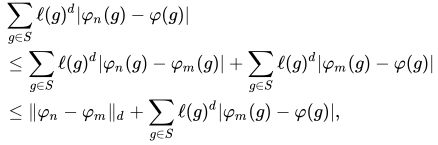
To see that
A
{\displaystyle A}
be a Cauchy sequence. Then for each g ∈ G {\displaystyle g\in G}
, φ n ( g ) {\displaystyle \varphi _{n}(g)}
is a Cauchy sequence in C {\displaystyle \mathbb {C} }
to be the limit. Then
-
∑
g
∈
S
ℓ
(
g
)
d
|
φ
n
(
g
)
−
φ
(
g
)
|
≤
∑
g
∈
S
ℓ
(
g
)
d
|
φ
n
(
g
)
−
φ
m
(
g
)
|
+
∑
g
∈
S
ℓ
(
g
)
d
|
φ
m
(
g
)
−
φ
(
g
)
|
≤
‖
φ
n
−
φ
m
‖
d
+
∑
g
∈
S
ℓ
(
g
)
d
|
φ
m
(
g
)
−
φ
(
g
)
|
,
{\displaystyle {\begin{aligned}&\sum _{g\in S}\ell (g)^{d}|\varphi _{n}(g)-\varphi (g)|\\&\leq \sum _{g\in S}\ell (g)^{d}|\varphi _{n}(g)-\varphi _{m}(g)|+\sum _{g\in S}\ell (g)^{d}|\varphi _{m}(g)-\varphi (g)|\\&\leq \|\varphi _{n}-\varphi _{m}\|_{d}+\sum _{g\in S}\ell (g)^{d}|\varphi _{m}(g)-\varphi (g)|,\end{aligned}}}
of G {\displaystyle G}
, and let K ϵ > 0 {\displaystyle K_{\epsilon }>0}
be such that ‖ φ n − φ m ‖ d < ϵ {\displaystyle \|\varphi _{n}-\varphi _{m}\|_{d}<\epsilon }
for m , n ≥ K ϵ {\displaystyle m,n\geq K_{\epsilon }}
. By letting m {\displaystyle m}
-
∑
g
∈
S
ℓ
(
g
)
d
|
φ
n
(
g
)
−
φ
(
g
)
|
<
ϵ
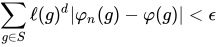
{\displaystyle \sum _{g\in S}\ell (g)^{d}|\varphi _{n}(g)-\varphi (g)|<\epsilon }
. Summing over all of G {\displaystyle G}
for n ≥ K ϵ {\displaystyle n\geq K_{\epsilon }}
-
∑
g
∈
S
ℓ
(
g
)
d
|
φ
(
g
)
|
≤
∑
g
∈
S
ℓ
(
g
)
d
|
φ
n
(
g
)
−
φ
(
g
)
|
+
∑
g
∈
S
ℓ
(
g
)
d
|
φ
n
(
g
)
|
≤
‖
φ
n
−
φ
‖
d
+
‖
φ
n
‖
d
,
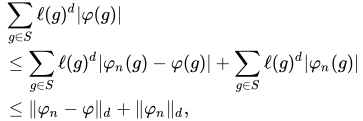
{\displaystyle {\begin{aligned}&{}\sum _{g\in S}\ell (g)^{d}|\varphi (g)|\\&{}\leq \sum _{g\in S}\ell (g)^{d}|\varphi _{n}(g)-\varphi (g)|+\sum _{g\in S}\ell (g)^{d}|\varphi _{n}(g)|\\&{}\leq \|\varphi _{n}-\varphi \|_{d}+\|\varphi _{n}\|_{d},\end{aligned}}}
. Since this holds for each d ∈ N {\displaystyle d\in \mathbb {N} }
, we have φ ∈ A {\displaystyle \varphi \in A}
and φ n → φ {\displaystyle \varphi _{n}\to \varphi }
in the Fréchet topology, so A {\displaystyle A}
-
∑
g
∈
S
ℓ
(
g
)
d
|
φ
n
(
g
)
−
φ
(
g
)
|
≤
∑
g
∈
S
ℓ
(
g
)
d
|
φ
n
(
g
)
−
φ
m
(
g
)
|
+
∑
g
∈
S
ℓ
(
g
)
d
|
φ
m
(
g
)
−
φ
(
g
)
|
≤
‖
φ
n
−
φ
m
‖
d
+
∑
g
∈
S
ℓ
(
g
)
d
|
φ
m
(
g
)
−
φ
(
g
)
|
,
{\displaystyle {\begin{aligned}&\sum _{g\in S}\ell (g)^{d}|\varphi _{n}(g)-\varphi (g)|\\&\leq \sum _{g\in S}\ell (g)^{d}|\varphi _{n}(g)-\varphi _{m}(g)|+\sum _{g\in S}\ell (g)^{d}|\varphi _{m}(g)-\varphi (g)|\\&\leq \|\varphi _{n}-\varphi _{m}\|_{d}+\sum _{g\in S}\ell (g)^{d}|\varphi _{m}(g)-\varphi (g)|,\end{aligned}}}
-
-
‖
φ
∗
ψ
‖
d
≤
∑
g
∈
G
(
∑
h
∈
G
ℓ
(
g
)
d
|
φ
(
h
)
|
|
ψ
(
h
−
1
g
)
|
)
≤
∑
g
,
h
∈
G
(
ℓ
(
h
)
+
ℓ
(
h
−
1
g
)
)
d
|
φ
(
h
)
|
|
ψ
(
h
−
1
g
)
|
=
∑
i
=
0
d
(
d
i
)
(
∑
g
,
h
∈
G
|
ℓ
i
φ
(
h
)
|
|
ℓ
d
−
i
ψ
(
h
−
1
g
)
|
)
=
∑
i
=
0
d
(
d
i
)
(
∑
h
∈
G
|
ℓ
i
φ
(
h
)
|
)
(
∑
g
∈
G
|
ℓ
d
−
i
ψ
(
g
)
|
)
=
∑
i
=
0
d
(
d
i
)
‖
φ
‖
i
‖
ψ
‖
d
−
i
≤
2
d
‖
φ
‖
d
′
‖
ψ
‖
d
′
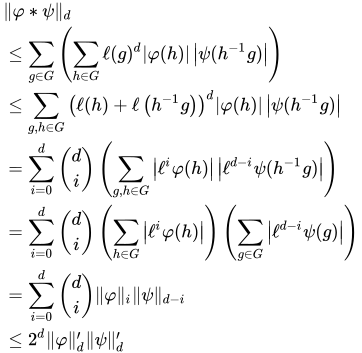
{\displaystyle {\begin{aligned}&\|\varphi *\psi \|_{d}\\&\leq \sum _{g\in G}\left(\sum _{h\in G}\ell (g)^{d}|\varphi (h)|\left|\psi (h^{-1}g)\right|\right)\\&\leq \sum _{g,h\in G}\left(\ell (h)+\ell \left(h^{-1}g\right)\right)^{d}|\varphi (h)|\left|\psi (h^{-1}g)\right|\\&=\sum _{i=0}^{d}{d \choose i}\left(\sum _{g,h\in G}\left|\ell ^{i}\varphi (h)\right|\left|\ell ^{d-i}\psi (h^{-1}g)\right|\right)\\&=\sum _{i=0}^{d}{d \choose i}\left(\sum _{h\in G}\left|\ell ^{i}\varphi (h)\right|\right)\left(\sum _{g\in G}\left|\ell ^{d-i}\psi (g)\right|\right)\\&=\sum _{i=0}^{d}{d \choose i}\|\varphi \|_{i}\|\psi \|_{d-i}\\&\leq 2^{d}\|\varphi \|'_{d}\|\psi \|'_{d}\end{aligned}}}
-
‖
φ
∗
ψ
‖
d
≤
∑
g
∈
G
(
∑
h
∈
G
ℓ
(
g
)
d
|
φ
(
h
)
|
|
ψ
(
h
−
1
g
)
|
)
≤
∑
g
,
h
∈
G
(
ℓ
(
h
)
+
ℓ
(
h
−
1
g
)
)
d
|
φ
(
h
)
|
|
ψ
(
h
−
1
g
)
|
=
∑
i
=
0
d
(
d
i
)
(
∑
g
,
h
∈
G
|
ℓ
i
φ
(
h
)
|
|
ℓ
d
−
i
ψ
(
h
−
1
g
)
|
)
=
∑
i
=
0
d
(
d
i
)
(
∑
h
∈
G
|
ℓ
i
φ
(
h
)
|
)
(
∑
g
∈
G
|
ℓ
d
−
i
ψ
(
g
)
|
)
=
∑
i
=
0
d
(
d
i
)
‖
φ
‖
i
‖
ψ
‖
d
−
i
≤
2
d
‖
φ
‖
d
′
‖
ψ
‖
d
′
{\displaystyle {\begin{aligned}&\|\varphi *\psi \|_{d}\\&\leq \sum _{g\in G}\left(\sum _{h\in G}\ell (g)^{d}|\varphi (h)|\left|\psi (h^{-1}g)\right|\right)\\&\leq \sum _{g,h\in G}\left(\ell (h)+\ell \left(h^{-1}g\right)\right)^{d}|\varphi (h)|\left|\psi (h^{-1}g)\right|\\&=\sum _{i=0}^{d}{d \choose i}\left(\sum _{g,h\in G}\left|\ell ^{i}\varphi (h)\right|\left|\ell ^{d-i}\psi (h^{-1}g)\right|\right)\\&=\sum _{i=0}^{d}{d \choose i}\left(\sum _{h\in G}\left|\ell ^{i}\varphi (h)\right|\right)\left(\sum _{g\in G}\left|\ell ^{d-i}\psi (g)\right|\right)\\&=\sum _{i=0}^{d}{d \choose i}\|\varphi \|_{i}\|\psi \|_{d-i}\\&\leq 2^{d}\|\varphi \|'_{d}\|\psi \|'_{d}\end{aligned}}}


Citations
- Mitiagin, Rolewicz & Żelazko 1962; Żelazko 2001.
- Husain 1991; Żelazko 2001.
- Waelbroeck 1971, Chapter VII, Proposition 1; Palmer 1994,
§
{\displaystyle \S }
2.9.
- Waelbroeck 1971, Chapter VII, Proposition 2.
- Mitiagin, Rolewicz & Żelazko 1962, Lemma 1.2.
- Żelazko 1965, Theorem 13.17.
- Żelazko 1994, pp. 283–290.
- Michael 1952, Theorem 5.1.
- Michael 1952, Theorem 5.2.
- See also Palmer 1994, Theorem 2.9.6.
- Fragoulopoulou 2005, Example 6.13 (2).
- Waelbroeck 1971.
- Rudin 1973, 1.8(e).
- Michael 1952; Husain 1991.
- Fragoulopoulou 2005, Chapter 1.
- Michael 1952,
§
{\displaystyle \S }
Sources
- Fragoulopoulou, Maria (2005). "Bibliography". Topological Algebras with Involution. North-Holland Mathematics Studies. Vol. 200. Amsterdam: Elsevier B.V. pp. 451–485. doi:10.1016/S0304-0208(05)80031-3. ISBN 978-044452025-8.
- Husain, Taqdir (1991). Orthogonal Schauder Bases. Pure and Applied Mathematics. Vol. 143. New York City: Marcel Dekker. ISBN 0-8247-8508-8.
- Michael, Ernest A. (1952). Locally Multiplicatively-Convex Topological Algebras. Memoirs of the American Mathematical Society. Vol. 11. MR 0051444.
- Mitiagin, B.; Rolewicz, S.; Żelazko, W. (1962). "Entire functions in B0-algebras". Studia Mathematica. 21 (3): 291–306. doi:10.4064/sm-21-3-291-306. MR 0144222.
- Palmer, T.W. (1994). Banach Algebras and the General Theory of *-algebras, Volume I: Algebras and Banach Algebras. Encyclopedia of Mathematics and its Applications. Vol. 49. New York City: Cambridge University Press. ISBN 978-052136637-3.
- Rudin, Walter (1973). Functional Analysis. Series in Higher Mathematics. New York City: McGraw-Hill Book. 1.8(e). ISBN 978-007054236-5 – via Internet Archive.
- Waelbroeck, Lucien (1971). Topological Vector Spaces and Algebras. Lecture Notes in Mathematics. Vol. 230. doi:10.1007/BFb0061234. ISBN 978-354005650-8. MR 0467234.
- Żelazko, W. (1965). "Metric generalizations of Banach algebras". Rozprawy Mat. (Dissertationes Math.). 47. Theorem 13.17. MR 0193532.
- Żelazko, W. (1994). "Concerning entire functions in B0-algebras". Studia Mathematica. 110 (3): 283–290. doi:10.4064/sm-110-3-283-290. MR 1292849.
- Żelazko, W. (2001) [1994]. "Fréchet algebra". Encyclopedia of Mathematics. EMS Press.