In mathematics, the Frobenius inner product (also known as the Double-dot product) is a binary operation that takes two matrices and returns a scalar. It is often denoted
⟨
A
,
B
⟩
F
{\displaystyle \langle \mathbf {A} ,\mathbf {B} \rangle _{\mathrm {F} }}


It is named after Ferdinand Georg Frobenius.
Definition
Given two complex-number-valued n×m matrices A and B, written explicitly as
-
A
=
(
A
11
A
12
⋯
A
1
m
A
21
A
22
⋯
A
2
m
⋮
⋮
⋱
⋮
A
n
1
A
n
2
⋯
A
n
m
)
,
B
=
(
B
11
B
12
⋯
B
1
m
B
21
B
22
⋯
B
2
m
⋮
⋮
⋱
⋮
B
n
1
B
n
2
⋯
B
n
m
)
,
{\displaystyle \mathbf {A} ={\begin{pmatrix}A_{11}&A_{12}&\cdots &A_{1m}\\A_{21}&A_{22}&\cdots &A_{2m}\\\vdots &\vdots &\ddots &\vdots \\A_{n1}&A_{n2}&\cdots &A_{nm}\\\end{pmatrix}}\,,\quad \mathbf {B} ={\begin{pmatrix}B_{11}&B_{12}&\cdots &B_{1m}\\B_{21}&B_{22}&\cdots &B_{2m}\\\vdots &\vdots &\ddots &\vdots \\B_{n1}&B_{n2}&\cdots &B_{nm}\\\end{pmatrix}},}

the Frobenius inner product is defined as
-
⟨
A
,
B
⟩
F
=
∑
i
,
j
A
i
j
¯
B
i
j
=
T
r
(
A
T
¯
B
)
≡
T
r
(
A
†
B
)
,
{\displaystyle \langle \mathbf {A} ,\mathbf {B} \rangle _{\mathrm {F} }=\sum _{i,j}{\overline {A_{ij}}}B_{ij}\,=\mathrm {Tr} \left({\overline {\mathbf {A} ^{T}}}\mathbf {B} \right)\equiv \mathrm {Tr} \left(\mathbf {A} ^{\!\dagger }\mathbf {B} \right),}

where the overline denotes the complex conjugate, and
†
{\displaystyle \dagger }

-
⟨
A
,
B
⟩
F
=
A
¯
11
B
11
+
A
¯
12
B
12
+
⋯
+
A
¯
1
m
B
1
m
+
A
¯
21
B
21
+
A
¯
22
B
22
+
⋯
+
A
¯
2
m
B
2
m
⋮
+
A
¯
n
1
B
n
1
+
A
¯
n
2
B
n
2
+
⋯
+
A
¯
n
m
B
n
m
{\displaystyle {\begin{aligned}\langle \mathbf {A} ,\mathbf {B} \rangle _{\mathrm {F} }=&{\overline {A}}_{11}B_{11}+{\overline {A}}_{12}B_{12}+\cdots +{\overline {A}}_{1m}B_{1m}\\&+{\overline {A}}_{21}B_{21}+{\overline {A}}_{22}B_{22}+\cdots +{\overline {A}}_{2m}B_{2m}\\&\vdots \\&+{\overline {A}}_{n1}B_{n1}+{\overline {A}}_{n2}B_{n2}+\cdots +{\overline {A}}_{nm}B_{nm}\\\end{aligned}}}
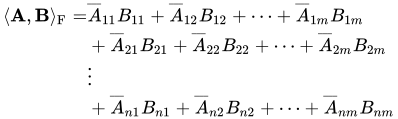
The calculation is very similar to the dot product of two vectors, which in turn is an example of an inner product.
Relation to other products
If A and B are each real-valued matrices, then the Frobenius inner product is the sum of the entries of the Hadamard product. If the matrices are vectorized (i.e., converted into column vectors, denoted by "
v
e
c
(
⋅
)
{\displaystyle \mathrm {vec} (\cdot )}

-
v
e
c
(
A
)
=
(
A
11
A
12
⋮
A
21
A
22
⋮
A
n
m
)
,
v
e
c
(
B
)
=
(
B
11
B
12
⋮
B
21
B
22
⋮
B
n
m
)
,
{\displaystyle \mathrm {vec} (\mathbf {A} )={\begin{pmatrix}A_{11}\\A_{12}\\\vdots \\A_{21}\\A_{22}\\\vdots \\A_{nm}\end{pmatrix}},\quad \mathrm {vec} (\mathbf {B} )={\begin{pmatrix}B_{11}\\B_{12}\\\vdots \\B_{21}\\B_{22}\\\vdots \\B_{nm}\end{pmatrix}}\,,}
v e c ( A ) ¯ T v e c ( B ) = ( A ¯ 11 A ¯ 12 ⋯ A ¯ 21 A ¯ 22 ⋯ A ¯ n m ) ( B 11 B 12 ⋮ B 21 B 22 ⋮ B n m ) {\displaystyle \quad {\overline {\mathrm {vec} (\mathbf {A} )}}^{T}\mathrm {vec} (\mathbf {B} )={\begin{pmatrix}{\overline {A}}_{11}&{\overline {A}}_{12}&\cdots &{\overline {A}}_{21}&{\overline {A}}_{22}&\cdots &{\overline {A}}_{nm}\end{pmatrix}}{\begin{pmatrix}B_{11}\\B_{12}\\\vdots \\B_{21}\\B_{22}\\\vdots \\B_{nm}\end{pmatrix}}}
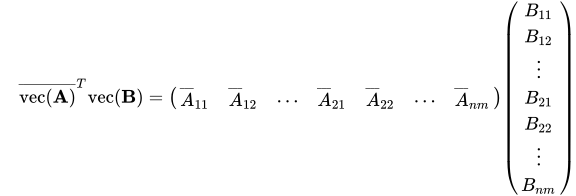
Therefore
-
⟨
A
,
B
⟩
F
=
v
e
c
(
A
)
¯
T
v
e
c
(
B
)
.
{\displaystyle \langle \mathbf {A} ,\mathbf {B} \rangle _{\mathrm {F} }={\overline {\mathrm {vec} (\mathbf {A} )}}^{T}\mathrm {vec} (\mathbf {B} )\,.}

Properties
Like any inner product, it is a sesquilinear form, for four complex-valued matrices A, B, C, D, and two complex numbers a and b:
-
⟨
a
A
,
b
B
⟩
F
=
a
¯
b
⟨
A
,
B
⟩
F
{\displaystyle \langle a\mathbf {A} ,b\mathbf {B} \rangle _{\mathrm {F} }={\overline {a}}b\langle \mathbf {A} ,\mathbf {B} \rangle _{\mathrm {F} }}
-
⟨
A
+
C
,
B
+
D
⟩
F
=
⟨
A
,
B
⟩
F
+
⟨
A
,
D
⟩
F
+
⟨
C
,
B
⟩
F
+
⟨
C
,
D
⟩
F
{\displaystyle \langle \mathbf {A} +\mathbf {C} ,\mathbf {B} +\mathbf {D} \rangle _{\mathrm {F} }=\langle \mathbf {A} ,\mathbf {B} \rangle _{\mathrm {F} }+\langle \mathbf {A} ,\mathbf {D} \rangle _{\mathrm {F} }+\langle \mathbf {C} ,\mathbf {B} \rangle _{\mathrm {F} }+\langle \mathbf {C} ,\mathbf {D} \rangle _{\mathrm {F} }}


Also, exchanging the matrices amounts to complex conjugation:
-
⟨
B
,
A
⟩
F
=
⟨
A
,
B
⟩
F
¯
{\displaystyle \langle \mathbf {B} ,\mathbf {A} \rangle _{\mathrm {F} }={\overline {\langle \mathbf {A} ,\mathbf {B} \rangle _{\mathrm {F} }}}}

For the same matrix, the inner product induces the Frobenius norm
-
⟨
A
,
A
⟩
F
=
‖
A
‖
F
2
≥
0
{\displaystyle \langle \mathbf {A} ,\mathbf {A} \rangle _{\mathrm {F} }=\|\mathbf {A} \|_{\mathrm {F} }^{2}\geq 0}
,[1]
and is zero for a zero matrix,
-
⟨
A
,
A
⟩
F
=
0
⟺
A
=
0
{\displaystyle \langle \mathbf {A} ,\mathbf {A} \rangle _{\mathrm {F} }=0\Longleftrightarrow \mathbf {A} =\mathbf {0} }
.
Examples
Real-valued matrices
For two real-valued matrices, if
-
A
=
(
2
0
6
1
−
1
2
)
,
B
=
(
8
−
3
2
4
1
−
5
)
,
{\displaystyle \mathbf {A} ={\begin{pmatrix}2&0&6\\1&-1&2\end{pmatrix}}\,,\quad \mathbf {B} ={\begin{pmatrix}8&-3&2\\4&1&-5\end{pmatrix}},}

then
-
⟨
A
,
B
⟩
F
=
2
⋅
8
+
0
⋅
(
−
3
)
+
6
⋅
2
+
1
⋅
4
+
(
−
1
)
⋅
1
+
2
⋅
(
−
5
)
=
21.
{\displaystyle {\begin{aligned}\langle \mathbf {A} ,\mathbf {B} \rangle _{\mathrm {F} }&=2\cdot 8+0\cdot (-3)+6\cdot 2+1\cdot 4+(-1)\cdot 1+2\cdot (-5)\\&=21.\end{aligned}}}

Complex-valued matrices
For two complex-valued matrices, if
-
A
=
(
1
+
i
−
2
i
3
−
5
)
,
B
=
(
−
2
3
i
4
−
3
i
6
)
,
{\displaystyle \mathbf {A} ={\begin{pmatrix}1+i&-2i\\3&-5\end{pmatrix}}\,,\quad \mathbf {B} ={\begin{pmatrix}-2&3i\\4-3i&6\end{pmatrix}},}

then
-
⟨
A
,
B
⟩
F
=
(
1
−
i
)
⋅
(
−
2
)
+
(
2
i
)
⋅
3
i
+
3
⋅
(
4
−
3
i
)
+
(
−
5
)
⋅
6
=
−
26
−
7
i
,
{\displaystyle {\begin{aligned}\langle \mathbf {A} ,\mathbf {B} \rangle _{\mathrm {F} }&=(1-i)\cdot (-2)+(2i)\cdot 3i+3\cdot (4-3i)+(-5)\cdot 6\\&=-26-7i,\end{aligned}}}

while
-
⟨
B
,
A
⟩
F
=
(
−
2
)
⋅
(
1
+
i
)
+
(
−
3
i
)
⋅
(
−
2
i
)
+
(
4
+
3
i
)
⋅
3
+
6
⋅
(
−
5
)
=
−
26
+
7
i
.
{\displaystyle {\begin{aligned}\langle \mathbf {B} ,\mathbf {A} \rangle _{\mathrm {F} }&=(-2)\cdot (1+i)+(-3i)\cdot (-2i)+(4+3i)\cdot 3+6\cdot (-5)\\&=-26+7i.\end{aligned}}}

The Frobenius inner products of A with itself, and B with itself, are respectively
-
⟨
A
,
A
⟩
F
=
2
+
4
+
9
+
25
=
40
{\displaystyle \langle \mathbf {A} ,\mathbf {A} \rangle _{\mathrm {F} }=2+4+9+25=40}
⟨ B , B ⟩ F = 4 + 9 + 25 + 36 = 74. {\displaystyle \qquad \langle \mathbf {B} ,\mathbf {B} \rangle _{\mathrm {F} }=4+9+25+36=74.}

See also
- Hadamard product (matrices)
- Hilbert–Schmidt inner product
- Kronecker product
- Matrix multiplication
- Tensor product of Hilbert spaces – the Frobenius inner product is the special case where the vector spaces are finite-dimensional real or complex vector spaces with the usual Euclidean inner product
References
- Horn, R.A.; Johnson., C. R. (2012). Matrix Analysis (2nd ed.). Cambridge: Cambridge University Press. p. 321. ISBN 978-0-521-83940-2.