Generalized balanced ternary is a generalization of the balanced ternary numeral system to represent points in a higher-dimensional space. It was first described in 1982 by Laurie Gibson and Dean Lucas.[1] It has since been used for various applications, including geospatial[2] and high-performance scientific[3] computing.
General form
Like standard positional numeral systems, generalized balanced ternary represents a point
p
{\displaystyle p}


p
=
d
0
+
B
d
1
+
B
2
d
2
+
…
{\displaystyle p=d_{0}+Bd_{1}+B^{2}d_{2}+\ldots }

Generalized balanced ternary uses a transformation matrix as its base
B
{\displaystyle B}

One dimension
In one dimension, generalized balanced ternary is equivalent to standard balanced ternary, with three digits (0, 1, and −1).
B
{\displaystyle B}


B
=
3
D
0
=
0
D
1
=
1
D
2
=
−
1
{\displaystyle {\begin{aligned}B&=3\\D_{0}&=0\\D_{1}&=1\\D_{2}&=-1\end{aligned}}}

Addition table
This is the same addition table as standard balanced ternary, but with
D
2
{\displaystyle D_{2}}


Addition + 0 1 2 0 0 1 2 1 1 12 0 2 2 0 21
Two dimensions

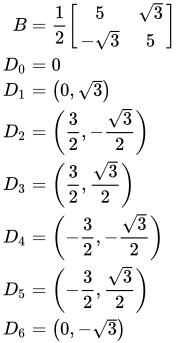
In two dimensions, there are seven digits. The digits
D
1
,
…
,
D
6
{\displaystyle D_{1},\ldots ,D_{6}}


B
=
1
2
[
5
3
−
3
5
]
D
0
=
0
D
1
=
(
0
,
3
)
D
2
=
(
3
2
,
−
3
2
)
D
3
=
(
3
2
,
3
2
)
D
4
=
(
−
3
2
,
−
3
2
)
D
5
=
(
−
3
2
,
3
2
)
D
6
=
(
0
,
−
3
)
{\displaystyle {\begin{aligned}B&={\frac {1}{2}}{\begin{bmatrix}5&{\sqrt {3}}\\-{\sqrt {3}}&5\end{bmatrix}}\\D_{0}&=0\\D_{1}&=\left(0,{\sqrt {3}}\right)\\D_{2}&=\left({\frac {3}{2}},-{\frac {\sqrt {3}}{2}}\right)\\D_{3}&=\left({\frac {3}{2}},{\frac {\sqrt {3}}{2}}\right)\\D_{4}&=\left(-{\frac {3}{2}},-{\frac {\sqrt {3}}{2}}\right)\\D_{5}&=\left(-{\frac {3}{2}},{\frac {\sqrt {3}}{2}}\right)\\D_{6}&=\left(0,-{\sqrt {3}}\right)\\\end{aligned}}}
Addition table
As in the one-dimensional addition table, the numeral
i
{\displaystyle i}
Addition[4] + 0 1 2 3 4 5 6 0 0 1 2 3 4 5 6 1 1 12 3 34 5 16 0 2 2 3 24 25 6 0 61 3 3 34 25 36 0 1 2 4 4 5 6 0 41 52 43 5 5 16 0 1 52 53 4 6 6 0 61 2 43 4 65
If there are two numerals in a cell, the left one is carried over to the next digit. Unlike standard addition, addition of two-dimensional generalized balanced ternary numbers may require multiple carries to be performed while computing a single digit.[4]
See also
References
- Gibson, Laurie; Lucas, Dean (1982). "Spatial Data Processing Using Generalized Balanced Ternary". Proceedings of the IEEE Computer Society Conference on Pattern Recognition and Image Processing: 566–571.
- Sahr, Kevin (2011-01-01). "Hexagonal Discrete Global Grid Systems for Geospatial Computing" (PDF). Archives of Photogrammetry, Cartography and Remote Sensing. 22: 363. Bibcode:2011ArFKT..22..363S.
- de Kinder, R. E. Jr.; Barnes, J. R. (August 1997). "The Generalized Balanced Ternary (GBT) Applied to High-Performance Computational Algorithms". APS Meeting Abstracts. Bibcode:1997APS..CPC..C409D.
- van Roessel, Jan W. (1988). "Conversion of Cartesian coordinates from and to Generalized Balanced Ternary addresses" (PDF). Photogrammetric Engineering and Remote Sensing. 54: 1565–1570.
External links
- Spiral Honeycomb Mosaic, another name for the two-dimensional form of this numbering system
- "Clever Hex Grid Method" discussion on rec.games.roguelike.development