 ?
?In number theory, the generalized taxicab number Taxicab(k, j, n) is the smallest number — if it exists — that can be expressed as the sum of j numbers to the kth positive power in n different ways. For k = 3 and j = 2, they coincide with the taxicab number.
T
a
x
i
c
a
b
(
1
,
2
,
2
)
=
4
=
1
+
3
=
2
+
2
T
a
x
i
c
a
b
(
2
,
2
,
2
)
=
50
=
1
2
+
7
2
=
5
2
+
5
2
T
a
x
i
c
a
b
(
3
,
2
,
2
)
=
1729
=
1
3
+
12
3
=
9
3
+
10
3
{\displaystyle {\begin{aligned}\mathrm {Taxicab} (1,2,2)&=4=1+3=2+2\\\mathrm {Taxicab} (2,2,2)&=50=1^{2}+7^{2}=5^{2}+5^{2}\\\mathrm {Taxicab} (3,2,2)&=1729=1^{3}+12^{3}=9^{3}+10^{3}\end{aligned}}}
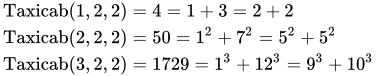
The latter example is 1729, as first noted by Ramanujan.
Euler showed that
T
a
x
i
c
a
b
(
4
,
2
,
2
)
=
635318657
=
59
4
+
158
4
=
133
4
+
134
4
.
{\displaystyle \mathrm {Taxicab} (4,2,2)=635318657=59^{4}+158^{4}=133^{4}+134^{4}.}

However, Taxicab(5, 2, n) is not known for any n ≥ 2:
No positive integer is known that can be written as the sum of two 5th powers in more than one way, and it is not known whether such a number exists.[1]
See also
References
- Guy, Richard K. (2004). Unsolved Problems in Number Theory (Third ed.). New York, New York, USA: Springer-Science+Business Media, Inc. ISBN 0-387-20860-7.
- Ekl, Randy L. (1998). "New results in equal sums of like powers". Math. Comp. 67 (223): 1309–1315. doi:10.1090/S0025-5718-98-00979-X. MR 1474650.