
 , showing a large component and many small ones. At this edge probability, the large component is not yet a giant component: it contains only a sublinear number of vertices.
In network theory, a giant component is a connected component of a given random graph that contains a significant fraction of the entire graph's vertices.
More precisely, in graphs drawn randomly from a probability distribution over arbitrarily large graphs, a giant component is a connected component whose fraction of the overall number of vertices is bounded away from zero. In sufficiently dense graphs distributed according to the Erdős–Rényi model, a giant component exists with high probability.
Giant component in Erdős–Rényi model
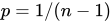
Giant components are a prominent feature of the Erdős–Rényi model (ER) of random graphs, in which each possible edge connecting pairs of a given set of n vertices is present, independently of the other edges, with probability p. In this model, if
p
≤
1
−
ϵ
n
{\displaystyle p\leq {\frac {1-\epsilon }{n}}}


Giant component is also important in percolation theory.[1][2] When a fraction of nodes,
q
=
1
−
p
{\displaystyle q=1-p}





At
p
c
{\displaystyle p_{c}}


Alternatively, if one adds randomly selected edges one at a time, starting with an empty graph, then it is not until approximately
n
/
2
{\displaystyle n/2}


Graphs with arbitrary degree distributions
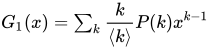
A similar sharp threshold between parameters that lead to graphs with all components small and parameters that lead to a giant component also occurs in tree-like random graphs with non-uniform degree distributions
P
(
k
)
{\displaystyle P(k)}


![{\displaystyle \langle k^{n}\rangle =\mathbb {E} [k^{n}]=\sum k^{n}P(k)}](https://wikimedia.org/api/rest_v1/media/math/render/svg/aeeb80603c209c9c706f02a8840849081bcd525a)
When there is no giant component, the expected size of the small component can also be determined by the first and second moments and it is
1
+
⟨
k
⟩
2
2
⟨
k
⟩
+
⟨
k
2
⟩
.
{\displaystyle 1+{\frac {\langle k\rangle ^{2}}{2\langle k\rangle +\langle k^{2}\rangle }}.}

Criteria for giant component existence in directed and undirected configuration graphs
Similar expressions are also valid for directed graphs, in which case the degree distribution is two-dimensional.[5] There are three types of connected components in directed graphs. For a randomly chosen vertex:
- out-component is a set of vertices that can be reached by recursively following all out-edges forward;
- in-component is a set of vertices that can be reached by recursively following all in-edges backward;
- weak component is a set of vertices that can be reached by recursively following all edges regardless of their direction.
Let a randomly chosen vertex has
k
in
{\displaystyle k_{\text{in}}}


![{\displaystyle c=\mathbb {E} [k_{\text{in}}]=\mathbb {E} [k_{\text{out}}]}](https://wikimedia.org/api/rest_v1/media/math/render/svg/4813043d5dfd1571ff31431e528f6b2ccc8b3a3b)





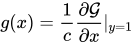
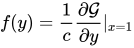
| Type | Criteria |
|---|---|
| undirected: giant component |
E
[
k
2
]
−
2
E
[
k
]
>
0
{\displaystyle \mathbb {E} [k^{2}]-2\mathbb {E} [k]>0}
![{\displaystyle \mathbb {E} [k^{2}]-2\mathbb {E} [k]>0}](https://wikimedia.org/api/rest_v1/media/math/render/svg/44dcd8d41441a48d8e6cb473a137c1629d1caece) ,[3] or
G
1
′
(
1
)
=
1
{\displaystyle G'_{1}(1)=1} ,[3] or
G
1
′
(
1
)
=
1
{\displaystyle G'_{1}(1)=1}
 [5] [5] |
| directed: giant in/out-component |
E
[
k
in
k
o
u
t
]
−
E
[
k
in
]
>
0
{\displaystyle \mathbb {E} [k_{\text{in}}k_{out}]-\mathbb {E} [k_{\text{in}}]>0}
![{\displaystyle \mathbb {E} [k_{\text{in}}k_{out}]-\mathbb {E} [k_{\text{in}}]>0}](https://wikimedia.org/api/rest_v1/media/math/render/svg/f5a2d3b7a35b48534b2475cce716a93ee46dcb6b) ,[5] or
g
1
′
(
1
)
=
f
1
′
(
1
)
=
1
{\displaystyle g'_{1}(1)=f'_{1}(1)=1} ,[5] or
g
1
′
(
1
)
=
f
1
′
(
1
)
=
1
{\displaystyle g'_{1}(1)=f'_{1}(1)=1}
 [5] [5] |
| directed: giant weak component |
2
E
[
k
in
]
E
[
k
in
k
out
]
−
E
[
k
in
]
E
[
k
out
2
]
−
E
[
k
in
]
E
[
k
in
2
]
+
E
[
k
in
2
]
E
[
k
out
2
]
−
E
[
k
in
k
out
]
2
>
0
{\displaystyle 2\mathbb {E} [k_{\text{in}}]\mathbb {E} [k_{\text{in}}k_{\text{out}}]-\mathbb {E} [k_{\text{in}}]\mathbb {E} [k_{\text{out}}^{2}]-\mathbb {E} [k_{\text{in}}]\mathbb {E} [k_{\text{in}}^{2}]+\mathbb {E} [k_{\text{in}}^{2}]\mathbb {E} [k_{\text{out}}^{2}]-\mathbb {E} [k_{\text{in}}k_{\text{out}}]^{2}>0}
![{\displaystyle 2\mathbb {E} [k_{\text{in}}]\mathbb {E} [k_{\text{in}}k_{\text{out}}]-\mathbb {E} [k_{\text{in}}]\mathbb {E} [k_{\text{out}}^{2}]-\mathbb {E} [k_{\text{in}}]\mathbb {E} [k_{\text{in}}^{2}]+\mathbb {E} [k_{\text{in}}^{2}]\mathbb {E} [k_{\text{out}}^{2}]-\mathbb {E} [k_{\text{in}}k_{\text{out}}]^{2}>0}](https://wikimedia.org/api/rest_v1/media/math/render/svg/d43d8855a07e1ac17456ec0da13517fbd422d323) [6] [6] |
See also
- Complex network – Network with non-trivial topological features
- Erdős–Rényi model – Two closely related models for generating random graphs
- Fractals – Infinitely detailed mathematical structurePages displaying short descriptions of redirect targets
- Graph theory – Area of discrete mathematics
- Interdependent networks – Subfield of network science
- Network science – Academic field
- Percolation theory – Mathematical theory on behavior of connected clusters in a random graph
- Percolation – Filtration of fluids through porous materials
- Scale-free network – Network whose degree distribution follows a power law
References
- Bollobás, Béla (2001), "6. The Evolution of Random Graphs—The Giant Component", Random Graphs, Cambridge studies in advanced mathematics, vol. 73 (2nd ed.), Cambridge University Press, pp. 130–159, ISBN 978-0-521-79722-1.
- Newman, M. E. J. (2010). Networks: an introduction. New York: Oxford University Press. OCLC 456837194.
- Molloy, Michael; Reed, Bruce (1995). "A critical point for random graphs with a given degree sequence". Random Structures & Algorithms. 6 (2–3): 161–180. doi:10.1002/rsa.3240060204. ISSN 1042-9832.
- Molloy, Michael; Reed, Bruce (March 1995). "A critical point for random graphs with a given degree sequence". Random Structures & Algorithms. 6 (2–3): 161–180. doi:10.1002/rsa.3240060204. ISSN 1042-9832.
- Newman, M. E. J.; Strogatz, S. H.; Watts, D. J. (2001-07-24). "Random graphs with arbitrary degree distributions and their applications". Physical Review E. 64 (2) 026118. arXiv:cond-mat/0007235. Bibcode:2001PhRvE..64b6118N. doi:10.1103/physreve.64.026118. ISSN 1063-651X. PMID 11497662.
- Kryven, Ivan (2016-07-27). "Emergence of the giant weak component in directed random graphs with arbitrary degree distributions". Physical Review E. 94 (1) 012315. arXiv:1607.03793. Bibcode:2016PhRvE..94a2315K. doi:10.1103/physreve.94.012315. ISSN 2470-0045. PMID 27575156. S2CID 206251373.