In mathematics, the upper half-plane,
H
,
{\displaystyle {\mathcal {H}},}
is the set of points
(
x
,
y
)
{\displaystyle (x,y)}
in the Cartesian plane with
y
>
0.
{\displaystyle y>0.}
The lower half-plane is the set of points
(
x
,
y
)
{\displaystyle (x,y)}
with
y
<
0
{\displaystyle y<0}
instead. Arbitrarily oriented half-planes can be obtained via a planar rotation. Half-planes are an example of two-dimensional half-space. A half-plane can be split in two quadrants.
Affine geometry
The affine transformations of the upper half-plane include
- shifts
(
x
,
y
)
↦
(
x
+
c
,
y
)
{\displaystyle (x,y)\mapsto (x+c,y)}
, c ∈ R {\displaystyle c\in \mathbb {R} }
, and
- dilations
(
x
,
y
)
↦
(
λ
x
,
λ
y
)
{\displaystyle (x,y)\mapsto (\lambda x,\lambda y)}
, λ > 0. {\displaystyle \lambda >0.}
Proposition: Let
A
{\displaystyle A}
and
B
{\displaystyle B}
be semicircles in the upper half-plane with centers on the boundary. Then there is an affine mapping that takes
A
{\displaystyle A}
to
B
{\displaystyle B}
.
- Proof: First shift the center of
A
{\displaystyle A}
to ( 0 , 0 ) . {\displaystyle (0,0).}
Then take λ = ( diameter of B ) / ( diameter of A ) {\displaystyle \lambda =({\text{diameter of}}\ B)/({\text{diameter of}}\ A)}

and dilate. Then shift
(
0
,
0
)
{\displaystyle (0,0)}
to the center of
B
.
{\displaystyle B.}
Inversive geometry
Definition:
Z
:=
{
(
cos
2
θ
,
1
2
sin
2
θ
)
∣
0
<
θ
<
π
}
{\displaystyle {\mathcal {Z}}:=\left\{\left(\cos ^{2}\theta ,{\tfrac {1}{2}}\sin 2\theta \right)\mid 0<\theta <\pi \right\}}

.
Z
{\displaystyle {\mathcal {Z}}}
can be recognized as the circle of radius
1
2
{\displaystyle {\tfrac {1}{2}}}
centered at
(
1
2
,
0
)
,
{\displaystyle {\bigl (}{\tfrac {1}{2}},0{\bigr )},}
and as the polar plot of
ρ
(
θ
)
=
cos
θ
.
{\displaystyle \rho (\theta )=\cos \theta .}
Proposition:
(
0
,
0
)
,
{\displaystyle (0,0),}
ρ
(
θ
)
{\displaystyle \rho (\theta )}
in
Z
,
{\displaystyle {\mathcal {Z}},}
and
(
1
,
tan
θ
)
{\displaystyle (1,\tan \theta )}
are collinear points.
In fact,
Z
{\displaystyle {\mathcal {Z}}}
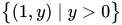
is the inversion of the line
{
(
1
,
y
)
∣
y
>
0
}
{\displaystyle {\bigl \{}(1,y)\mid y>0{\bigr \}}}
in the unit circle. Indeed, the diagonal from
(
0
,
0
)
{\displaystyle (0,0)}
to
(
1
,
tan
θ
)
{\displaystyle (1,\tan \theta )}
has squared length
1
+
tan
2
θ
=
sec
2
θ
{\displaystyle 1+\tan ^{2}\theta =\sec ^{2}\theta }
, so that
ρ
(
θ
)
=
cos
θ
{\displaystyle \rho (\theta )=\cos \theta }
is the reciprocal of that length.
Metric geometry
The distance between any two points
p
{\displaystyle p}
and
q
{\displaystyle q}
in the upper half-plane can be consistently defined as follows: The perpendicular bisector of the segment from
p
{\displaystyle p}
to
q
{\displaystyle q}
either intersects the boundary or is parallel to it. In the latter case
p
{\displaystyle p}
and
q
{\displaystyle q}
lie on a ray perpendicular to the boundary and logarithmic measure can be used to define a distance that is invariant under dilation. In the former case
p
{\displaystyle p}
and
q
{\displaystyle q}
lie on a circle centered at the intersection of their perpendicular bisector and the boundary. By the above proposition this circle can be moved by affine motion to
Z
.
{\displaystyle {\mathcal {Z}}.}
Distances on
Z
{\displaystyle {\mathcal {Z}}}
can be defined using the correspondence with points on
{
(
1
,
y
)
∣
y
>
0
}
{\displaystyle {\bigl \{}(1,y)\mid y>0{\bigr \}}}
and logarithmic measure on this ray. In consequence, the upper half-plane becomes a metric space. The generic name of this metric space is the hyperbolic plane. In terms of the models of hyperbolic geometry, this model is frequently designated the Poincaré half-plane model.
Complex plane
Mathematicians sometimes identify the Cartesian plane with the complex plane, and then the upper half-plane corresponds to the set of complex numbers with positive imaginary part:
-
H
:=
{
x
+
i
y
∣
y
>
0
;
x
,
y
∈
R
}
.
{\displaystyle {\mathcal {H}}:=\{x+iy\mid y>0;\ x,y\in \mathbb {R} \}.}

The term arises from a common visualization of the complex number
x
+
i
y
{\displaystyle x+iy}
as the point
(
x
,
y
)
{\displaystyle (x,y)}
in the plane endowed with Cartesian coordinates. When the
y
{\displaystyle y}
axis is oriented vertically, the "upper half-plane" corresponds to the region above the
x
{\displaystyle x}
axis and thus complex numbers for which
y
>
0
{\displaystyle y>0}
.
It is the domain of many functions of interest in complex analysis, especially modular forms. The lower half-plane, defined by
y
<
0
{\displaystyle y<0}
is equally good, but less used by convention. The open unit disk
D
{\displaystyle {\mathcal {D}}}
(the set of all complex numbers of absolute value less than one) is equivalent by a conformal mapping to
H
{\displaystyle {\mathcal {H}}}
(see "Poincaré metric"), meaning that it is usually possible to pass between
H
{\displaystyle {\mathcal {H}}}
and
D
.
{\displaystyle {\mathcal {D}}.}
It also plays an important role in hyperbolic geometry, where the Poincaré half-plane model provides a way of examining hyperbolic motions. The Poincaré metric provides a hyperbolic metric on the space.
The uniformization theorem for surfaces states that the upper half-plane is the universal covering space of surfaces with constant negative Gaussian curvature.
The closed upper half-plane is the union of the upper half-plane and the real axis. It is the closure of the upper half-plane.
Generalizations
One natural generalization in differential geometry is hyperbolic
n
{\displaystyle n}
-space
H
n
,
{\displaystyle {\mathcal {H}}^{n},}
the maximally symmetric, simply connected,
n
{\displaystyle n}
-dimensional Riemannian manifold with constant sectional curvature
−
1
{\displaystyle -1}
. In this terminology, the upper half-plane is
H
2
{\displaystyle {\mathcal {H}}^{2}}
since it has real dimension
2.
{\displaystyle 2.}
In number theory, the theory of Hilbert modular forms is concerned with the study of certain functions on the direct product
H
n
{\displaystyle {\mathcal {H}}^{n}}
of
n
{\displaystyle n}
copies of the upper half-plane. Yet another space interesting to number theorists is the Siegel upper half-space
H
n
,
{\displaystyle {\mathcal {H}}_{n},}
which is the domain of Siegel modular forms.
