In mathematics and physics, a Hamiltonian vector field on a symplectic manifold is a vector field defined for any energy function or Hamiltonian. Named after the physicist and mathematician Sir William Rowan Hamilton, a Hamiltonian vector field is a geometric manifestation of Hamilton's equations in classical mechanics. The integral curves of a Hamiltonian vector field represent solutions to the equations of motion in the Hamiltonian form. The diffeomorphisms of a symplectic manifold arising from the flow of a Hamiltonian vector field are known as canonical transformations in physics and (Hamiltonian) symplectomorphisms in mathematics.[1]
Hamiltonian vector fields can be defined more generally on an arbitrary Poisson manifold. The Lie bracket of two Hamiltonian vector fields corresponding to functions
f
{\displaystyle f}


Definition
Suppose that
(
M
,
ω
)
{\displaystyle (M,\omega )}


ω
:
T
M
→
T
∗
M
,
{\displaystyle \omega :TM\to T^{*}M,}

between the tangent bundle
T
M
{\displaystyle TM}


Ω
:
T
∗
M
→
T
M
,
Ω
=
ω
−
1
.
{\displaystyle \Omega :T^{*}M\to TM,\quad \Omega =\omega ^{-1}.}

Therefore, one-forms on a symplectic manifold
M
{\displaystyle M}


d
H
(
Y
)
=
ω
(
X
H
,
Y
)
.
{\displaystyle \mathrm {d} H(Y)=\omega (X_{H},Y).}


Note: Some authors define the Hamiltonian vector field with the opposite sign. One has to be mindful of varying conventions in physical and mathematical literature.
Examples
Suppose that
M
{\displaystyle M}


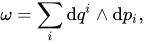
where
d
{\displaystyle \operatorname {d} }


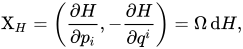
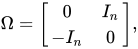
where
Ω
{\displaystyle \Omega }


Ω
=
[
0
I
n
−
I
n
0
]
,
{\displaystyle \Omega ={\begin{bmatrix}0&I_{n}\\-I_{n}&0\\\end{bmatrix}},}
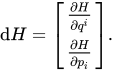
and
d
H
=
[
∂
H
∂
q
i
∂
H
∂
p
i
]
.
{\displaystyle \mathrm {d} H={\begin{bmatrix}{\frac {\partial H}{\partial q^{i}}}\\{\frac {\partial H}{\partial p_{i}}}\end{bmatrix}}.}
The matrix
Ω
{\displaystyle \Omega }

Suppose that
M
=
R
2
n
{\displaystyle M=\mathbb {R} ^{2n}}

- If
H
=
p
i
{\displaystyle H=p_{i}}
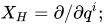
then X H = ∂ / ∂ q i ; {\displaystyle X_{H}=\partial /\partial q^{i};}
- if
H
=
q
i
{\displaystyle H=q_{i}}
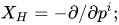
then X H = − ∂ / ∂ p i ; {\displaystyle X_{H}=-\partial /\partial p^{i};}
- if
H
=
1
2
∑
(
p
i
)
2
{\textstyle H={\frac {1}{2}}\sum (p_{i})^{2}}
then X H = ∑ p i ∂ / ∂ q i ; {\textstyle X_{H}=\sum p_{i}\partial /\partial q^{i};}
- if
H
=
1
2
∑
a
i
j
q
i
q
j
,
a
i
j
=
a
j
i
{\textstyle H={\frac {1}{2}}\sum a_{ij}q^{i}q^{j},a_{ij}=a_{ji}}
then X H = − ∑ a i j q i ∂ / ∂ p j . {\textstyle X_{H}=-\sum a_{ij}q_{i}\partial /\partial p^{j}.}


Properties
- The assignment
f
↦
X
f
{\displaystyle f\mapsto X_{f}}
is linear, so that the sum of two Hamiltonian functions transforms into the sum of the corresponding Hamiltonian vector fields.
- Suppose that
(
q
1
,
⋯
,
q
n
,
p
1
,
⋯
,
p
n
)
{\displaystyle (q^{1},\cdots ,q^{n},p_{1},\cdots ,p_{n})}
is an integral curve of the Hamiltonian vector field X H {\displaystyle X_{H}}
- The Hamiltonian
H
{\displaystyle H}
. That is, H ( γ ( t ) ) {\displaystyle H(\gamma (t))}
is actually independent of t {\displaystyle t}
. This property corresponds to the conservation of energy in Hamiltonian mechanics.
- More generally, if two functions
F
{\displaystyle F}
and H {\displaystyle H}
- The symplectic form
ω
{\displaystyle \omega }
.

Poisson bracket
The notion of a Hamiltonian vector field leads to a skew-symmetric bilinear operation on the differentiable functions on a symplectic manifold
M
{\displaystyle M}
{
f
,
g
}
=
ω
(
X
g
,
X
f
)
=
d
g
(
X
f
)
=
L
X
f
g
{\displaystyle \{f,g\}=\omega (X_{g},X_{f})=dg(X_{f})={\mathcal {L}}_{X_{f}}g}

where
L
X
{\displaystyle {\mathcal {L}}_{X}}


![{\displaystyle X_{\{f,g\}}=-[X_{f},X_{g}]}](https://wikimedia.org/api/rest_v1/media/math/render/svg/0dfb1e3c93318f8ebb6c131c219ad7e08ac8230f)
where the right hand side represents the Lie bracket of the Hamiltonian vector fields with Hamiltonians
f
{\displaystyle f}

which means that the vector space of differentiable functions on
M
{\displaystyle M}

Remarks
- See Lee (2003, Chapter 18) for a very concise statement and proof of Noether's theorem.
Notes
Works cited
- Abraham, Ralph; Marsden, Jerrold E. (1978). Foundations of Mechanics. London: Benjamin-Cummings. ISBN 978-080530102-1.See section 3.2.
- Arnol'd, V.I. (1997). Mathematical Methods of Classical Mechanics. Berlin etc: Springer. ISBN 0-387-96890-3.
- Frankel, Theodore (1997). The Geometry of Physics. Cambridge University Press. ISBN 0-521-38753-1.
- Lee, J. M. (2003), Introduction to Smooth manifolds, Springer Graduate Texts in Mathematics, vol. 218, ISBN 0-387-95448-1
- McDuff, Dusa; Salamon, D. (1998). Introduction to Symplectic Topology. Oxford Mathematical Monographs. ISBN 0-19-850451-9.