In mathematics, a Heilbronn set is an infinite set S of natural numbers for which every real number can be arbitrarily closely approximated by a fraction whose denominator is in S. For any given real number
θ
{\displaystyle \theta }
and natural number
h
{\displaystyle h}
, it is easy to find the integer
g
{\displaystyle g}
such that
g
/
h
{\displaystyle g/h}
is closest to
θ
{\displaystyle \theta }
. For example, for the real number
π
{\displaystyle \pi }
and
h
=
100
{\displaystyle h=100}
we have
g
=
314
{\displaystyle g=314}
. If we call the closeness of
θ
{\displaystyle \theta }
to
g
/
h
{\displaystyle g/h}
the difference between
h
θ
{\displaystyle h\theta }
and
g
{\displaystyle g}
, the closeness is always less than 1/2 (in our example it is 0.15926...). A collection of numbers is a Heilbronn set if for any
θ
{\displaystyle \theta }
we can always find a sequence of values for
h
{\displaystyle h}
in the set where the closeness tends to zero.
More mathematically let
‖
α
‖
{\displaystyle \|\alpha \|}
denote the distance from
α
{\displaystyle \alpha }
to the nearest integer then
H
{\displaystyle {\mathcal {H}}}
is a Heilbronn set if and only if for every real number
θ
{\displaystyle \theta }
and every
ε
>
0
{\displaystyle \varepsilon >0}
there exists
h
∈
H
{\displaystyle h\in {\mathcal {H}}}
such that
‖
h
θ
‖
<
ε
{\displaystyle \|h\theta \|<\varepsilon }
.[1]
Examples
The natural numbers are a Heilbronn set as Dirichlet's approximation theorem shows that there exists
q
<
[
1
/
ε
]
{\displaystyle q<[1/\varepsilon ]}
with
‖
q
θ
‖
<
ε
{\displaystyle \|q\theta \|<\varepsilon }
.
The
k
{\displaystyle k}
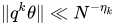
th powers of integers are a Heilbronn set. This follows from a result of I. M. Vinogradov who showed that for every
N
{\displaystyle N}
and
k
{\displaystyle k}
there exists an exponent
η
k
>
0
{\displaystyle \eta _{k}>0}
and
q
<
N
{\displaystyle q<N}
such that
‖
q
k
θ
‖
≪
N
−
η
k
{\displaystyle \|q^{k}\theta \|\ll N^{-\eta _{k}}}
.[2] In the case
k
=
2
{\displaystyle k=2}
Hans Heilbronn was able to show that
η
2
{\displaystyle \eta _{2}}
may be taken arbitrarily close to 1/2.[3] Alexandru Zaharescu has improved Heilbronn's result to show that
η
2
{\displaystyle \eta _{2}}
may be taken arbitrarily close to 4/7.[4]
Any Van der Corput set is also a Heilbronn set.
Example of a non-Heilbronn set
The powers of 10 are not a Heilbronn set. Take
ε
=
0.001
{\displaystyle \varepsilon =0.001}
then the statement that
‖
10
k
θ
‖
<
ε
{\displaystyle \|10^{k}\theta \|<\varepsilon }
for some
k
{\displaystyle k}
is equivalent to saying that the decimal expansion of
θ
{\displaystyle \theta }
has run of three zeros or three nines somewhere. This is not true for all real numbers.
References
- Montgomery, Hugh Lowell (1994). Ten lectures on the Interface Between Analytic Number Theory and Harmonic Analysis. CBMS Regional Conference Series in Mathematics. Vol. 84. Providence Rhode Island: American Mathematical Society. ISBN 0-8218-0737-4.
- Vinogradov, I. M. (1927). "Analytischer Beweis des Satzes uber die Verteilung der Bruchteile eines ganzen Polynoms". Bull. Acad. Sci. USSR. 21 (6): 567–578.
- Heilbronn, Hans (1948). "On the distribution of the sequence
n
2
θ
(
mod
1
)
{\displaystyle n^{2}\theta {\pmod {1}}}
". Q. J. Math. First Series. 19: 249–256. doi:10.1093/qmath/os-19.1.249. MR 0027294.
- Zaharescu, Alexandru (1995). "Small values of
n
2
α
(
mod
1
)
{\displaystyle n^{2}\alpha {\pmod {1}}}
". Invent. Math. 121 (2): 379–388. doi:10.1007/BF01884304. MR 1346212. S2CID 120435242.