Hele-Shaw flow is defined as flow taking place between two parallel flat plates separated by a narrow gap satisfying certain conditions, named after Henry Selby Hele-Shaw, who studied the problem in 1898.[1][2] Various problems in fluid mechanics can be approximated to Hele-Shaw flows and thus the research of these flows is of importance. Approximation to Hele-Shaw flow is specifically important to micro-flows. This is due to manufacturing techniques, which creates shallow planar configurations, and the typically low Reynolds numbers of micro-flows.
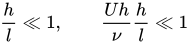
The conditions that needs to be satisfied are
-
h
l
≪
1
,
U
h
ν
h
l
≪
1
{\displaystyle {\frac {h}{l}}\ll 1,\qquad {\frac {Uh}{\nu }}{\frac {h}{l}}\ll 1}
where
h
{\displaystyle h}


The governing equation of Hele-Shaw flows is identical to that of the inviscid potential flow and to the flow of fluid through a porous medium (Darcy's law). It thus permits visualization of this kind of flow in two dimensions.[3][4][5]
Mathematical formulation

Let
x
{\displaystyle x}


∂
p
∂
x
=
μ
∂
2
v
x
∂
z
2
,
∂
p
∂
y
=
μ
∂
2
v
y
∂
z
2
,
∂
p
∂
z
=
0
,
∂
v
x
∂
x
+
∂
v
y
∂
y
+
∂
v
z
∂
z
=
0
,
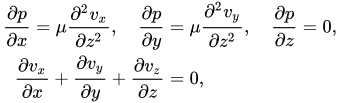
{\displaystyle {\begin{aligned}{\frac {\partial p}{\partial x}}=\mu {\frac {\partial ^{2}v_{x}}{\partial z^{2}}},\quad {\frac {\partial p}{\partial y}}&=\mu {\frac {\partial ^{2}v_{y}}{\partial z^{2}}},\quad {\frac {\partial p}{\partial z}}=0,\\{\frac {\partial v_{x}}{\partial x}}+{\frac {\partial v_{y}}{\partial y}}+{\frac {\partial v_{z}}{\partial z}}&=0,\\\end{aligned}}}
where
μ
{\displaystyle \mu }

-
p
=
p
(
x
,
y
)
,
v
x
=
−
1
2
μ
∂
p
∂
x
z
(
h
−
z
)
,
v
y
=
−
1
2
μ
∂
p
∂
y
z
(
h
−
z
)
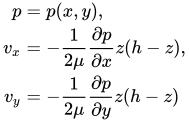
{\displaystyle {\begin{aligned}p&=p(x,y),\\v_{x}&=-{\frac {1}{2\mu }}{\frac {\partial p}{\partial x}}z(h-z),\\v_{y}&=-{\frac {1}{2\mu }}{\frac {\partial p}{\partial y}}z(h-z)\end{aligned}}}
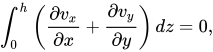
The equation for
p
{\displaystyle p}

-
∫
0
h
(
∂
v
x
∂
x
+
∂
v
y
∂
y
)
d
z
=
0
,
{\displaystyle \int _{0}^{h}\left({\frac {\partial v_{x}}{\partial x}}+{\frac {\partial v_{y}}{\partial y}}\right)dz=0,}
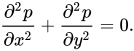
which leads to the Laplace Equation:
-
∂
2
p
∂
x
2
+
∂
2
p
∂
y
2
=
0.
{\displaystyle {\frac {\partial ^{2}p}{\partial x^{2}}}+{\frac {\partial ^{2}p}{\partial y^{2}}}=0.}
This equation is supplemented by appropriate boundary conditions. For example, no-penetration boundary conditions on the side walls become:
∇
p
⋅
n
=
0
{\displaystyle {\mathbf {\nabla } }p\cdot \mathbf {n} =0}


-
v
z
=
0
{\displaystyle v_{z}=0}

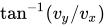
that follows from the continuity equation. While the velocity magnitude
v
x
2
+
v
y
2
{\displaystyle {\sqrt {v_{x}^{2}+v_{y}^{2}}}}


-
ω
x
=
1
2
μ
∂
p
∂
y
(
h
−
2
z
)
,
ω
y
=
−
1
2
μ
∂
p
∂
x
(
h
−
2
z
)
,
ω
z
=
0.
{\displaystyle \omega _{x}={\frac {1}{2\mu }}{\frac {\partial p}{\partial y}}(h-2z),\quad \omega _{y}=-{\frac {1}{2\mu }}{\frac {\partial p}{\partial x}}(h-2z),\quad \omega _{z}=0.}

Since
ω
z
=
0
{\displaystyle \omega _{z}=0}


-
Γ
=
∮
C
v
x
d
x
+
v
y
d
y
=
−
1
2
μ
z
(
h
−
z
)
∮
C
(
∂
p
∂
x
d
x
+
∂
p
∂
y
d
y
)
=
0
{\displaystyle \Gamma =\oint _{C}v_{x}dx+v_{y}dy=-{\frac {1}{2\mu }}z(h-z)\oint _{C}\left({\frac {\partial p}{\partial x}}dx+{\frac {\partial p}{\partial y}}dy\right)=0}

where the last integral is set to zero because
p
{\displaystyle p}
Depth-averaged form
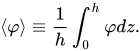
In a Hele-Shaw channel, one can define the depth-averaged version of any physical quantity, say
φ
{\displaystyle \varphi }

-
⟨
φ
⟩
≡
1
h
∫
0
h
φ
d
z
.
{\displaystyle \langle \varphi \rangle \equiv {\frac {1}{h}}\int _{0}^{h}\varphi dz.}
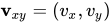
Then the two-dimensional depth-averaged velocity vector
u
≡
⟨
v
x
y
⟩
{\displaystyle \mathbf {u} \equiv \langle \mathbf {v} _{xy}\rangle }

-
−
12
μ
h
2
u
=
∇
p
with
∇
⋅
u
=
0.
{\displaystyle -{\frac {12\mu }{h^{2}}}\mathbf {u} =\nabla p\quad {\text{with}}\quad \nabla \cdot \mathbf {u} =0.}

Further,
⟨
ω
⟩
=
0.
{\displaystyle \langle {\boldsymbol {\omega }}\rangle =0.}

Hele-Shaw cell
The term Hele-Shaw cell is commonly used for cases in which a fluid is injected into the shallow geometry from above or below the geometry, and when the fluid is bounded by another liquid or gas.[7] For such flows the boundary conditions are defined by pressures and surface tensions.
See also
References
- Shaw, Henry S. H. (1898). Investigation of the nature of surface resistance of water and of stream-line motion under certain experimental conditions. Inst. N.A. OCLC 17929897.
- Hele-Shaw, H. S. (1 May 1898). "The Flow of Water". Nature. 58 (1489): 34–36. Bibcode:1898Natur..58...34H. doi:10.1038/058034a0.
- Hermann Schlichting,Boundary Layer Theory, 7th ed. New York: McGraw-Hill, 1979.
- L. M. Milne-Thomson (1996). Theoretical Hydrodynamics. Dover Publications, Inc.
- Horace Lamb, Hydrodynamics (1934).
- Acheson, D. J. (1991). Elementary fluid dynamics.
- Saffman, P. G. (21 April 2006). "Viscous fingering in Hele-Shaw cells" (PDF). Journal of Fluid Mechanics. 173: 73–94. doi:10.1017/s0022112086001088. S2CID 17003612.