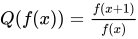
In mathematics, the indefinite product operator is the inverse operator of
Q
(
f
(
x
)
)
=
f
(
x
+
1
)
f
(
x
)
{\textstyle Q(f(x))={\frac {f(x+1)}{f(x)}}}
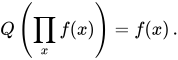
Thus
-
Q
(
∏
x
f
(
x
)
)
=
f
(
x
)
.
{\displaystyle Q\left(\prod _{x}f(x)\right)=f(x)\,.}
More explicitly, if
∏
x
f
(
x
)
=
F
(
x
)
{\textstyle \prod _{x}f(x)=F(x)}

-
F
(
x
+
1
)
F
(
x
)
=
f
(
x
)
.
{\displaystyle {\frac {F(x+1)}{F(x)}}=f(x)\,.}
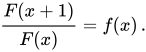
If F(x) is a solution of this functional equation for a given f(x), then so is CF(x) for any constant C. Therefore, each indefinite product actually represents a family of functions, differing by a multiplicative constant.
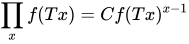
Period rule
If
T
{\displaystyle T}


-
∏
x
f
(
T
x
)
=
C
f
(
T
x
)
x
−
1
{\displaystyle \prod _{x}f(Tx)=Cf(Tx)^{x-1}}
Connection to indefinite sum
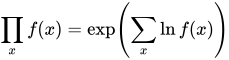
Indefinite product can be expressed in terms of indefinite sum:
-
∏
x
f
(
x
)
=
exp
(
∑
x
ln
f
(
x
)
)
{\displaystyle \prod _{x}f(x)=\exp \left(\sum _{x}\ln f(x)\right)}
Alternative usage
Some authors use the phrase "indefinite product" in a slightly different but related way to describe a product in which the numerical value of the upper limit is not given.[1] e.g.
-
∏
k
=
1
n
f
(
k
)
{\displaystyle \prod _{k=1}^{n}f(k)}
.
Rules
-
∏
x
f
(
x
)
g
(
x
)
=
∏
x
f
(
x
)
∏
x
g
(
x
)
{\displaystyle \prod _{x}f(x)g(x)=\prod _{x}f(x)\prod _{x}g(x)}

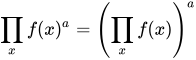
-
∏
x
f
(
x
)
a
=
(
∏
x
f
(
x
)
)
a
{\displaystyle \prod _{x}f(x)^{a}=\left(\prod _{x}f(x)\right)^{a}}
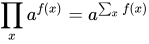
-
∏
x
a
f
(
x
)
=
a
∑
x
f
(
x
)
{\displaystyle \prod _{x}a^{f(x)}=a^{\sum _{x}f(x)}}
List of indefinite products
This is a list of indefinite products
∏
x
f
(
x
)
{\textstyle \prod _{x}f(x)}

-
∏
x
a
=
C
a
x
{\displaystyle \prod _{x}a=Ca^{x}}

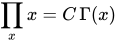
-
∏
x
x
=
C
Γ
(
x
)
{\displaystyle \prod _{x}x=C\,\Gamma (x)}
-
∏
x
x
+
1
x
=
C
x
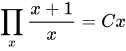
{\displaystyle \prod _{x}{\frac {x+1}{x}}=Cx}
-
∏
x
x
+
a
x
=
C
Γ
(
x
+
a
)
Γ
(
x
)
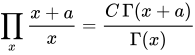
{\displaystyle \prod _{x}{\frac {x+a}{x}}={\frac {C\,\Gamma (x+a)}{\Gamma (x)}}}
-
∏
x
x
a
=
C
Γ
(
x
)
a
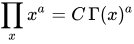
{\displaystyle \prod _{x}x^{a}=C\,\Gamma (x)^{a}}
-
∏
x
a
x
=
C
a
x
Γ
(
x
)
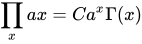
{\displaystyle \prod _{x}ax=Ca^{x}\Gamma (x)}
-
∏
x
a
x
=
C
a
x
2
(
x
−
1
)
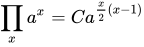
{\displaystyle \prod _{x}a^{x}=Ca^{{\frac {x}{2}}(x-1)}}
-
∏
x
a
1
x
=
C
a
Γ
′
(
x
)
Γ
(
x
)
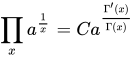
{\displaystyle \prod _{x}a^{\frac {1}{x}}=Ca^{\frac {\Gamma '(x)}{\Gamma (x)}}}
-
∏
x
x
x
=
C
e
ζ
′
(
−
1
,
x
)
−
ζ
′
(
−
1
)
=
C
e
ψ
(
−
2
)
(
z
)
+
z
2
−
z
2
−
z
2
ln
(
2
π
)
=
C
K
(
x
)
{\displaystyle \prod _{x}x^{x}=C\,e^{\zeta ^{\prime }(-1,x)-\zeta ^{\prime }(-1)}=C\,e^{\psi ^{(-2)}(z)+{\frac {z^{2}-z}{2}}-{\frac {z}{2}}\ln(2\pi )}=C\,\operatorname {K} (x)}

- (see K-function)
-
∏
x
Γ
(
x
)
=
C
Γ
(
x
)
x
−
1
K
(
x
)
=
C
Γ
(
x
)
x
−
1
e
z
2
ln
(
2
π
)
−
z
2
−
z
2
−
ψ
(
−
2
)
(
z
)
=
C
G
(
x
)
{\displaystyle \prod _{x}\Gamma (x)={\frac {C\,\Gamma (x)^{x-1}}{\operatorname {K} (x)}}=C\,\Gamma (x)^{x-1}e^{{\frac {z}{2}}\ln(2\pi )-{\frac {z^{2}-z}{2}}-\psi ^{(-2)}(z)}=C\,\operatorname {G} (x)}

- (see Barnes G-function)
-
∏
x
sexp
a
(
x
)
=
C
(
sexp
a
(
x
)
)
′
sexp
a
(
x
)
(
ln
a
)
x
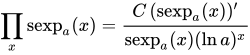
{\displaystyle \prod _{x}\operatorname {sexp} _{a}(x)={\frac {C\,(\operatorname {sexp} _{a}(x))'}{\operatorname {sexp} _{a}(x)(\ln a)^{x}}}}
-
∏
x
x
+
a
=
C
Γ
(
x
+
a
)
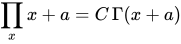
{\displaystyle \prod _{x}x+a=C\,\Gamma (x+a)}
-
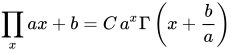
∏
x
a
x
+
b
=
C
a
x
Γ
(
x
+
b
a
)
{\displaystyle \prod _{x}ax+b=C\,a^{x}\Gamma \left(x+{\frac {b}{a}}\right)}
-
∏
x
a
x
2
+
b
x
=
C
a
x
Γ
(
x
)
Γ
(
x
+
b
a
)
{\displaystyle \prod _{x}ax^{2}+bx=C\,a^{x}\Gamma (x)\Gamma \left(x+{\frac {b}{a}}\right)}

-
∏
x
x
2
+
1
=
C
Γ
(
x
−
i
)
Γ
(
x
+
i
)
{\displaystyle \prod _{x}x^{2}+1=C\,\Gamma (x-i)\Gamma (x+i)}

-
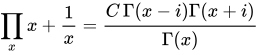
∏
x
x
+
1
x
=
C
Γ
(
x
−
i
)
Γ
(
x
+
i
)
Γ
(
x
)
{\displaystyle \prod _{x}x+{\frac {1}{x}}={\frac {C\,\Gamma (x-i)\Gamma (x+i)}{\Gamma (x)}}}
-
∏
x
csc
x
sin
(
x
+
1
)
=
C
sin
x
{\displaystyle \prod _{x}\csc x\sin(x+1)=C\sin x}

-
∏
x
sec
x
cos
(
x
+
1
)
=
C
cos
x
{\displaystyle \prod _{x}\sec x\cos(x+1)=C\cos x}

-
∏
x
cot
x
tan
(
x
+
1
)
=
C
tan
x
{\displaystyle \prod _{x}\cot x\tan(x+1)=C\tan x}

-
∏
x
tan
x
cot
(
x
+
1
)
=
C
cot
x
{\displaystyle \prod _{x}\tan x\cot(x+1)=C\cot x}

See also
References
- Algorithms for Nonlinear Higher Order Difference Equations, Manuel Kauers
Further reading
- http://reference.wolfram.com/mathematica/ref/Product.html -Indefinite products with Mathematica
- - bug in Maple V to Maple 8 handling of indefinite product
- Markus Müller. How to Add a Non-Integer Number of Terms, and How to Produce Unusual Infinite Summations
- Markus Mueller, Dierk Schleicher. Fractional Sums and Euler-like Identities