In complex geometry, an Inoue surface is any of several complex surfaces of Kodaira class VII. They are named after Masahisa Inoue, who gave the first non-trivial examples of Kodaira class VII surfaces in 1974.[1]
The Inoue surfaces are not Kähler manifolds.
Inoue surfaces with b2 = 0
Inoue introduced three families of surfaces, S0, S+ and S−, which are compact quotients
of
C
×
H
{\displaystyle \mathbb {C} \times \mathbb {H} }


The solvmanifold surfaces constructed by Inoue all have second Betti number
b
2
=
0
{\displaystyle b_{2}=0}


These surfaces have no meromorphic functions and no curves.
K. Hasegawa [5] gives a list of all complex 2-dimensional solvmanifolds; these are complex torus, hyperelliptic surface, Kodaira surface and Inoue surfaces S0, S+ and S−.
The Inoue surfaces are constructed explicitly as follows.[5]
Of type S0
Let φ be an integer 3 × 3 matrix, with two complex eigenvalues
α
,
α
¯
{\displaystyle \alpha ,{\overline {\alpha }}}


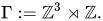
-
R
3
⋊
R
=
(
C
×
R
)
⋊
R
,
{\displaystyle \mathbb {R} ^{3}\rtimes \mathbb {R} =(\mathbb {C} \times \mathbb {R} )\rtimes \mathbb {R} ,}

acting on
C
×
R
,
{\displaystyle \mathbb {C} \times \mathbb {R} ,}



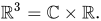
We extend this action to
C
×
H
=
C
×
R
×
R
>
0
{\displaystyle \mathbb {C} \times \mathbb {H} =\mathbb {C} \times \mathbb {R} \times \mathbb {R} ^{>0}}



The Inoue surface of type S0 is determined by the choice of an integer matrix φ, constrained as above. There is a countable number of such surfaces.
Of type S+
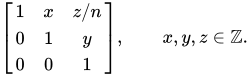
Let n be a positive integer, and
Λ
n
{\displaystyle \Lambda _{n}}

-
[
1
x
z
/
n
0
1
y
0
0
1
]
,
x
,
y
,
z
∈
Z
.
{\displaystyle {\begin{bmatrix}1&x&z/n\\0&1&y\\0&0&1\end{bmatrix}},\qquad x,y,z\in \mathbb {Z} .}
The quotient of
Λ
n
{\displaystyle \Lambda _{n}}







Of type S−
Inoue surfaces of type
S
−
{\displaystyle S^{-}}

Parabolic and hyperbolic Inoue surfaces
Parabolic and hyperbolic Inoue surfaces are Kodaira class VII surfaces defined by Iku Nakamura in 1984.[6] They are not solvmanifolds. These surfaces have positive second Betti number. They have spherical shells, and can be deformed into a blown-up Hopf surface.
Parabolic Inoue surfaces contain a cycle of rational curves with 0 self-intersection and an elliptic curve. They are a particular case of Enoki surfaces which have a cycle of rational curves with zero self-intersection but without elliptic curve. Half-Inoue surfaces contain a cycle C of rational curves and are a quotient of a hyperbolic Inoue surface with two cycles of rational curves.
Hyperbolic Inoue surfaces are class VII0 surfaces with two cycles of rational curves.[7] Parabolic and hyperbolic surfaces are particular cases of minimal surfaces with global spherical shells (GSS) also called Kato surfaces. All these surfaces may be constructed by non invertible contractions.[8]
Notes
- M. Inoue, "On surfaces of class VII0," Inventiones math., 24 (1974), 269–310.
- Bogomolov, F.: "Classification of surfaces of class VII0 with b2 = 0", Math. USSR Izv 10, 255–269 (1976)
- Li, J., Yau, S., T.: "Hermitian Yang–Mills connections on non-Kähler manifolds", Math. aspects of string theory (San Diego, Calif., 1986), Adv. Ser. Math. Phys. 1, 560–573, World Scientific Publishing (1987)
- Teleman, A.: "Projectively flat surfaces and Bogomolov's theorem on class VII0-surfaces", Int. J. Math., Vol. 5, No 2, 253–264 (1994)
- Keizo Hasegawa Complex and Kähler structures on Compact Solvmanifolds, J. Symplectic Geom. Volume 3, Number 4 (2005), 749–767.
- I. Nakamura, "On surfaces of class VII0 with curves," Inv. Math. 78, 393–443 (1984).
- I. Nakamura. "Survey on VII0 surfaces Archived 16 July 2011 at the Wayback Machine", Recent Developments in NonKaehler Geometry, Sapporo, 2008 March.
- G. Dloussky, "Une construction elementaire des surfaces d'Inoue–Hirzebruch". Math. Ann. 280, 663–682 (1988).