In mathematical analysis, an integral linear operator is a linear operator T given by integration; i.e.,
-
(
T
f
)
(
x
)
=
∫
f
(
y
)
K
(
x
,
y
)
d
y
{\displaystyle (Tf)(x)=\int f(y)K(x,y)\,dy}

where
K
(
x
,
y
)
{\displaystyle K(x,y)}

More generally, an integral bilinear form is a bilinear functional that belongs to the continuous dual space of
X
⊗
^
ϵ
Y
{\displaystyle X{\widehat {\otimes }}_{\epsilon }Y}

These maps play an important role in the theory of nuclear spaces and nuclear maps.
Definition - Integral forms as the dual of the injective tensor product
Let X and Y be locally convex TVSs, let
X
⊗
π
Y
{\displaystyle X\otimes _{\pi }Y}




Let
Id
:
X
⊗
π
Y
→
X
⊗
ϵ
Y
{\displaystyle \operatorname {Id} :X\otimes _{\pi }Y\to X\otimes _{\epsilon }Y}




Theorem[1][2]—The dual J(X, Y) of
X
⊗
^
ϵ
Y
{\displaystyle X{\widehat {\otimes }}_{\epsilon }Y}
-
u
(
x
,
y
)
=
∫
S
×
T
⟨
x
,
x
′
⟩
⟨
y
,
y
′
⟩
d
μ
(
x
′
,
y
′
)
,
{\displaystyle u(x,y)=\int _{S\times T}\langle x,x'\rangle \langle y,y'\rangle \;d\mu \!\left(x',y'\right),}

where S and T are respectively some weakly closed and equicontinuous (hence weakly compact) subsets of the duals
X
′
{\displaystyle X^{\prime }}


There is also a closely related formulation [3] of the theorem above that can also be used to explain the terminology integral bilinear form: a continuous bilinear form
u
{\displaystyle u}


-
u
(
x
,
y
)
=
⟨
α
(
x
)
,
β
(
y
)
⟩
=
∫
Ω
α
(
x
)
β
(
y
)
d
μ
{\displaystyle u(x,y)=\langle \alpha (x),\beta (y)\rangle =\int _{\Omega }\alpha (x)\beta (y)\;d\mu }
,
i.e., the form
u
{\displaystyle u}
Integral linear maps
A continuous linear map
κ
:
X
→
Y
′
{\displaystyle \kappa :X\to Y'}


-
x
∈
X
↦
κ
(
x
)
=
∫
S
×
T
⟨
x
′
,
x
⟩
y
′
d
μ
(
x
′
,
y
′
)
{\displaystyle x\in X\mapsto \kappa (x)=\int _{S\times T}\left\langle x',x\right\rangle y'\mathrm {d} \mu \!\left(x',y'\right)}

for suitable weakly closed and equicontinuous subsets S and T of
X
′
{\displaystyle X'}



Given a linear map
Λ
:
X
→
Y
{\displaystyle \Lambda :X\to Y}






-
⟨
y
′
,
Λ
(
x
)
⟩
=
∫
A
′
×
B
″
⟨
x
′
,
x
⟩
⟨
y
″
,
y
′
⟩
d
μ
(
x
′
,
y
″
)
{\displaystyle \left\langle y',\Lambda (x)\right\rangle =\int _{A'\times B''}\left\langle x',x\right\rangle \left\langle y'',y'\right\rangle \mathrm {d} \mu \!\left(x',y''\right)}

for suitable weakly closed and equicontinuous aubsets
A
′
{\displaystyle A'}


Relation to Hilbert spaces
The following result shows that integral maps "factor through" Hilbert spaces.
Proposition:[6] Suppose that
u
:
X
→
Y
{\displaystyle u:X\to Y}


Furthermore, every integral operator between two Hilbert spaces is nuclear.[6] Thus a continuous linear operator between two Hilbert spaces is nuclear if and only if it is integral.
Sufficient conditions
Every nuclear map is integral.[5] An important partial converse is that every integral operator between two Hilbert spaces is nuclear.[6]
Suppose that A, B, C, and D are Hausdorff locally convex TVSs and that
α
:
A
→
B
{\displaystyle \alpha :A\to B}



If
u
:
X
→
Y
{\displaystyle u:X\to Y}

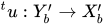
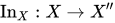
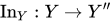
Suppose that
u
:
X
→
Y
{\displaystyle u:X\to Y}


Properties
Suppose that A, B, C, and D are Hausdorff locally convex TVSs with B and D complete. If
α
:
A
→
B
{\displaystyle \alpha :A\to B}

See also
References
- Schaefer & Wolff 1999, p. 168.
- Trèves 2006, pp. 500–502.
- Grothendieck 1955, pp. 124–126.
- Schaefer & Wolff 1999, p. 169.
- Trèves 2006, pp. 502–505.
- Trèves 2006, pp. 506–508.
- Trèves 2006, pp. 505.
Bibliography
- Diestel, Joe (2008). The Metric Theory of Tensor Products: Grothendieck's Résumé Revisited. Vol. 16. Providence, R.I.: American Mathematical Society. ISBN 9781470424831. OCLC 185095773.
- Dubinsky, Ed (1979). The Structure of Nuclear Fréchet Spaces. Lecture Notes in Mathematics. Vol. 720. Berlin New York: Springer-Verlag. ISBN 978-3-540-09504-0. OCLC 5126156.
- Grothendieck, Alexander (1955). "Produits Tensoriels Topologiques et Espaces Nucléaires" [Topological Tensor Products and Nuclear Spaces]. Memoirs of the American Mathematical Society Series (in French). 16. Providence: American Mathematical Society. MR 0075539. OCLC 9308061.
- Husain, Taqdir; Khaleelulla, S. M. (1978). Barrelledness in Topological and Ordered Vector Spaces. Lecture Notes in Mathematics. Vol. 692. Berlin, New York, Heidelberg: Springer-Verlag. ISBN 978-3-540-09096-0. OCLC 4493665.
- Khaleelulla, S. M. (1982). Counterexamples in Topological Vector Spaces. Lecture Notes in Mathematics. Vol. 936. Berlin, Heidelberg, New York: Springer-Verlag. ISBN 978-3-540-11565-6. OCLC 8588370.
- Narici, Lawrence; Beckenstein, Edward (2011). Topological Vector Spaces. Pure and applied mathematics (Second ed.). Boca Raton, FL: CRC Press. ISBN 978-1584888666. OCLC 144216834.
- Hogbe-Nlend, Henri (1977). Bornologies and Functional Analysis: Introductory Course on the Theory of Duality Topology-Bornology and its use in Functional Analysis. North-Holland Mathematics Studies. Vol. 26. Amsterdam New York New York: North Holland. ISBN 978-0-08-087137-0. MR 0500064. OCLC 316549583.
- Hogbe-Nlend, Henri; Moscatelli, V. B. (1981). Nuclear and Conuclear Spaces: Introductory Course on Nuclear and Conuclear Spaces in the Light of the Duality "topology-bornology". North-Holland Mathematics Studies. Vol. 52. Amsterdam New York New York: North Holland. ISBN 978-0-08-087163-9. OCLC 316564345.
- Pietsch, Albrecht (1979). Nuclear Locally Convex Spaces. Ergebnisse der Mathematik und ihrer Grenzgebiete. Vol. 66 (Second ed.). Berlin, New York: Springer-Verlag. ISBN 978-0-387-05644-9. OCLC 539541.
- Robertson, Alex P.; Robertson, Wendy J. (1980). Topological Vector Spaces. Cambridge Tracts in Mathematics. Vol. 53. Cambridge England: Cambridge University Press. ISBN 978-0-521-29882-7. OCLC 589250.
- Rudin, Walter (1991). Functional Analysis. International Series in Pure and Applied Mathematics. Vol. 8 (Second ed.). New York, NY: McGraw-Hill Science/Engineering/Math. ISBN 978-0-07-054236-5. OCLC 21163277.
- Ryan, Raymond A. (2002). Introduction to Tensor Products of Banach Spaces. Springer Monographs in Mathematics. London New York: Springer. ISBN 978-1-85233-437-6. OCLC 48092184.
- Schaefer, Helmut H.; Wolff, Manfred P. (1999). Topological Vector Spaces. GTM. Vol. 8 (Second ed.). New York, NY: Springer New York Imprint Springer. ISBN 978-1-4612-7155-0. OCLC 840278135.
- Trèves, François (2006) [1967]. Topological Vector Spaces, Distributions and Kernels. Mineola, N.Y.: Dover Publications. ISBN 978-0-486-45352-1. OCLC 853623322.
- Wong, Yau-Chuen (1979). Schwartz Spaces, Nuclear Spaces, and Tensor Products. Lecture Notes in Mathematics. Vol. 726. Berlin New York: Springer-Verlag. ISBN 978-3-540-09513-2. OCLC 5126158.