
f ′ ( x ) = 1 [ f − 1 ] ′ ( f ( x ) ) {\displaystyle {\color {CornflowerBlue}{f'}}(x)={\frac {1}{{\color {Salmon}{\left[f^{-1}\right]'}}({\color {Blue}{f}}(x))}}}
![{\displaystyle {\color {CornflowerBlue}{f'}}(x)={\frac {1}{{\color {Salmon}{\left[f^{-1}\right]'}}({\color {Blue}{f}}(x))}}}](https://wikimedia.org/api/rest_v1/media/math/render/svg/b9920de3471ec652f1de7c233efbcff0b5a4cabf)
Example for arbitrary x 0 ≈ 5.8 {\displaystyle x_{0}\approx 5.8}
 :
:f ′ ( x 0 ) = 1 4 {\displaystyle {\color {CornflowerBlue}{f'}}(x_{0})={\frac {1}{4}}}

[ f − 1 ] ′ ( f ( x 0 ) ) = 4 {\displaystyle {\color {Salmon}{\left[f^{-1}\right]'}}({\color {Blue}{f}}(x_{0}))=4~}
![{\displaystyle {\color {Salmon}{\left[f^{-1}\right]'}}({\color {Blue}{f}}(x_{0}))=4~}](https://wikimedia.org/api/rest_v1/media/math/render/svg/3ae2406dd36b880dbbc2d504a1203e81eb241dd0)
| Part of a series of articles about |
| Calculus |
|---|
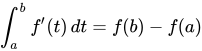
∫
a
b
f
′
(
t
)
d
t
=
f
(
b
)
−
f
(
a
)
{\displaystyle \int _{a}^{b}f'(t)\,dt=f(b)-f(a)}
 |
In calculus, the inverse function rule is a formula that expresses the derivative of the inverse of a bijective and differentiable function f in terms of the derivative of f. More precisely, if the inverse of
f
{\displaystyle f}


-
[
f
−
1
]
′
(
y
)
=
1
f
′
(
f
−
1
(
y
)
)
.
{\displaystyle \left[f^{-1}\right]'(y)={\frac {1}{f'\left(f^{-1}(y)\right)}}.}
![{\displaystyle \left[f^{-1}\right]'(y)={\frac {1}{f'\left(f^{-1}(y)\right)}}.}](https://wikimedia.org/api/rest_v1/media/math/render/svg/f98f0f8972938a3ffce4fc1e06d37ecc31d730b3)
This formula holds in general whenever
f
{\displaystyle f}


-
D
[
f
−
1
]
=
1
(
D
f
)
∘
(
f
−
1
)
,
{\displaystyle {\mathcal {D}}\left[f^{-1}\right]={\frac {1}{({\mathcal {D}}f)\circ \left(f^{-1}\right)}},}
![{\displaystyle {\mathcal {D}}\left[f^{-1}\right]={\frac {1}{({\mathcal {D}}f)\circ \left(f^{-1}\right)}},}](https://wikimedia.org/api/rest_v1/media/math/render/svg/b71cf74aa5480ff9d43a9823ceb5580914f923a5)
where
D
{\displaystyle {\mathcal {D}}}


Geometrically, a function and inverse function have graphs that are reflections, in the line
y
=
x
{\displaystyle y=x}

Assuming that
f
{\displaystyle f}

The inverse function rule may also be expressed in Leibniz's notation. As that notation suggests,
-
d
x
d
y
d
y
d
x
=
1.
{\displaystyle {\frac {dx}{dy}}\,{\frac {dy}{dx}}=1.}

This relation is obtained by differentiating the equation
f
−
1
(
y
)
=
x
{\displaystyle f^{-1}(y)=x}
-
d
x
d
y
d
y
d
x
=
d
x
d
x
{\displaystyle {\frac {dx}{dy}}\,{\frac {dy}{dx}}={\frac {dx}{dx}}}

considering that the derivative of x with respect to x is 1.
Derivation
Let
f
{\displaystyle f}


-
f
′
(
g
(
y
)
)
⋅
g
′
(
y
)
=
1.
{\displaystyle f'(g(y))\cdot g'(y)=1.}

That is,
-
g
′
(
y
)
=
1
f
′
(
g
(
y
)
)
{\displaystyle g'(y)={\frac {1}{f'(g(y))}}}

or
-
[
f
−
1
]
′
(
y
)
=
1
f
′
(
f
−
1
(
y
)
)
.
{\displaystyle \left[f^{-1}\right]^{\prime }(y)={\frac {1}{f^{\prime }(f^{-1}(y))}}.}
![{\displaystyle \left[f^{-1}\right]^{\prime }(y)={\frac {1}{f^{\prime }(f^{-1}(y))}}.}](https://wikimedia.org/api/rest_v1/media/math/render/svg/a573d319a13f2c2d552741bd65153ceb1cc3cbb9)
Examples
-
y
=
x
2
{\displaystyle y=x^{2}}
(for positive x) has inverse x = y {\displaystyle x={\sqrt {y}}}
.
-
d
y
d
x
=
2
x
;
d
x
d
y
=
1
2
y
=
1
2
x
{\displaystyle {\frac {dy}{dx}}=2x{\mbox{ }}{\mbox{ }}{\mbox{ }}{\mbox{ }};{\mbox{ }}{\mbox{ }}{\mbox{ }}{\mbox{ }}{\frac {dx}{dy}}={\frac {1}{2{\sqrt {y}}}}={\frac {1}{2x}}}

-
d
y
d
x
d
x
d
y
=
2
x
⋅
1
2
x
=
1.
{\displaystyle {\frac {dy}{dx}}\,{\frac {dx}{dy}}=2x\cdot {\frac {1}{2x}}=1.}

At
x
=
0
{\displaystyle x=0}

-
y
=
e
x
{\displaystyle y=e^{x}}
(for real x) has inverse x = ln y {\displaystyle x=\ln {y}}
(for positive y {\displaystyle y}
-
d
y
d
x
=
e
x
;
d
x
d
y
=
1
y
=
e
−
x
{\displaystyle {\frac {dy}{dx}}=e^{x}{\mbox{ }}{\mbox{ }}{\mbox{ }}{\mbox{ }};{\mbox{ }}{\mbox{ }}{\mbox{ }}{\mbox{ }}{\frac {dx}{dy}}={\frac {1}{y}}=e^{-x}}

-
d
y
d
x
d
x
d
y
=
e
x
e
−
x
=
1.
{\displaystyle {\frac {dy}{dx}}\,{\frac {dx}{dy}}=e^{x}e^{-x}=1.}

Additional properties
- Integrating this relationship gives
-
f
−
1
(
y
)
=
∫
1
f
′
(
f
−
1
(
y
)
)
d
y
+
C
.
{\displaystyle {f^{-1}}(y)=\int {\frac {1}{f'({f^{-1}}(y))}}\,{dy}+C.}
-
f
−
1
(
y
)
=
∫
1
f
′
(
f
−
1
(
y
)
)
d
y
+
C
.
{\displaystyle {f^{-1}}(y)=\int {\frac {1}{f'({f^{-1}}(y))}}\,{dy}+C.}

- This is only useful if the integral exists. In particular we need
f
′
(
x
)
{\displaystyle f'(x)}
to be non-zero across the range of integration.
- It follows that a function that has a continuous derivative has an inverse in a neighbourhood of every point where the derivative is non-zero. This need not be true if the derivative is not continuous.
- Another very interesting and useful property is the following:
-
∫
f
−
1
(
y
)
d
y
=
y
f
−
1
(
y
)
−
F
(
f
−
1
(
y
)
)
+
C
{\displaystyle \int f^{-1}(y)\,{dy}=yf^{-1}(y)-F(f^{-1}(y))+C}
-
∫
f
−
1
(
y
)
d
y
=
y
f
−
1
(
y
)
−
F
(
f
−
1
(
y
)
)
+
C
{\displaystyle \int f^{-1}(y)\,{dy}=yf^{-1}(y)-F(f^{-1}(y))+C}

- where
F
{\displaystyle F}
denotes the antiderivative of f {\displaystyle f}
- The inverse of the derivative of f(x) is also of interest, as it is used in showing the convexity of the Legendre transform.
Let
z
=
f
′
(
x
)
{\displaystyle z=f'(x)}


![{\displaystyle {\frac {d}{dz}}\left[f'\right]^{-1}(z)={\frac {1}{f''(x)}}}](https://wikimedia.org/api/rest_v1/media/math/render/svg/aff43b2af418f915ca5251cb90e751f2999bb363)

-
f
′
(
x
)
=
d
y
d
x
=
d
y
d
z
d
z
d
x
=
d
y
d
z
f
″
(
x
)
⇒
d
y
d
z
=
f
′
(
x
)
f
″
(
x
)
{\displaystyle f'(x)={\frac {dy}{dx}}={\frac {dy}{dz}}{\frac {dz}{dx}}={\frac {dy}{dz}}f''(x)\Rightarrow {\frac {dy}{dz}}={\frac {f'(x)}{f''(x)}}}
Therefore:
-
d
d
z
[
f
′
]
−
1
(
z
)
=
d
x
d
z
=
d
y
d
z
d
x
d
y
=
f
′
(
x
)
f
″
(
x
)
1
f
′
(
x
)
=
1
f
″
(
x
)
{\displaystyle {\frac {d}{dz}}[f']^{-1}(z)={\frac {dx}{dz}}={\frac {dy}{dz}}{\frac {dx}{dy}}={\frac {f'(x)}{f''(x)}}{\frac {1}{f'(x)}}={\frac {1}{f''(x)}}}
![{\displaystyle {\frac {d}{dz}}[f']^{-1}(z)={\frac {dx}{dz}}={\frac {dy}{dz}}{\frac {dx}{dy}}={\frac {f'(x)}{f''(x)}}{\frac {1}{f'(x)}}={\frac {1}{f''(x)}}}](https://wikimedia.org/api/rest_v1/media/math/render/svg/01c4d75a194df00675b56860a93c8dd083df0bf2)
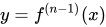
By induction, we can generalize this result for any integer
n
≥
1
{\displaystyle n\geq 1}



-
d
d
z
[
f
(
n
)
]
−
1
(
z
)
=
1
f
(
n
+
1
)
(
x
)
{\displaystyle {\frac {d}{dz}}\left[f^{(n)}\right]^{-1}(z)={\frac {1}{f^{(n+1)}(x)}}}
![{\displaystyle {\frac {d}{dz}}\left[f^{(n)}\right]^{-1}(z)={\frac {1}{f^{(n+1)}(x)}}}](https://wikimedia.org/api/rest_v1/media/math/render/svg/2132412b582762447cda0856d2ae403241c6b1f3)
Higher order derivatives
The chain rule given above is obtained by differentiating the identity
f
−
1
(
y
)
=
x
{\displaystyle f^{-1}(y)=x}
-
d
2
y
d
x
2
d
x
d
y
+
d
d
x
(
d
x
d
y
)
(
d
y
d
x
)
=
0
,
{\displaystyle {\frac {d^{2}y}{dx^{2}}}\,{\frac {dx}{dy}}+{\frac {d}{dx}}\left({\frac {dx}{dy}}\right)\,\left({\frac {dy}{dx}}\right)=0,}

that is simplified further by the chain rule as
-
d
2
y
d
x
2
d
x
d
y
+
d
2
x
d
y
2
(
d
y
d
x
)
2
=
0.
{\displaystyle {\frac {d^{2}y}{dx^{2}}}\,{\frac {dx}{dy}}+{\frac {d^{2}x}{dy^{2}}}\,\left({\frac {dy}{dx}}\right)^{2}=0.}

Replacing the first derivative, using the identity obtained earlier, we get
-
d
2
y
d
x
2
=
−
d
2
x
d
y
2
(
d
y
d
x
)
3
{\displaystyle {\frac {d^{2}y}{dx^{2}}}=-{\frac {d^{2}x}{dy^{2}}}\,\left({\frac {dy}{dx}}\right)^{3}}

which implies
-
d
2
x
d
y
2
=
−
d
2
y
/
d
x
2
(
d
y
/
d
x
)
3
.
{\displaystyle {\frac {d^{2}x}{dy^{2}}}=-{\frac {d^{2}y/dx^{2}}{\left(dy/dx\right)^{3}}}.}

Similarly for the third derivative we have
-
d
3
y
d
x
3
=
−
d
3
x
d
y
3
(
d
y
d
x
)
4
−
3
d
2
x
d
y
2
d
2
y
d
x
2
(
d
y
d
x
)
2
.
{\displaystyle {\frac {d^{3}y}{dx^{3}}}=-{\frac {d^{3}x}{dy^{3}}}\,\left({\frac {dy}{dx}}\right)^{4}-3{\frac {d^{2}x}{dy^{2}}}\,{\frac {d^{2}y}{dx^{2}}}\,\left({\frac {dy}{dx}}\right)^{2}.}

Using the formula for the second derivative, we get
-
d
3
y
d
x
3
=
−
d
3
x
d
y
3
(
d
y
d
x
)
4
+
3
(
d
2
y
d
x
2
)
2
(
d
y
d
x
)
−
1
{\displaystyle {\frac {d^{3}y}{dx^{3}}}=-{\frac {d^{3}x}{dy^{3}}}\,\left({\frac {dy}{dx}}\right)^{4}+3\left({\frac {d^{2}y}{dx^{2}}}\right)^{2}\,\left({\frac {dy}{dx}}\right)^{-1}}

which implies
-
d
3
x
d
y
3
=
−
d
3
y
/
d
x
3
(
d
y
/
d
x
)
4
+
3
(
d
2
y
/
d
x
2
)
2
(
d
y
/
d
x
)
5
.
{\displaystyle {\frac {d^{3}x}{dy^{3}}}=-{\frac {d^{3}y/dx^{3}}{\left(dy/dx\right)^{4}}}+3{\frac {\left(d^{2}y/dx^{2}\right)^{2}}{\left(dy/dx\right)^{5}}}.}

These formulas can also be written using Lagrange's notation:
-
[
f
−
1
]
″
(
y
)
=
−
f
″
(
f
−
1
(
y
)
)
[
f
′
(
f
−
1
(
y
)
)
]
3
,
{\displaystyle \left[f^{-1}\right]''(y)=-{\frac {f''(f^{-1}(y))}{\left[f'(f^{-1}(y))\right]^{3}}},}
![{\displaystyle \left[f^{-1}\right]''(y)=-{\frac {f''(f^{-1}(y))}{\left[f'(f^{-1}(y))\right]^{3}}},}](https://wikimedia.org/api/rest_v1/media/math/render/svg/2a500a56a2b2e802de1c0703a8c1afab481a4a9f)
-
[
f
−
1
]
‴
(
y
)
=
−
f
‴
(
f
−
1
(
y
)
)
[
f
′
(
f
−
1
(
y
)
)
]
4
+
3
[
f
″
(
f
−
1
(
y
)
)
]
2
[
f
′
(
f
−
1
(
y
)
)
]
5
.
{\displaystyle \left[f^{-1}\right]'''(y)=-{\frac {f'''(f^{-1}(y))}{\left[f'(f^{-1}(y))\right]^{4}}}+3{\frac {\left[f''(f^{-1}(y))\right]^{2}}{\left[f'(f^{-1}(y))\right]^{5}}}.}
![{\displaystyle \left[f^{-1}\right]'''(y)=-{\frac {f'''(f^{-1}(y))}{\left[f'(f^{-1}(y))\right]^{4}}}+3{\frac {\left[f''(f^{-1}(y))\right]^{2}}{\left[f'(f^{-1}(y))\right]^{5}}}.}](https://wikimedia.org/api/rest_v1/media/math/render/svg/ebdf6524f94de4aecab9ec8374d6ccf94da0f41e)
In general, higher order derivatives of an inverse function can be expressed with Faà di Bruno's formula. Alternatively, the nth derivative can be written succinctly as:
-
[
f
−
1
]
(
n
)
(
y
)
=
[
(
1
f
′
(
t
)
d
d
t
)
n
t
]
t
=
f
−
1
(
y
)
.
{\displaystyle \left[f^{-1}\right]^{(n)}(y)=\left[\left({\frac {1}{f'(t)}}{\frac {d}{dt}}\right)^{n}t\right]_{t=f^{-1}(y)}.}
![{\displaystyle \left[f^{-1}\right]^{(n)}(y)=\left[\left({\frac {1}{f'(t)}}{\frac {d}{dt}}\right)^{n}t\right]_{t=f^{-1}(y)}.}](https://wikimedia.org/api/rest_v1/media/math/render/svg/393c9e0a7ff7ad39f12963815de463c5a6095de7)
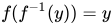
From this expression, one can also derive the nth-integration of inverse function with base-point a using Cauchy formula for repeated integration whenever
f
(
f
−
1
(
y
)
)
=
y
{\displaystyle f(f^{-1}(y))=y}
-
[
f
−
1
]
(
−
n
)
(
y
)
=
1
n
!
(
f
−
1
(
a
)
(
y
−
a
)
n
+
∫
f
−
1
(
a
)
f
−
1
(
y
)
(
y
−
f
(
u
)
)
n
d
u
)
.
{\displaystyle \left[f^{-1}\right]^{(-n)}(y)={\frac {1}{n!}}\left(f^{-1}(a)(y-a)^{n}+\int _{f^{-1}(a)}^{f^{-1}(y)}\left(y-f(u)\right)^{n}\,du\right).}
![{\displaystyle \left[f^{-1}\right]^{(-n)}(y)={\frac {1}{n!}}\left(f^{-1}(a)(y-a)^{n}+\int _{f^{-1}(a)}^{f^{-1}(y)}\left(y-f(u)\right)^{n}\,du\right).}](https://wikimedia.org/api/rest_v1/media/math/render/svg/b1f81a7009f03d42bb6ae1833521ab78504907e6)
Example
-
y
=
e
x
{\displaystyle y=e^{x}}
. Using the formula for the second derivative of the inverse function,
-
d
y
d
x
=
d
2
y
d
x
2
=
e
x
=
y
;
(
d
y
d
x
)
3
=
y
3
;
{\displaystyle {\frac {dy}{dx}}={\frac {d^{2}y}{dx^{2}}}=e^{x}=y{\mbox{ }}{\mbox{ }}{\mbox{ }}{\mbox{ }};{\mbox{ }}{\mbox{ }}{\mbox{ }}{\mbox{ }}\left({\frac {dy}{dx}}\right)^{3}=y^{3};}

so that
-
d
2
x
d
y
2
⋅
y
3
+
y
=
0
;
d
2
x
d
y
2
=
−
1
y
2
,
{\displaystyle {\frac {d^{2}x}{dy^{2}}}\,\cdot \,y^{3}+y=0{\mbox{ }}{\mbox{ }}{\mbox{ }}{\mbox{ }};{\mbox{ }}{\mbox{ }}{\mbox{ }}{\mbox{ }}{\frac {d^{2}x}{dy^{2}}}=-{\frac {1}{y^{2}}},}

which agrees with the direct calculation.
See also
- Calculus – Branch of mathematics
- Chain rule – Formula in calculus
- Differentiation of trigonometric functions – Mathematical process of finding the derivative of a trigonometric function
- Differentiation rules – Rules for computing derivatives of functions
- Implicit function theorem – On converting relations to functions of several real variables
- Integration of inverse functions – Mathematical theorem, used in calculusPages displaying short descriptions of redirect targets
- Inverse function – Mathematical concept
- Inverse function theorem – Theorem in mathematics
- Table of derivatives – Rules for computing derivatives of functionsPages displaying short descriptions of redirect targets
- Vector calculus identities – Mathematical identities
References
Citations
- "Derivatives of Inverse Functions". oregonstate.edu. Archived from the original on 2021-04-10. Retrieved 2019-07-26.
Sources
- Marsden, Jerrold E.; Weinstein, Alan (1981). "Chapter 8: Inverse Functions and the Chain Rule". Calculus unlimited (PDF). Menlo Park, Calif.: Benjamin/Cummings Pub. Co. ISBN 0-8053-6932-5.