
In mathematics, an irrationality measure of a real number
x
{\displaystyle x}

If a function
f
(
t
,
λ
)
{\displaystyle f(t,\lambda )}


-
0
<
|
x
−
p
q
|
<
f
(
q
,
λ
)
{\displaystyle 0<\left|x-{\frac {p}{q}}\right|<f(q,\lambda )}

for a given real number
x
∈
R
{\displaystyle x\in \mathbb {R} }


By definition, there is a sequence
(
ε
n
)
n
∈
N
{\displaystyle (\varepsilon _{n})_{n\in \mathbb {N} }}


0
<
|
x
−
p
q
|
<
f
(
q
,
λ
(
x
)
+
ε
n
)
{\displaystyle 0<\left|x-{\frac {p}{q}}\right|<f(q,\lambda (x)+\varepsilon _{n})}

has at most finitely many solutions
p
q
{\displaystyle {\frac {p}{q}}}

-
0
<
|
x
−
p
q
|
<
f
(
q
,
λ
(
x
)
+
ε
)
{\displaystyle 0<\left|x-{\frac {p}{q}}\right|<f(q,\lambda (x)+\varepsilon )}

has at most only finitely many solutions
p
q
{\displaystyle {\frac {p}{q}}}

Irrationality exponent
The irrationality exponent or Liouville–Roth irrationality measure is given by setting
f
(
q
,
μ
)
=
q
−
μ
{\displaystyle f(q,\mu )=q^{-\mu }}


For any value
n
<
μ
(
x
)
{\displaystyle n<\mu (x)}


For example, whenever a rational approximation
p
q
≈
x
{\displaystyle {\frac {p}{q}}\approx x}


-
1
10
n
≥
|
x
−
p
q
|
≥
1
q
μ
(
x
)
+
ε
{\displaystyle {\frac {1}{10^{n}}}\geq \left|x-{\frac {p}{q}}\right|\geq {\frac {1}{q^{\mu (x)+\varepsilon }}}}

for any
ε
>
0
{\displaystyle \varepsilon >0}
A number
x
∈
R
{\displaystyle x\in \mathbb {R} }


Corollaries
Rational numbers have irrationality exponent 1, while (as a consequence of Dirichlet's approximation theorem) every irrational number has irrationality exponent at least 2.
On the other hand, an application of Borel-Cantelli lemma shows that almost all numbers, including all algebraic irrational numbers, have an irrationality exponent exactly equal to 2.[3]: 246
It is
μ
(
x
)
=
μ
(
r
x
+
s
)
{\displaystyle \mu (x)=\mu (rx+s)}


For a real number
x
{\displaystyle x}


-
μ
(
x
)
=
1
+
lim sup
n
→
∞
ln
q
n
+
1
ln
q
n
=
2
+
lim sup
n
→
∞
ln
a
n
+
1
ln
q
n
.
{\displaystyle \mu (x)=1+\limsup _{n\to \infty }{\frac {\ln q_{n+1}}{\ln q_{n}}}=2+\limsup _{n\to \infty }{\frac {\ln a_{n+1}}{\ln q_{n}}}.}

If we have
lim sup
n
→
∞
1
n
ln
|
q
n
|
≤
σ
{\displaystyle \limsup _{n\to \infty }{\tfrac {1}{n}}{\ln |q_{n}|}\leq \sigma }


-
μ
(
x
)
≤
1
+
σ
τ
{\displaystyle \mu (x)\leq 1+{\frac {\sigma }{\tau }}}

Known bounds
For most transcendental numbers, the exact value of their irrationality exponent is not known.[5] Below is a table of known upper and lower bounds.
| Number
x
{\displaystyle x}
|
Irrationality exponent
μ
(
x
)
{\displaystyle \mu (x)}
|
Notes | |
|---|---|---|---|
| Lower bound | Upper bound | ||
| Rational number
p
/
q
{\displaystyle p/q}
with
p
∈
Z
,
q
∈
Z
+
{\displaystyle p\in \mathbb {Z} ,q\in \mathbb {Z} ^{+}}
|
1 | Every rational number
p
/
q
{\displaystyle p/q}
has an irrationality exponent of exactly 1. | |
Irrational algebraic number
α
{\displaystyle \alpha }
 |
2 | By Roth's theorem the irrationality exponent of any irrational algebraic number is exactly 2. Examples include square roots and the golden ratio
φ
{\displaystyle \varphi }
 . | |
e
2
/
k
,
k
∈
Z
+
{\displaystyle e^{2/k},k\in \mathbb {Z} ^{+}}
 |
2 | If the elements
a
n
{\displaystyle a_{n}}
 of the simple continued fraction expansion of an irrational number
x
{\displaystyle x}
are bounded above
a
n
<
P
(
n
)
{\displaystyle a_{n}<P(n)}  by an arbitrary polynomial
P
{\displaystyle P}  , then its irrationality exponent is
μ
(
x
)
=
2
{\displaystyle \mu (x)=2}  . Examples include numbers whose continued fractions behave predictably such as
e
=
[
2
;
1
,
2
,
1
,
1
,
4
,
1
,
1
,
6
,
1
,
.
.
.
]
{\displaystyle e=[2;1,2,1,1,4,1,1,6,1,...]}
| |
tan
(
1
/
k
)
,
k
∈
Z
+
{\displaystyle \tan(1/k),k\in \mathbb {Z} ^{+}}
 |
2 | ||
tanh
(
1
/
k
)
,
k
∈
Z
+
{\displaystyle \tanh(1/k),k\in \mathbb {Z} ^{+}}
 |
2 | ||
S
(
b
)
{\displaystyle S(b)}
 with
b
≥
2
{\displaystyle b\geq 2}  |
2 |
S
(
b
)
:=
∑
k
=
0
∞
b
−
2
k
{\displaystyle S(b):=\sum _{k=0}^{\infty }b^{-2^{k}}}
 with
b
∈
Z
{\displaystyle b\in \mathbb {Z} }  , has continued fraction terms which do not exceed a fixed constant.[8][9] | |
T
(
b
)
{\displaystyle T(b)}
 with
b
≥
2
{\displaystyle b\geq 2}
[10] |
2 |
T
(
b
)
:=
∑
k
=
0
∞
t
k
b
−
k
{\displaystyle T(b):=\sum _{k=0}^{\infty }t_{k}b^{-k}}
 where
t
k
{\displaystyle t_{k}}  is the Thue–Morse sequence and
b
∈
Z
{\displaystyle b\in \mathbb {Z} }
. See Prouhet-Thue-Morse constant. | |
ln
(
2
)
{\displaystyle \ln(2)}
 [11][12] |
2 | 3.57455... | There are other numbers of the form
ln
(
a
/
b
)
{\displaystyle \ln(a/b)}
 for which bounds on their irrationality exponents are known.[13][14][15] |
ln
(
3
)
{\displaystyle \ln(3)}
 [11][16] |
2 | 5.11620... | |
5
ln
(
3
/
2
)
{\displaystyle 5\ln(3/2)}
 [17] |
2 | 3.43506... | There are many other numbers of the form
2
k
+
1
ln
(
2
k
+
1
+
1
2
k
+
1
−
1
)
{\displaystyle {\sqrt {2k+1}}\ln \left({\frac {{\sqrt {2k+1}}+1}{{\sqrt {2k+1}}-1}}\right)}
 for which bounds on their irrationality exponents are known.[17] This is the case for
k
=
12
{\displaystyle k=12}  . |
π
/
3
{\displaystyle \pi /{\sqrt {3}}}
 [18][19] |
2 | 4.60105... | There are many other numbers of the form
2
k
−
1
arctan
(
2
k
−
1
k
−
1
)
{\displaystyle {\sqrt {2k-1}}\arctan \left({\frac {\sqrt {2k-1}}{k-1}}\right)}
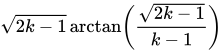 for which bounds on their irrationality exponents are known.[18] This is the case for
k
=
2
{\displaystyle k=2}  . |
π
{\displaystyle \pi }
 [11][20] |
2 | 7.10320... | It has been proven that
π
{\displaystyle \pi }
's irrationality exponent is at most
5
/
2
{\displaystyle 5/2}
 if the Flint Hills series
∑
n
=
1
∞
csc
2
n
n
3
{\displaystyle \displaystyle \sum _{n=1}^{\infty }{\frac {\csc ^{2}n}{n^{3}}}}  (where n is in radians) converges,[21][22] and that if the irrationality exponent is at least
5
/
2
{\displaystyle 5/2}
it diverges.[23] Conversely,[23] (theorem 2.5) proved that the Flint Hills series converges if
π
{\displaystyle \pi }
's irrationality exponent is
≤
5
/
2
{\displaystyle \leq 5/2}  , completing the biconditional (unless
μ
(
π
)
=
5
/
2
{\displaystyle \mu (\pi )=5/2}  ). In 2026, OpenAI released an unverified proof claiming that
μ
(
π
)
=
2
{\displaystyle \mu (\pi )=2}  .[24] |
π
2
{\displaystyle \pi ^{2}}
 [11][25] |
2 | 5.09541... |
π
2
{\displaystyle \pi ^{2}}
and
ζ
(
2
)
{\displaystyle \zeta (2)}
 are linearly dependent over
Q
{\displaystyle \mathbb {Q} }  .
(
ζ
(
2
)
=
π
2
6
)
{\displaystyle \left(\zeta (2)={\frac {\pi ^{2}}{6}}\right)}  , also see the Basel problem. |
arctan
(
1
/
2
)
{\displaystyle \arctan(1/2)}
 [26] |
2 | 9.27204... | There are many other numbers of the form
arctan
(
1
/
k
)
{\displaystyle \arctan(1/k)}
 for which bounds on their irrationality exponents are known.[27][28] |
arctan
(
1
/
3
)
{\displaystyle \arctan(1/3)}
 [29] |
2 | 5.94202... | |
Apéry's constant
ζ
(
3
)
{\displaystyle \zeta (3)}
 [11] |
2 | 5.51389... | |
Γ
(
1
/
4
)
{\displaystyle \Gamma (1/4)}
 [30] |
2 | 10143 | |
Cahen's constant
C
{\displaystyle C}
 [31] |
3 | ||
Champernowne constants
C
b
{\displaystyle C_{b}}
 in base
b
≥
2
{\displaystyle b\geq 2}
[32] |
b
{\displaystyle b}
 |
Examples include
C
10
=
0.1234567891011...
=
[
0
;
8
,
9
,
1
,
149083
,
1
,
.
.
.
]
{\displaystyle C_{10}=0.1234567891011...=[0;8,9,1,149083,1,...]}
 | |
Liouville numbers
L
{\displaystyle L}
 |
∞
{\displaystyle \infty }
 |
The Liouville numbers are precisely those numbers having infinite irrationality exponent.[3]: 248 | |


Irrationality base
The irrationality base or Sondow irrationality measure is obtained by setting
f
(
q
,
β
)
=
β
−
q
{\displaystyle f(q,\beta )=\beta ^{-q}}


Let
x
{\displaystyle x}


-
|
x
−
p
q
|
>
1
(
β
+
ε
)
q
{\displaystyle \left|x-{\frac {p}{q}}\right|>{\frac {1}{(\beta +\varepsilon )^{q}}}}

for all integers
p
,
q
{\displaystyle p,q}


If no such
β
{\displaystyle \beta }

If a real number
x
{\displaystyle x}
-
β
(
x
)
=
lim sup
n
→
∞
ln
q
n
+
1
q
n
=
lim sup
n
→
∞
ln
a
n
+
1
q
n
{\displaystyle \beta (x)=\limsup _{n\to \infty }{\frac {\ln q_{n+1}}{q_{n}}}=\limsup _{n\to \infty }{\frac {\ln a_{n+1}}{q_{n}}}}
.[1]
Examples
Any real number
x
{\displaystyle x}


The number
L
=
[
1
;
2
,
2
2
,
2
2
2
,
.
.
.
]
{\displaystyle L=[1;2,2^{2},2^{2^{2}},...]}


The numbers
τ
a
=
∑
n
=
0
∞
1
n
a
=
1
+
1
a
+
1
a
a
+
1
a
a
a
+
1
a
a
a
a
+
.
.
.
{\displaystyle \tau _{a}=\sum _{n=0}^{\infty }{\frac {1}{^{n}a}}=1+{\frac {1}{a}}+{\frac {1}{a^{a}}}+{\frac {1}{a^{a^{a}}}}+{\frac {1}{a^{a^{a^{a}}}}}+...}


The number
S
=
1
+
1
2
1
+
1
4
2
1
+
1
8
4
2
1
+
1
16
8
4
2
1
+
1
32
16
8
4
2
1
+
…
{\displaystyle S=1+{\frac {1}{2^{1}}}+{\frac {1}{4^{2^{1}}}}+{\frac {1}{8^{4^{2^{1}}}}}+{\frac {1}{16^{8^{4^{2^{1}}}}}}+{\frac {1}{32^{16^{8^{4^{2^{1}}}}}}}+\ldots }


Although it is not known whether or not
e
π
{\displaystyle e^{\pi }}


Other irrationality measures
Markov constant
Setting
f
(
q
,
M
)
=
(
M
q
2
)
−
1
{\displaystyle f(q,M)=(Mq^{2})^{-1}}


-
0
<
|
x
−
p
q
|
<
1
c
q
2
{\displaystyle 0<\left|x-{\frac {p}{q}}\right|<{\frac {1}{cq^{2}}}}
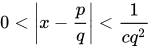
has infinitely many solutions
p
q
∈
Q
{\displaystyle {\frac {p}{q}}\in \mathbb {Q} }


Dirichlet's approximation theorem implies
M
(
x
)
≥
1
{\displaystyle M(x)\geq 1}


This is in fact the best general lower bound since the golden ratio gives
M
(
φ
)
=
5
{\displaystyle M(\varphi )={\sqrt {5}}}


Given
x
=
[
a
0
;
a
1
,
a
2
,
.
.
.
]
{\displaystyle x=[a_{0};a_{1},a_{2},...]}
-
M
(
x
)
=
lim sup
n
→
∞
(
[
a
n
+
1
;
a
n
+
2
,
a
n
+
3
,
.
.
.
]
+
[
0
;
a
n
,
a
n
−
1
,
.
.
.
,
a
2
,
a
1
]
)
.
{\displaystyle M(x)=\limsup _{n\to \infty }{([a_{n+1};a_{n+2},a_{n+3},...]+[0;a_{n},a_{n-1},...,a_{2},a_{1}])}.}

Bounds for the Markov constant of
x
=
[
a
0
;
a
1
,
a
2
,
.
.
.
]
{\displaystyle x=[a_{0};a_{1},a_{2},...]}


Any number with
μ
(
x
)
>
2
{\displaystyle \mu (x)>2}


For rational numbers
r
{\displaystyle r}


Other results
The values
M
(
e
)
=
∞
{\displaystyle M(e)=\infty }


-
0
<
|
e
−
p
q
|
<
c
ln
ln
q
q
2
ln
q
{\displaystyle 0<\left|e-{\frac {p}{q}}\right|<{\frac {c\ln \ln q}{q^{2}\ln q}}}

which is satisfied by infinitely many
p
q
∈
Q
{\displaystyle {\frac {p}{q}}\in \mathbb {Q} }


This makes the number
e
{\displaystyle e}

-
0
<
|
x
−
p
q
|
<
1
q
2
ln
q
{\displaystyle 0<\left|x-{\frac {p}{q}}\right|<{\frac {1}{q^{2}\ln q}}}
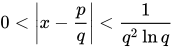
Mahler's generalization
Kurt Mahler extended the concept of an irrationality measure and defined a so-called transcendence measure, drawing on the idea of a Liouville number and partitioning the transcendental numbers into three distinct classes.[3]
Mahler's irrationality measure
Instead of taking for a given real number
x
{\displaystyle x}


0
<
|
q
x
−
p
|
≤
max
(
|
p
|
,
|
q
|
)
−
ω
{\displaystyle 0<|qx-p|\leq \max(|p|,|q|)^{-\omega }}


Define
R
{\displaystyle R}



Transcendence measure
Mahler's irrationality measure can be generalized as follows:[2][3] Take
P
{\displaystyle P}



0
<
|
P
(
z
)
|
≤
H
(
P
)
−
ω
{\displaystyle 0<|P(z)|\leq H(P)^{-\omega }}

Set
R
{\displaystyle R}


Then Mahler's transcendence measure is given by:
-
ω
(
z
)
=
lim sup
n
→
∞
ω
n
(
z
)
.
{\displaystyle \omega (z)=\limsup _{n\to \infty }\omega _{n}(z).}

The transcendental numbers can now be divided into the following three classes:
If for all
n
∈
Z
+
{\displaystyle n\in \mathbb {Z} ^{+}}


If for all
n
∈
Z
+
{\displaystyle n\in \mathbb {Z} ^{+}}
If there exists a smallest positive integer
N
{\displaystyle N}


The number
z
{\displaystyle z}

Almost all numbers are S-numbers. In fact, almost all real numbers give
ω
(
x
)
=
1
{\displaystyle \omega (x)=1}


Linear independence measure
Another generalization of Mahler's irrationality measure gives a linear independence measure.[2][13] For real numbers
x
1
,
.
.
.
,
x
n
∈
R
{\displaystyle x_{1},...,x_{n}\in \mathbb {R} }

0
<
|
c
1
x
1
+
.
.
.
+
c
n
x
n
|
≤
max
(
|
c
1
|
,
.
.
.
,
|
c
n
|
)
−
ν
{\displaystyle 0<|c_{1}x_{1}+...+c_{n}x_{n}|\leq \max(|c_{1}|,...,|c_{n}|)^{-\nu }}


Define
R
{\displaystyle R}


If the
x
1
,
.
.
.
,
x
n
{\displaystyle x_{1},...,x_{n}}


If
1
,
x
1
,
.
.
.
,
x
n
{\displaystyle 1,x_{1},...,x_{n}}


It is further
ν
(
1
,
x
)
=
ω
1
(
x
)
=
μ
(
x
)
−
1
{\displaystyle \nu (1,x)=\omega _{1}(x)=\mu (x)-1}

Other generalizations
Koksma’s generalization
Jurjen Koksma in 1939 proposed another generalization, similar to that of Mahler, based on approximations of complex numbers by algebraic numbers.[3][38]
For a given complex number
z
{\displaystyle z}

0
<
|
z
−
α
|
≤
H
(
α
)
−
ω
∗
−
1
{\displaystyle 0<|z-\alpha |\leq H(\alpha )^{-\omega ^{*}-1}}


Set
R
{\displaystyle R}


Then Koksma's transcendence measure is given by:
-
ω
∗
(
z
)
=
lim sup
n
→
∞
ω
n
∗
(
z
)
{\displaystyle \omega ^{*}(z)=\limsup _{n\to \infty }\omega _{n}^{*}(z)}
.
The complex numbers can now once again be partitioned into four classes A*, S*, T* and U*. However it turns out that these classes are equivalent to the ones given by Mahler in the sense that they produce exactly the same partition.[38]: 87
Simultaneous approximation of real numbers
Given a real number
x
∈
R
{\displaystyle x\in \mathbb {R} }


-
0
<
|
α
−
p
q
|
<
1
q
μ
{\displaystyle 0<\left|\alpha -{\frac {p}{q}}\right|<{\frac {1}{q^{\mu }}}}

has only at most finitely many solutions
p
q
∈
Q
{\displaystyle {\frac {p}{q}}\in \mathbb {Q} }

This can be generalized: Given a set of real numbers
x
1
,
.
.
.
,
x
n
∈
R
{\displaystyle x_{1},...,x_{n}\in \mathbb {R} }


-
0
<
|
α
i
−
p
i
q
|
<
1
q
μ
,
∀
i
∈
{
1
,
.
.
.
,
n
}
{\displaystyle 0<\left|\alpha _{i}-{\frac {p_{i}}{q}}\right|<{\frac {1}{q^{\mu }}},\forall i\in \{1,...,n\}}

have only at most finitely many solutions
(
p
1
q
,
.
.
.
,
p
n
q
)
∈
Q
n
{\displaystyle \left({\frac {p_{1}}{q}},...,{\frac {p_{n}}{q}}\right)\in \mathbb {Q} ^{n}}


See also
References
- Sondow, Jonathan (2004). "Irrationality Measures, Irrationality Bases, and a Theorem of Jarnik". arXiv:math/0406300.
- Parshin, A. N.; Shafarevich, I. R. (2013-03-09). Number Theory IV: Transcendental Numbers. Springer Science & Business Media. ISBN 978-3-662-03644-0.
- Bugeaud, Yann (2012). Distribution modulo one and Diophantine approximation. Cambridge Tracts in Mathematics. Vol. 193. Cambridge: Cambridge University Press. doi:10.1017/CBO9781139017732. ISBN 978-0-521-11169-0. MR 2953186. Zbl 1260.11001.
- Tao, Terence (2009). "245B, Notes 9: The Baire category theorem and its Banach space consequences". What's new. Retrieved 2024-09-08.
- Borwein, Jonathan M. (1987). Pi and the AGM: A Study in Analytic Number Theory and Computational Complexity. Wiley.
- Sondow, Jonathan (2003-07-23). "An irrationality measure for Liouville numbers and conditional measures for Euler's constant". arXiv:math/0307308.
- Chudnovsky, G. V. (1982). "Hermite-padé approximations to exponential functions and elementary estimates of the measure of irrationality of π". In Chudnovsky, David V.; Chudnovsky, Gregory V. (eds.). The Riemann Problem, Complete Integrability and Arithmetic Applications. Lecture Notes in Mathematics. Vol. 925. Berlin, Heidelberg: Springer. pp. 299–322. doi:10.1007/BFb0093516. ISBN 978-3-540-39152-4.
- Shallit, Jeffrey (1979-05-01). "Simple continued fractions for some irrational numbers". Journal of Number Theory. 11 (2): 209–217. doi:10.1016/0022-314X(79)90040-4. ISSN 0022-314X.
- Shallit, J. O (1982-04-01). "Simple continued fractions for some irrational numbers, II". Journal of Number Theory. 14 (2): 228–231. doi:10.1016/0022-314X(82)90047-6. ISSN 0022-314X.
- Bugeaud, Yann (2011). "On the rational approximation to the Thue–Morse–Mahler numbers". Annales de l'Institut Fourier. 61 (5): 2065–2076. doi:10.5802/aif.2666. ISSN 1777-5310.
- Weisstein, Eric W. "Irrationality Measure". mathworld.wolfram.com. Retrieved 2020-10-14.
- Nesterenko, Yu. V. (2010-10-01). "On the irrationality exponent of the number ln 2". Mathematical Notes. 88 (3): 530–543. doi:10.1134/S0001434610090257. ISSN 1573-8876. S2CID 120685006.
- Wu, Qiang (2003). "On the Linear Independence Measure of Logarithms of Rational Numbers". Mathematics of Computation. 72 (242): 901–911. doi:10.1090/S0025-5718-02-01442-4. ISSN 0025-5718. JSTOR 4099938.
- Bouchelaghem, Abderraouf; He, Yuxin; Li, Yuanhang; Wu, Qiang (2024-03-01). "On the linear independence measures of logarithms of rational numbers. II". J. Korean Math. Soc. 61 (2): 293–307. doi:10.4134/JKMS.j230133.
- Sal’nikova, E. S. (2008-04-01). "Diophantine approximations of log 2 and other logarithms". Mathematical Notes. 83 (3): 389–398. doi:10.1134/S0001434608030097. ISSN 1573-8876.
- "Symmetrized polynomials in a problem of estimating of the irrationality measure of number ln 3". www.mathnet.ru. Retrieved 2020-10-14.
- Polyanskii, Alexandr (2015-01-27). "On the irrationality measure of certain numbers". arXiv:1501.06752 [math.NT].
- Polyanskii, A. A. (2018-03-01). "On the Irrationality Measures of Certain Numbers. II". Mathematical Notes. 103 (3): 626–634. doi:10.1134/S0001434618030306. ISSN 1573-8876. S2CID 125251520.
- Androsenko, V. A. (2015). "Irrationality measure of the number \frac{\pi}{\sqrt{3}}". Izvestiya: Mathematics. 79 (1): 1–17. doi:10.1070/im2015v079n01abeh002731. ISSN 1064-5632. S2CID 123775303.
- Zeilberger, Doron; Zudilin, Wadim (2020-01-07). "The irrationality measure of π is at most 7.103205334137...". Moscow Journal of Combinatorics and Number Theory. 9 (4): 407–419. arXiv:1912.06345. doi:10.2140/moscow.2020.9.407. S2CID 209370638.
- Alekseyev, Max A. (2011). "On convergence of the Flint Hills series". arXiv:1104.5100 [math.CA].
- Weisstein, Eric W. "Flint Hills Series". MathWorld.
- Meiburg, Alex (2022). "Bounds on Irrationality Measures and the Flint-Hills Series". arXiv:2208.13356 [math.NT].
- OpenAI (2026-09-24). "The irrationality exponent of π is 2" (PDF). GitHub. Retrieved 2026-10-07.
- Zudilin, Wadim (2014-06-01). "Two hypergeometric tales and a new irrationality measure of ζ(2)". Annales mathématiques du Québec. 38 (1): 101–117. arXiv:1310.1526. doi:10.1007/s40316-014-0016-0. ISSN 2195-4763. S2CID 119154009.
- Bashmakova, M. G.; Salikhov, V. Kh. (2019). "Об оценке меры иррациональности arctg 1/2". Чебышевский сборник. 20 (4 (72)): 58–68. ISSN 2226-8383.
- Tomashevskaya, E. B. "On the irrationality measure of the number log 5+pi/2 and some other numbers". www.mathnet.ru. Retrieved 2020-10-14.
- Salikhov, Vladislav K.; Bashmakova, Mariya G. (2022). "On rational approximations for some values of arctan(s/r) for natural s and r, s". Moscow Journal of Combinatorics and Number Theory. 11 (2): 181–188. doi:10.2140/moscow.2022.11.181. ISSN 2220-5438.
- Salikhov, V. Kh.; Bashmakova, M. G. (2020-12-01). "On Irrationality Measure of Some Values of $\operatorname{arctg} \frac{1}{n}$". Russian Mathematics. 64 (12): 29–37. doi:10.3103/S1066369X2012004X. ISSN 1934-810X.
- Bruiltet, Sylvain (2002). "D'une mesure d'approximation simultanee a une mesure d'irrationalite : le cas de Γ(1/4) et Γ(1/3)". Acta Arithmetica. 104 (3): 243–281. doi:10.4064/aa104-3-3. ISSN 0065-1036.
- Duverney, Daniel; Shiokawa, Iekata (2020-01-01). "Irrationality exponents of numbers related with Cahen's constant". Monatshefte für Mathematik. 191 (1): 53–76. doi:10.1007/s00605-019-01335-0. ISSN 1436-5081.
- Amou, Masaaki (1991-02-01). "Approximation to certain transcendental decimal fractions by algebraic numbers". Journal of Number Theory. 37 (2): 231–241. doi:10.1016/S0022-314X(05)80039-3. ISSN 0022-314X.
- Waldschmidt, Michel (2004-01-24). "Open Diophantine Problems". arXiv:math/0312440.
- Hurwitz, A. (1891). "Ueber die angenäherte Darstellung der Irrationalzahlen durch rationale Brüche (On the approximate representation of irrational numbers by rational fractions)". Mathematische Annalen (in German). 39 (2): 279–284. doi:10.1007/BF01206656. JFM 23.0222.02. S2CID 119535189.
- LeVeque, William (1977). Fundamentals of Number Theory. Addison-Wesley Publishing Company, Inc. pp. 251–254. ISBN 0-201-04287-8.
- Hancl, Jaroslav (January 2016). "Second basic theorem of Hurwitz". Lithuanian Mathematical Journal. 56: 72–76. doi:10.1007/s10986-016-9305-4. S2CID 124639896.
- Davis, C. S. (1978). "Rational approximations to e". Journal of the Australian Mathematical Society. 25 (4): 497–502. doi:10.1017/S1446788700021480. ISSN 1446-8107.
- Baker, Alan (1979). Transcendental number theory (Repr. with additional material ed.). Cambridge: Cambridge Univ. Pr. ISBN 978-0-521-20461-3.
- Burger, Edward B.; Tubbs, Robert (2004-07-28). Making Transcendence Transparent: An Intuitive Approach to Classical Transcendental Number Theory. Springer Science & Business Media. ISBN 978-0-387-21444-3.
- Schmidt, Wolfgang M. (1972). "Norm Form Equations". Annals of Mathematics. 96 (3): 526–551. doi:10.2307/1970824. ISSN 0003-486X. JSTOR 1970824.
- Schmidt, Wolfgang M. (1996). Diophantine approximation. Lecture notes in mathematics. Berlin; New York: Springer. ISBN 978-3-540-09762-4.