In mathematics, a sequence of positive integers an is called an irrationality sequence if it has the property that for every sequence xn of positive integers, the sum of the series
-
∑
n
=
1
∞
1
a
n
x
n
{\displaystyle \sum _{n=1}^{\infty }{\frac {1}{a_{n}x_{n}}}}

exists (that is, it converges) and is an irrational number.[1][2] The problem of characterizing irrationality sequences was posed by Paul Erdős and Ernst G. Straus, who originally called the property of being an irrationality sequence "Property P".[3]
Examples
The powers of two whose exponents are powers of two,
2
2
n
{\displaystyle 2^{2^{n}}}

- 2, 3, 7, 43, 1807, 3263443, ...
(in which each term is one more than the product of all previous terms) also grows doubly exponentially, it does not form an irrationality sequence. For, letting
x
n
=
1
{\displaystyle x_{n}=1}


-
1
2
+
1
3
+
1
7
+
1
43
+
⋯
=
1
,
{\displaystyle {\frac {1}{2}}+{\frac {1}{3}}+{\frac {1}{7}}+{\frac {1}{43}}+\cdots =1,}

a series converging to a rational number. Likewise, the factorials,
n
!
{\displaystyle n!}


-
∑
n
=
0
∞
1
(
n
+
2
)
n
!
=
1
2
+
1
3
+
1
8
+
1
30
+
1
144
+
⋯
=
1.
{\displaystyle \sum _{n=0}^{\infty }{\frac {1}{(n+2)n!}}={\frac {1}{2}}+{\frac {1}{3}}+{\frac {1}{8}}+{\frac {1}{30}}+{\frac {1}{144}}+\cdots =1.}
[1]
Growth rate
For any sequence an to be an irrationality sequence, it must grow at a rate such that
-
lim sup
n
→
∞
log
log
a
n
n
≥
log
2
{\displaystyle \limsup _{n\to \infty }{\frac {\log \log a_{n}}{n}}\geq \log 2}
.[4]
This includes sequences that grow at a more than doubly exponential rate as well as some doubly exponential sequences that grow more quickly than the powers of powers of two.[1]
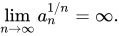
Every irrationality sequence must grow quickly enough that
-
lim
n
→
∞
a
n
1
/
n
=
∞
.
{\displaystyle \lim _{n\to \infty }a_{n}^{1/n}=\infty .}
However, it is not known whether there exists such a sequence in which the greatest common divisor of each pair of terms is 1 (unlike the powers of powers of two) and for which
-
lim
n
→
∞
a
n
1
/
2
n
<
∞
.
{\displaystyle \lim _{n\to \infty }a_{n}^{1/2^{n}}<\infty .}
[5]
Related properties
Analogously to irrationality sequences, Hančl (1996) has defined a transcendental sequence to be an integer sequence an such that, for every sequence xn of positive integers, the sum of the series
-
∑
n
=
1
∞
1
a
n
x
n
{\displaystyle \sum _{n=1}^{\infty }{\frac {1}{a_{n}x_{n}}}}
exists and is a transcendental number.[6]
References
- Guy, Richard K. (2004), "E24 Irrationality sequences", Unsolved problems in number theory (3rd ed.), Springer-Verlag, p. 346, ISBN 0-387-20860-7, Zbl 1058.11001.
- Erdős, P.; Graham, R. L. (1980), Old and new problems and results in combinatorial number theory, Monographies de L'Enseignement Mathématique, vol. 28, Geneva: Université de Genève L'Enseignement Mathématique, p. 128, MR 0592420.
- Erdős, P. (1975), "Some problems and results on the irrationality of the sum of infinite series" (PDF), Journal of Mathematical Sciences, 10: 1–7 (1976), MR 0539489.
- Hančl, Jaroslav (1991), "Expression of real numbers with the help of infinite series", Acta Arithmetica, 59 (2): 97–104, doi:10.4064/aa-59-2-97-104, MR 1133951
- Erdős, P. (1988), "On the irrationality of certain series: problems and results", New advances in transcendence theory (Durham, 1986) (PDF), Cambridge: Cambridge Univ. Press, pp. 102–109, MR 0971997.
- Hančl, Jaroslav (1996), "Transcendental sequences", Mathematica Slovaca, 46 (2–3): 177–179, MR 1427003.