In mathematics, the Iwasawa decomposition (aka KAN from its expression) of a semisimple Lie group generalises the way a square real matrix can be written as a product of an orthogonal matrix and an upper triangular matrix (QR decomposition, a consequence of Gram–Schmidt orthogonalization). It is named after Kenkichi Iwasawa, the Japanese mathematician who developed this method.[1]
Definition
- G is a connected semisimple real Lie group.
-
g
0
{\displaystyle {\mathfrak {g}}_{0}}
is the Lie algebra of G
-
g
{\displaystyle {\mathfrak {g}}}
is the complexification of g 0 {\displaystyle {\mathfrak {g}}_{0}}
- θ is a Cartan involution of
g
0
{\displaystyle {\mathfrak {g}}_{0}}
-
g
0
=
k
0
⊕
p
0
{\displaystyle {\mathfrak {g}}_{0}={\mathfrak {k}}_{0}\oplus {\mathfrak {p}}_{0}}
is the corresponding Cartan decomposition
-
a
0
{\displaystyle {\mathfrak {a}}_{0}}
is a maximal abelian subalgebra of p 0 {\displaystyle {\mathfrak {p}}_{0}}
- Σ is the set of restricted roots of
a
0
{\displaystyle {\mathfrak {a}}_{0}}
- Σ+ is a choice of positive roots of Σ
-
n
0
{\displaystyle {\mathfrak {n}}_{0}}
is a nilpotent Lie algebra given as the sum of the root spaces of Σ+
- K, A, N, are the Lie subgroups of G generated by
k
0
,
a
0
{\displaystyle {\mathfrak {k}}_{0},{\mathfrak {a}}_{0}}
and n 0 {\displaystyle {\mathfrak {n}}_{0}}

Then the Iwasawa decomposition of
g
0
{\displaystyle {\mathfrak {g}}_{0}}
-
g
0
=
k
0
⊕
a
0
⊕
n
0
{\displaystyle {\mathfrak {g}}_{0}={\mathfrak {k}}_{0}\oplus {\mathfrak {a}}_{0}\oplus {\mathfrak {n}}_{0}}

and the Iwasawa decomposition of G is
-
G
=
K
A
N
{\displaystyle G=KAN}

meaning there is an analytic diffeomorphism (but not a group homomorphism) from the manifold
K
×
A
×
N
{\displaystyle K\times A\times N}



The dimension of A (or equivalently of
a
0
{\displaystyle {\mathfrak {a}}_{0}}
Iwasawa decompositions also hold for some disconnected semisimple groups G, where K becomes a (disconnected) maximal compact subgroup provided the center of G is finite.
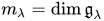
The restricted root space decomposition is
-
g
0
=
m
0
⊕
a
0
⊕
λ
∈
Σ
g
λ
{\displaystyle {\mathfrak {g}}_{0}={\mathfrak {m}}_{0}\oplus {\mathfrak {a}}_{0}\oplus _{\lambda \in \Sigma }{\mathfrak {g}}_{\lambda }}

where
m
0
{\displaystyle {\mathfrak {m}}_{0}}


![{\displaystyle {\mathfrak {g}}_{\lambda }=\{X\in {\mathfrak {g}}_{0}:[H,X]=\lambda (H)X\;\;\forall H\in {\mathfrak {a}}_{0}\}}](https://wikimedia.org/api/rest_v1/media/math/render/svg/a5f7ae9557810a19abc81b71341deed21e0fed22)

Examples
If G=SLn(R), then we can take K to be the orthogonal matrices, A to be the positive diagonal matrices with determinant 1, and N to be the unipotent group consisting of upper triangular matrices with 1s on the diagonal.
For the case of n = 2, the Iwasawa decomposition of G = SL(2, R) is in terms of
-
K
=
{
(
cos
θ
−
sin
θ
sin
θ
cos
θ
)
∈
S
L
(
2
,
R
)
|
θ
∈
R
}
≅
S
O
(
2
)
,
{\displaystyle \mathbf {K} =\left\{{\begin{pmatrix}\cos \theta &-\sin \theta \\\sin \theta &\cos \theta \end{pmatrix}}\in SL(2,\mathbb {R} )\ |\ \theta \in \mathbf {R} \right\}\cong SO(2),}
-
A
=
{
(
r
0
0
r
−
1
)
∈
S
L
(
2
,
R
)
|
r
>
0
}
,
{\displaystyle \mathbf {A} =\left\{{\begin{pmatrix}r&0\\0&r^{-1}\end{pmatrix}}\in SL(2,\mathbb {R} )\ |\ r>0\right\},}
-
N
=
{
(
1
x
0
1
)
∈
S
L
(
2
,
R
)
|
x
∈
R
}
.
{\displaystyle \mathbf {N} =\left\{{\begin{pmatrix}1&x\\0&1\end{pmatrix}}\in SL(2,\mathbb {R} )\ |\ x\in \mathbf {R} \right\}.}



For the symplectic group G = Sp(2n, R), a possible Iwasawa decomposition is in terms of
-
K
=
S
p
(
2
n
,
R
)
∩
S
O
(
2
n
)
=
{
(
A
B
−
B
A
)
∈
S
p
(
2
n
,
R
)
|
A
+
i
B
∈
U
(
n
)
}
≅
U
(
n
)
,
{\displaystyle \mathbf {K} =Sp(2n,\mathbb {R} )\cap SO(2n)=\left\{{\begin{pmatrix}A&B\\-B&A\end{pmatrix}}\in Sp(2n,\mathbb {R} )\ |\ A+iB\in U(n)\right\}\cong U(n),}
-
A
=
{
(
D
0
0
D
−
1
)
∈
S
p
(
2
n
,
R
)
|
D
positive, diagonal
}
,
{\displaystyle \mathbf {A} =\left\{{\begin{pmatrix}D&0\\0&D^{-1}\end{pmatrix}}\in Sp(2n,\mathbb {R} )\ |\ D{\text{ positive, diagonal}}\right\},}
-
N
=
{
(
N
M
0
N
−
T
)
∈
S
p
(
2
n
,
R
)
|
N
upper triangular with diagonal elements = 1
,
N
M
T
=
M
N
T
}
.
{\displaystyle \mathbf {N} =\left\{{\begin{pmatrix}N&M\\0&N^{-T}\end{pmatrix}}\in Sp(2n,\mathbb {R} )\ |\ N{\text{ upper triangular with diagonal elements = 1}},\ NM^{T}=MN^{T}\right\}.}



Obtaining the matrices appearing in the decomposition above can be reduced to the calculation of matrix square roots, matrix inverses and performing a QR decomposition.[2]
Non-Archimedean Iwasawa decomposition
There is an analog to the above Iwasawa decomposition for a non-Archimedean field
F
{\displaystyle F}


See also
References
- Iwasawa, Kenkichi (1949). "On Some Types of Topological Groups". Annals of Mathematics. 50 (3): 507–558. doi:10.2307/1969548. JSTOR 1969548.
- Houde, Martin; McCutcheon, Will; Quesada, Nicolas (2024). "Matrix decompositions in quantum optics: Takagi/Autonne, Bloch–Messiah/Euler, Iwasawa, and Williamson". Canadian Journal of Physics. 102 (10): 497–597. doi:10.1139/cjp-2024-0070. hdl:1807/139527.
- Bump, Daniel (1997), Automorphic forms and representations, Cambridge: Cambridge University Press, doi:10.1017/CBO9780511609572, ISBN 0-521-55098-X, Prop. 4.5.2
- Fedenko, A.S.; Shtern, A.I. (2001) [1994], "Iwasawa decomposition", Encyclopedia of Mathematics, EMS Press
- Knapp, A. W. (2002). Lie groups beyond an introduction (2nd ed.). Springer. ISBN 9780817642594.