In mathematics, the Jacobi–Anger expansion (or Jacobi–Anger identity) is an expansion of exponentials of trigonometric functions in the basis of their harmonics. It is useful in physics (for example, to convert between plane waves and cylindrical waves), and in signal processing (to describe FM signals). This identity is named after the 19th-century mathematicians Carl Jacobi and Carl Theodor Anger.
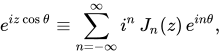
The most general identity is given by:[1][2]
-
e
i
z
cos
θ
≡
∑
n
=
−
∞
∞
i
n
J
n
(
z
)
e
i
n
θ
,
{\displaystyle e^{iz\cos \theta }\equiv \sum _{n=-\infty }^{\infty }i^{n}\,J_{n}(z)\,e^{in\theta },}
where
J
n
(
z
)
{\displaystyle J_{n}(z)}


-
e
i
z
sin
θ
≡
∑
n
=
−
∞
∞
J
n
(
z
)
e
i
n
θ
.
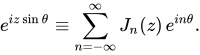
{\displaystyle e^{iz\sin \theta }\equiv \sum _{n=-\infty }^{\infty }J_{n}(z)\,e^{in\theta }.}
Using the relation
J
−
n
(
z
)
=
(
−
1
)
n
J
n
(
z
)
,
{\displaystyle J_{-n}(z)=(-1)^{n}\,J_{n}(z),}

-
e
i
z
cos
θ
≡
J
0
(
z
)
+
2
∑
n
=
1
∞
i
n
J
n
(
z
)
cos
(
n
θ
)
.
{\displaystyle e^{iz\cos \theta }\equiv J_{0}(z)\,+\,2\,\sum _{n=1}^{\infty }\,i^{n}\,J_{n}(z)\,\cos \,(n\theta ).}

Real-valued expressions
The following real-valued variations are often useful as well:[3]
-
cos
(
z
cos
θ
)
≡
J
0
(
z
)
+
2
∑
n
=
1
∞
(
−
1
)
n
J
2
n
(
z
)
cos
(
2
n
θ
)
,
sin
(
z
cos
θ
)
≡
−
2
∑
n
=
1
∞
(
−
1
)
n
J
2
n
−
1
(
z
)
cos
[
(
2
n
−
1
)
θ
]
,
cos
(
z
sin
θ
)
≡
J
0
(
z
)
+
2
∑
n
=
1
∞
J
2
n
(
z
)
cos
(
2
n
θ
)
,
sin
(
z
sin
θ
)
≡
2
∑
n
=
1
∞
J
2
n
−
1
(
z
)
sin
[
(
2
n
−
1
)
θ
]
.
{\displaystyle {\begin{aligned}\cos(z\cos \theta )&\equiv J_{0}(z)+2\sum _{n=1}^{\infty }(-1)^{n}J_{2n}(z)\cos(2n\theta ),\\\sin(z\cos \theta )&\equiv -2\sum _{n=1}^{\infty }(-1)^{n}J_{2n-1}(z)\cos \left[\left(2n-1\right)\theta \right],\\\cos(z\sin \theta )&\equiv J_{0}(z)+2\sum _{n=1}^{\infty }J_{2n}(z)\cos(2n\theta ),\\\sin(z\sin \theta )&\equiv 2\sum _{n=1}^{\infty }J_{2n-1}(z)\sin \left[\left(2n-1\right)\theta \right].\end{aligned}}}
![{\displaystyle {\begin{aligned}\cos(z\cos \theta )&\equiv J_{0}(z)+2\sum _{n=1}^{\infty }(-1)^{n}J_{2n}(z)\cos(2n\theta ),\\\sin(z\cos \theta )&\equiv -2\sum _{n=1}^{\infty }(-1)^{n}J_{2n-1}(z)\cos \left[\left(2n-1\right)\theta \right],\\\cos(z\sin \theta )&\equiv J_{0}(z)+2\sum _{n=1}^{\infty }J_{2n}(z)\cos(2n\theta ),\\\sin(z\sin \theta )&\equiv 2\sum _{n=1}^{\infty }J_{2n-1}(z)\sin \left[\left(2n-1\right)\theta \right].\end{aligned}}}](https://wikimedia.org/api/rest_v1/media/math/render/svg/479f84bed8d8c7faf30d65a780f65362e242bf92)
See also
Notes
- Colton & Kress (1998) p. 32.
- Cuyt et al. (2008) p. 344.
- Abramowitz & Stegun (1965) p. 361, 9.1.42–45
References
- Abramowitz, Milton; Stegun, Irene Ann, eds. (1983) [June 1964]. "Chapter 9". Handbook of Mathematical Functions with Formulas, Graphs, and Mathematical Tables. Applied Mathematics Series. Vol. 55 (Ninth reprint with additional corrections of tenth original printing with corrections (December 1972); first ed.). Washington D.C.; New York: United States Department of Commerce, National Bureau of Standards; Dover Publications. p. 355. ISBN 978-0-486-61272-0. LCCN 64-60036. MR 0167642. LCCN 65-12253.
- Colton, David; Kress, Rainer (1998), Inverse acoustic and electromagnetic scattering theory, Applied Mathematical Sciences, vol. 93 (2nd ed.), ISBN 978-3-540-62838-5
- Cuyt, Annie; Petersen, Vigdis; Verdonk, Brigitte; Waadeland, Haakon; Jones, William B. (2008), Handbook of continued fractions for special functions, Springer, ISBN 978-1-4020-6948-2
External links
- Weisstein, Eric W. "Jacobi–Anger expansion". MathWorld — a Wolfram web resource. Retrieved 2008-11-11.