In the geometry of numbers, the Klein polyhedron, named after Felix Klein, is used to generalize the concept of simple continued fractions to higher dimensions.
Definition
Let
C
{\displaystyle \textstyle C}
be a closed simplicial cone in Euclidean space
R
n
{\displaystyle \textstyle \mathbb {R} ^{n}}
. The Klein polyhedron of
C
{\displaystyle \textstyle C}
is the convex hull of the non-zero points of
C
∩
Z
n
{\displaystyle \textstyle C\cap \mathbb {Z} ^{n}}
.
Relation to continued fractions

Suppose
α
>
0
{\displaystyle \textstyle \alpha >0}
is an irrational number. In
R
2
{\displaystyle \textstyle \mathbb {R} ^{2}}
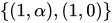
, the cones generated by
{
(
1
,
α
)
,
(
1
,
0
)
}
{\displaystyle \textstyle \{(1,\alpha ),(1,0)\}}
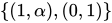
and by
{
(
1
,
α
)
,
(
0
,
1
)
}
{\displaystyle \textstyle \{(1,\alpha ),(0,1)\}}
give rise to two Klein polyhedra, each of which is bounded by a sequence of adjoining line segments. Define the integer length of a line segment to be one less than the size of its intersection with
Z
2
.
{\displaystyle \textstyle \mathbb {Z} ^{2}.}
Then the integer lengths of the edges of these two Klein polyhedra encode the continued-fraction expansion of
α
{\displaystyle \textstyle \alpha }
, one matching the even terms and the other matching the odd terms.
Graphs associated with the Klein polyhedron
Suppose
C
{\displaystyle \textstyle C}
is generated by a basis
(
a
i
)
{\displaystyle \textstyle (a_{i})}
of
R
n
{\displaystyle \textstyle \mathbb {R} ^{n}}
(so that
C
=
{
∑
i
λ
i
a
i
:
(
∀
i
)
λ
i
≥
0
}
{\displaystyle \textstyle C=\{\sum _{i}\lambda _{i}a_{i}:(\forall i)\;\lambda _{i}\geq 0\}}
), and let
(
w
i
)
{\displaystyle \textstyle (w_{i})}
be the dual basis (so that
C
=
{
x
:
(
∀
i
)
⟨
w
i
,
x
⟩
≥
0
}
{\displaystyle \textstyle C=\{x:(\forall i)\;\langle w_{i},x\rangle \geq 0\}}
). Write
D
(
x
)
{\displaystyle \textstyle D(x)}
for the line generated by the vector
x
{\displaystyle \textstyle x}
, and
H
(
x
)
{\displaystyle \textstyle H(x)}
for the hyperplane orthogonal to
x
{\displaystyle \textstyle x}
.
Call the vector
x
∈
R
n
{\displaystyle \textstyle x\in \mathbb {R} ^{n}}
irrational if
H
(
x
)
∩
Q
n
=
{
0
}
{\displaystyle \textstyle H(x)\cap \mathbb {Q} ^{n}=\{0\}}
; and call the cone
C
{\displaystyle \textstyle C}
irrational if all the vectors
a
i
{\displaystyle \textstyle a_{i}}
and
w
i
{\displaystyle \textstyle w_{i}}
are irrational.
The boundary
V
{\displaystyle \textstyle V}
of a Klein polyhedron is called a sail. Associated with the sail
V
{\displaystyle \textstyle V}
of an irrational cone are two graphs:
- the graph
Γ
e
(
V
)
{\displaystyle \textstyle \Gamma _{\mathrm {e} }(V)}
whose vertices are vertices of V {\displaystyle \textstyle V}
, two vertices being joined if they are endpoints of a (one-dimensional) edge of V {\displaystyle \textstyle V}
;
- the graph
Γ
f
(
V
)
{\displaystyle \textstyle \Gamma _{\mathrm {f} }(V)}
whose vertices are ( n − 1 ) {\displaystyle \textstyle (n-1)}
-dimensional faces (chambers) of V {\displaystyle \textstyle V}
, two chambers being joined if they share an ( n − 2 ) {\displaystyle \textstyle (n-2)}
-dimensional face.
Both of these graphs are structurally related to the directed graph
Υ
n
{\displaystyle \textstyle \Upsilon _{n}}
whose set of vertices is
G
L
n
(
Q
)
{\displaystyle \textstyle \mathrm {GL} _{n}(\mathbb {Q} )}
, where vertex
A
{\displaystyle \textstyle A}
is joined to vertex
B
{\displaystyle \textstyle B}
if and only if
A
−
1
B
{\displaystyle \textstyle A^{-1}B}
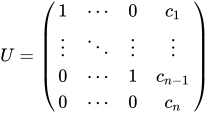
is of the form
U
W
{\displaystyle \textstyle UW}
where
-
U
=
(
1
⋯
0
c
1
⋮
⋱
⋮
⋮
0
⋯
1
c
n
−
1
0
⋯
0
c
n
)
{\displaystyle U=\left({\begin{array}{cccc}1&\cdots &0&c_{1}\\\vdots &\ddots &\vdots &\vdots \\0&\cdots &1&c_{n-1}\\0&\cdots &0&c_{n}\end{array}}\right)}
(with
c
i
∈
Q
{\displaystyle \textstyle c_{i}\in \mathbb {Q} }
,
c
n
≠
0
{\displaystyle \textstyle c_{n}\neq 0}
) and
W
{\displaystyle \textstyle W}
is a permutation matrix. Assuming that
V
{\displaystyle \textstyle V}
has been triangulated, the vertices of each of the graphs
Γ
e
(
V
)
{\displaystyle \textstyle \Gamma _{\mathrm {e} }(V)}
and
Γ
f
(
V
)
{\displaystyle \textstyle \Gamma _{\mathrm {f} }(V)}
can be described in terms of the graph
Υ
n
{\displaystyle \textstyle \Upsilon _{n}}
:
- Given any path
(
x
0
,
x
1
,
…
)
{\displaystyle \textstyle (x_{0},x_{1},\ldots )}
in Γ e ( V ) {\displaystyle \textstyle \Gamma _{\mathrm {e} }(V)}
, one can find a path ( A 0 , A 1 , … ) {\displaystyle \textstyle (A_{0},A_{1},\ldots )}
in Υ n {\displaystyle \textstyle \Upsilon _{n}}
such that x k = A k ( e ) {\displaystyle \textstyle x_{k}=A_{k}(e)}
, where e {\displaystyle \textstyle e}
is the vector ( 1 , … , 1 ) ∈ R n {\displaystyle \textstyle (1,\ldots ,1)\in \mathbb {R} ^{n}}
.
- Given any path
(
σ
0
,
σ
1
,
…
)
{\displaystyle \textstyle (\sigma _{0},\sigma _{1},\ldots )}
in Γ f ( V ) {\displaystyle \textstyle \Gamma _{\mathrm {f} }(V)}
, one can find a path ( A 0 , A 1 , … ) {\displaystyle \textstyle (A_{0},A_{1},\ldots )}
in Υ n {\displaystyle \textstyle \Upsilon _{n}}
such that σ k = A k ( Δ ) {\displaystyle \textstyle \sigma _{k}=A_{k}(\Delta )}
, where Δ {\displaystyle \textstyle \Delta }
is the ( n − 1 ) {\displaystyle \textstyle (n-1)}
-dimensional standard simplex in R n {\displaystyle \textstyle \mathbb {R} ^{n}}
.
Generalization of Lagrange's theorem
Lagrange proved that for an irrational real number
α
{\displaystyle \textstyle \alpha }
, the continued-fraction expansion of
α
{\displaystyle \textstyle \alpha }
is periodic if and only if
α
{\displaystyle \textstyle \alpha }
is a quadratic irrational. Klein polyhedra allow us to generalize this result.
Let
K
⊆
R
{\displaystyle \textstyle K\subseteq \mathbb {R} }
be a totally real algebraic number field of degree
n
{\displaystyle \textstyle n}
, and let
α
i
:
K
→
R
{\displaystyle \textstyle \alpha _{i}:K\to \mathbb {R} }
be the
n
{\displaystyle \textstyle n}
real embeddings of
K
{\displaystyle \textstyle K}
. The simplicial cone
C
{\displaystyle \textstyle C}
is said to be split over
K
{\displaystyle \textstyle K}
if
C
=
{
x
∈
R
n
:
(
∀
i
)
α
i
(
ω
1
)
x
1
+
…
+
α
i
(
ω
n
)
x
n
≥
0
}
{\displaystyle \textstyle C=\{x\in \mathbb {R} ^{n}:(\forall i)\;\alpha _{i}(\omega _{1})x_{1}+\ldots +\alpha _{i}(\omega _{n})x_{n}\geq 0\}}
where
ω
1
,
…
,
ω
n
{\displaystyle \textstyle \omega _{1},\ldots ,\omega _{n}}
is a basis for
K
{\displaystyle \textstyle K}
over
Q
{\displaystyle \textstyle \mathbb {Q} }
.
Given a path
(
A
0
,
A
1
,
…
)
{\displaystyle \textstyle (A_{0},A_{1},\ldots )}
in
Υ
n
{\displaystyle \textstyle \Upsilon _{n}}
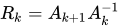
, let
R
k
=
A
k
+
1
A
k
−
1
{\displaystyle \textstyle R_{k}=A_{k+1}A_{k}^{-1}}
. The path is called periodic, with period
m
{\displaystyle \textstyle m}
, if
R
k
+
q
m
=
R
k
{\displaystyle \textstyle R_{k+qm}=R_{k}}
for all
k
,
q
≥
0
{\displaystyle \textstyle k,q\geq 0}
. The period matrix of such a path is defined to be
A
m
A
0
−
1
{\displaystyle \textstyle A_{m}A_{0}^{-1}}
. A path in
Γ
e
(
V
)
{\displaystyle \textstyle \Gamma _{\mathrm {e} }(V)}
or
Γ
f
(
V
)
{\displaystyle \textstyle \Gamma _{\mathrm {f} }(V)}
associated with such a path is also said to be periodic, with the same period matrix.
The generalized Lagrange theorem states that for an irrational simplicial cone
C
⊆
R
n
{\displaystyle \textstyle C\subseteq \mathbb {R} ^{n}}
, with generators
(
a
i
)
{\displaystyle \textstyle (a_{i})}
and
(
w
i
)
{\displaystyle \textstyle (w_{i})}
as above and with sail
V
{\displaystyle \textstyle V}
, the following three conditions are equivalent:
-
C
{\displaystyle \textstyle C}
is split over some totally real algebraic number field of degree n {\displaystyle \textstyle n}
.
- For each of the
a
i
{\displaystyle \textstyle a_{i}}
there is periodic path of vertices x 0 , x 1 , … {\displaystyle \textstyle x_{0},x_{1},\ldots }
in Γ e ( V ) {\displaystyle \textstyle \Gamma _{\mathrm {e} }(V)}
such that the x k {\displaystyle \textstyle x_{k}}
asymptotically approach the line D ( a i ) {\displaystyle \textstyle D(a_{i})}
; and the period matrices of these paths all commute.
- For each of the
w
i
{\displaystyle \textstyle w_{i}}
there is periodic path of chambers σ 0 , σ 1 , … {\displaystyle \textstyle \sigma _{0},\sigma _{1},\ldots }
in Γ f ( V ) {\displaystyle \textstyle \Gamma _{\mathrm {f} }(V)}
such that the σ k {\displaystyle \textstyle \sigma _{k}}
asymptotically approach the hyperplane H ( w i ) {\displaystyle \textstyle H(w_{i})}
; and the period matrices of these paths all commute.
Example
Take
n
=
2
{\displaystyle \textstyle n=2}
and
K
=
Q
(
2
)
{\displaystyle \textstyle K=\mathbb {Q} ({\sqrt {2}})}
. Then the simplicial cone
{
(
x
,
y
)
:
x
≥
0
,
|
y
|
≤
x
/
2
}
{\displaystyle \textstyle \{(x,y):x\geq 0,\vert y\vert \leq x/{\sqrt {2}}\}}
is split over
K
{\displaystyle \textstyle K}
. The vertices of the sail are the points
(
p
k
,
±
q
k
)
{\displaystyle \textstyle (p_{k},\pm q_{k})}
corresponding to the even convergents
p
k
/
q
k
{\displaystyle \textstyle p_{k}/q_{k}}
of the continued fraction for
2
{\displaystyle \textstyle {\sqrt {2}}}
. The path of vertices
(
x
k
)
{\displaystyle \textstyle (x_{k})}
in the positive quadrant starting at
(
1
,
0
)
{\displaystyle \textstyle (1,0)}
and proceeding in a positive direction is
(
(
1
,
0
)
,
(
3
,
2
)
,
(
17
,
12
)
,
(
99
,
70
)
,
…
)
{\displaystyle \textstyle ((1,0),(3,2),(17,12),(99,70),\ldots )}
. Let
σ
k
{\displaystyle \textstyle \sigma _{k}}
be the line segment joining
x
k
{\displaystyle \textstyle x_{k}}
to
x
k
+
1
{\displaystyle \textstyle x_{k+1}}
. Write
x
¯
k
{\displaystyle \textstyle {\bar {x}}_{k}}
and
σ
¯
k
{\displaystyle \textstyle {\bar {\sigma }}_{k}}
for the reflections of
x
k
{\displaystyle \textstyle x_{k}}
and
σ
k
{\displaystyle \textstyle \sigma _{k}}
in the
x
{\displaystyle \textstyle x}
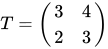
-axis. Let
T
=
(
3
4
2
3
)
{\displaystyle \textstyle T=\left({\begin{array}{cc}3&4\\2&3\end{array}}\right)}
, so that
x
k
+
1
=
T
x
k
{\displaystyle \textstyle x_{k+1}=Tx_{k}}
, and let
R
=
(
6
1
−
1
0
)
=
(
1
6
0
−
1
)
(
0
1
1
0
)
{\displaystyle \textstyle R=\left({\begin{array}{cc}6&1\\-1&0\end{array}}\right)=\left({\begin{array}{cc}1&6\\0&-1\end{array}}\right)\left({\begin{array}{cc}0&1\\1&0\end{array}}\right)}
.
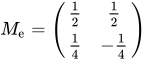
Let
M
e
=
(
1
2
1
2
1
4
−
1
4
)
{\displaystyle \textstyle M_{\mathrm {e} }=\left({\begin{array}{cc}{\frac {1}{2}}&{\frac {1}{2}}\\{\frac {1}{4}}&-{\frac {1}{4}}\end{array}}\right)}
,
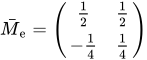
M
¯
e
=
(
1
2
1
2
−
1
4
1
4
)
{\displaystyle \textstyle {\bar {M}}_{\mathrm {e} }=\left({\begin{array}{cc}{\frac {1}{2}}&{\frac {1}{2}}\\-{\frac {1}{4}}&{\frac {1}{4}}\end{array}}\right)}
,
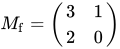
M
f
=
(
3
1
2
0
)
{\displaystyle \textstyle M_{\mathrm {f} }=\left({\begin{array}{cc}3&1\\2&0\end{array}}\right)}
, and
M
¯
f
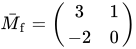
=
(
3
1
−
2
0
)
{\displaystyle \textstyle {\bar {M}}_{\mathrm {f} }=\left({\begin{array}{cc}3&1\\-2&0\end{array}}\right)}
.
- The paths
(
M
e
R
k
)
{\displaystyle \textstyle (M_{\mathrm {e} }R^{k})}
and ( M ¯ e R k ) {\displaystyle \textstyle ({\bar {M}}_{\mathrm {e} }R^{k})}
are periodic (with period one) in Υ 2 {\displaystyle \textstyle \Upsilon _{2}}
, with period matrices M e R M e − 1 = T {\displaystyle \textstyle M_{\mathrm {e} }RM_{\mathrm {e} }^{-1}=T}
and M ¯ e R M ¯ e − 1 = T − 1 {\displaystyle \textstyle {\bar {M}}_{\mathrm {e} }R{\bar {M}}_{\mathrm {e} }^{-1}=T^{-1}}
. We have x k = M e R k ( e ) {\displaystyle \textstyle x_{k}=M_{\mathrm {e} }R^{k}(e)}
and x ¯ k = M ¯ e R k ( e ) {\displaystyle \textstyle {\bar {x}}_{k}={\bar {M}}_{\mathrm {e} }R^{k}(e)}
.
- The paths
(
M
f
R
k
)
{\displaystyle \textstyle (M_{\mathrm {f} }R^{k})}
and ( M ¯ f R k ) {\displaystyle \textstyle ({\bar {M}}_{\mathrm {f} }R^{k})}
are periodic (with period one) in Υ 2 {\displaystyle \textstyle \Upsilon _{2}}
, with period matrices M f R M f − 1 = T {\displaystyle \textstyle M_{\mathrm {f} }RM_{\mathrm {f} }^{-1}=T}
and M ¯ f R M ¯ f − 1 = T − 1 {\displaystyle \textstyle {\bar {M}}_{\mathrm {f} }R{\bar {M}}_{\mathrm {f} }^{-1}=T^{-1}}
. We have σ k = M f R k ( Δ ) {\displaystyle \textstyle \sigma _{k}=M_{\mathrm {f} }R^{k}(\Delta )}
and σ ¯ k = M ¯ f R k ( Δ ) {\displaystyle \textstyle {\bar {\sigma }}_{k}={\bar {M}}_{\mathrm {f} }R^{k}(\Delta )}
.
Generalization of approximability
A real number
α
>
0
{\displaystyle \textstyle \alpha >0}
is called badly approximable if
{
q
(
p
α
−
q
)
:
p
,
q
∈
Z
,
q
>
0
}
{\displaystyle \textstyle \{q(p\alpha -q):p,q\in \mathbb {Z} ,q>0\}}
is bounded away from zero. An irrational number is badly approximable if and only if the partial quotients of its continued fraction are bounded.[1] This fact admits of a generalization in terms of Klein polyhedra.
Given a simplicial cone
C
=
{
x
:
(
∀
i
)
⟨
w
i
,
x
⟩
≥
0
}
{\displaystyle \textstyle C=\{x:(\forall i)\;\langle w_{i},x\rangle \geq 0\}}
in
R
n
{\displaystyle \textstyle \mathbb {R} ^{n}}
, where
⟨
w
i
,
w
i
⟩
=
1
{\displaystyle \textstyle \langle w_{i},w_{i}\rangle =1}
, define the norm minimum of
C
{\displaystyle \textstyle C}
as
N
(
C
)
=
inf
{
∏
i
⟨
w
i
,
x
⟩
:
x
∈
Z
n
∩
C
∖
{
0
}
}
{\displaystyle \textstyle N(C)=\inf\{\prod _{i}\langle w_{i},x\rangle :x\in \mathbb {Z} ^{n}\cap C\setminus \{0\}\}}
.
Given vectors
v
1
,
…
,
v
m
∈
Z
n
{\displaystyle \textstyle \mathbf {v} _{1},\ldots ,\mathbf {v} _{m}\in \mathbb {Z} ^{n}}

, let
[
v
1
,
…
,
v
m
]
=
∑
i
1
<
⋯
<
i
n
|
det
(
v
i
1
⋯
v
i
n
)
|
{\displaystyle \textstyle [\mathbf {v} _{1},\ldots ,\mathbf {v} _{m}]=\sum _{i_{1}<\cdots <i_{n}}\vert \det(\mathbf {v} _{i_{1}}\cdots \mathbf {v} _{i_{n}})\vert }
. This is the Euclidean volume of
{
∑
i
λ
i
v
i
:
(
∀
i
)
0
≤
λ
i
≤
1
}
{\displaystyle \textstyle \{\sum _{i}\lambda _{i}\mathbf {v} _{i}:(\forall i)\;0\leq \lambda _{i}\leq 1\}}
.
Let
V
{\displaystyle \textstyle V}
be the sail of an irrational simplicial cone
C
{\displaystyle \textstyle C}
.
- For a vertex
x
{\displaystyle \textstyle x}
of Γ e ( V ) {\displaystyle \textstyle \Gamma _{\mathrm {e} }(V)}
, define [ x ] = [ v 1 , … , v m ] {\displaystyle \textstyle [x]=[\mathbf {v} _{1},\ldots ,\mathbf {v} _{m}]}
where v 1 , … , v m {\displaystyle \textstyle \mathbf {v} _{1},\ldots ,\mathbf {v} _{m}}
are primitive vectors in Z n {\displaystyle \textstyle \mathbb {Z} ^{n}}
generating the edges emanating from x {\displaystyle \textstyle x}
.
- For a vertex
σ
{\displaystyle \textstyle \sigma }
of Γ f ( V ) {\displaystyle \textstyle \Gamma _{\mathrm {f} }(V)}
, define [ σ ] = [ v 1 , … , v m ] {\displaystyle \textstyle [\sigma ]=[\mathbf {v} _{1},\ldots ,\mathbf {v} _{m}]}
where v 1 , … , v m {\displaystyle \textstyle \mathbf {v} _{1},\ldots ,\mathbf {v} _{m}}
are the extreme points of σ {\displaystyle \textstyle \sigma }
.
Then
N
(
C
)
>
0
{\displaystyle \textstyle N(C)>0}
if and only if
{
[
x
]
:
x
∈
Γ
e
(
V
)
}
{\displaystyle \textstyle \{[x]:x\in \Gamma _{\mathrm {e} }(V)\}}
and
{
[
σ
]
:
σ
∈
Γ
f
(
V
)
}
{\displaystyle \textstyle \{[\sigma ]:\sigma \in \Gamma _{\mathrm {f} }(V)\}}
are both bounded.
The quantities
[
x
]
{\displaystyle \textstyle [x]}
and
[
σ
]
{\displaystyle \textstyle [\sigma ]}
are called determinants. In two dimensions, with the cone generated by
{
(
1
,
α
)
,
(
1
,
0
)
}
{\displaystyle \textstyle \{(1,\alpha ),(1,0)\}}
, they are just the partial quotients of the continued fraction of
α
{\displaystyle \textstyle \alpha }
.
See also
References
- Bugeaud, Yann (2012). Distribution modulo one and Diophantine approximation. Cambridge Tracts in Mathematics. Vol. 193. Cambridge: Cambridge University Press. p. 245. ISBN 978-0-521-11169-0. Zbl 1260.11001.
- O. N. German, 2007, "Klein polyhedra and lattices with positive norm minima". Journal de théorie des nombres de Bordeaux 19: 175–190.
- E. I. Korkina, 1995, "Two-dimensional continued fractions. The simplest examples". Proc. Steklov Institute of Mathematics 209: 124–144.
- G. Lachaud, 1998, "Sails and Klein polyhedra" in Contemporary Mathematics 210. American Mathematical Society: 373–385.